a Department of Epidemiology, Rollins School of Public Health , Emory University , Atlanta , USA.
b Center for Public Health and Human Rights, Department of Epidemiology , Johns Hopkins Bloomberg School of Public Health , Baltimore , USA.
Cult Health Sex. 2016;18(5):509-23. doi: 10.1080/13691058.2015.1096419. Epub 2015 Nov 16.
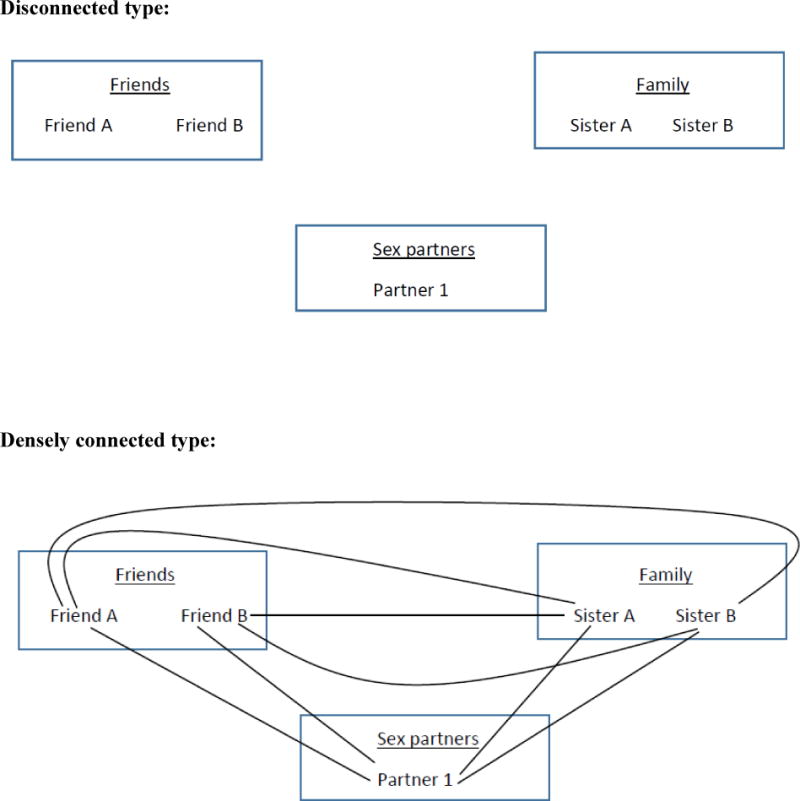
Despite the high prevalence of HIV among men who have sex with men in South Africa, very little is known about their lived realities, including their social and sexual networks. Given the influence of social network structure on sexual risk behaviours, a better understanding of the social contexts of men who have sex with men is essential for informing the design of HIV programming and messaging. This study explored social network connectivity, an understudied network attribute, examining self-reported connectivity between friends, family and sex partners. Data were collected in Cape Town and Port Elizabeth, South Africa, from 78 men who have sex with men who participated in in-depth interviews that included a social network mapping component. Five social network types emerged from the content analysis of these social network maps based on the level of connectivity between family, friends and sex partners, and ranged from disconnected to densely connected networks. The ways in which participants reported sexual risk-taking differed across the five network types, revealing diversity in social network profiles. HIV programming and messaging for this population can greatly benefit from recognising the diversity in lived realities and social connections between men who have sex with men.
尽管南非男男性行为者中艾滋病毒的感染率很高,但对于他们的真实生活状况,包括他们的社交网络和性关系网络,人们知之甚少。鉴于社交网络结构对性行为风险的影响,深入了解男男性行为者的社会背景对于为艾滋病规划和信息传递提供依据至关重要。本研究探讨了社交网络连接性这一研究不足的网络属性,研究了自我报告的朋友、家人和性伴侣之间的连接性。数据来自南非开普敦和伊丽莎白港的 78 名男男性行为者,他们参与了深入访谈,其中包括社交网络图谱绘制部分。根据家庭、朋友和性伴侣之间的连接程度,从内容分析中得出了五种社交网络类型,从完全不连接到紧密连接的网络。参与者报告的性风险行为因五种网络类型而异,揭示了男男性行为者社交网络特征的多样性。针对这一人群的艾滋病规划和信息传递可以从认识到男男性行为者之间的生活现实和社交联系的多样性中受益。