Carrim Naadiya, Arthur Jane F, Hamilton Justin R, Gardiner Elizabeth E, Andrews Robert K, Moran Niamh, Berndt Michael C, Metharom Pat
Department of Experimental Medicine, Royal College of Surgeons in Ireland, Dublin, Ireland.
Australian Centre for Blood Diseases, Monash University, Melbourne, Australia.
Redox Biol. 2015 Dec;6:640-647. doi: 10.1016/j.redox.2015.10.009. Epub 2015 Oct 28.
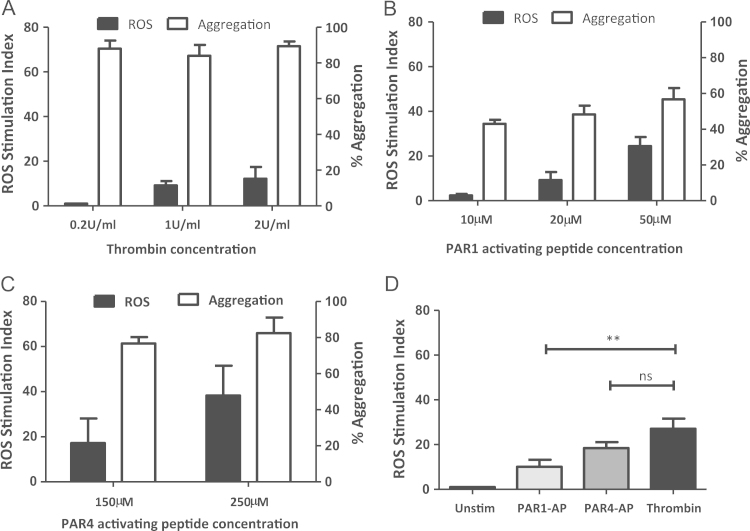
Platelets are essential for maintaining haemostasis and play a key role in the pathogenesis of cardiovascular disease. Upon ligation of platelet receptors through subendothelial matrix proteins, intracellular reactive oxygen species (ROS) are generated, further amplifying the platelet activation response. Thrombin, a potent platelet activator, can signal through GPIbα and protease-activated receptor (PAR) 1 and PAR4 on human platelets, and recently has been implicated in the generation of ROS. While ROS are known to have key roles in intra-platelet signalling and subsequent platelet activation, the precise receptors and signalling pathways involved in thrombin-induced ROS generation have yet to be fully elucidated.
To investigate the relative contribution of platelet GPIbα and PARs to thrombin-induced reactive oxygen species (ROS) generation.
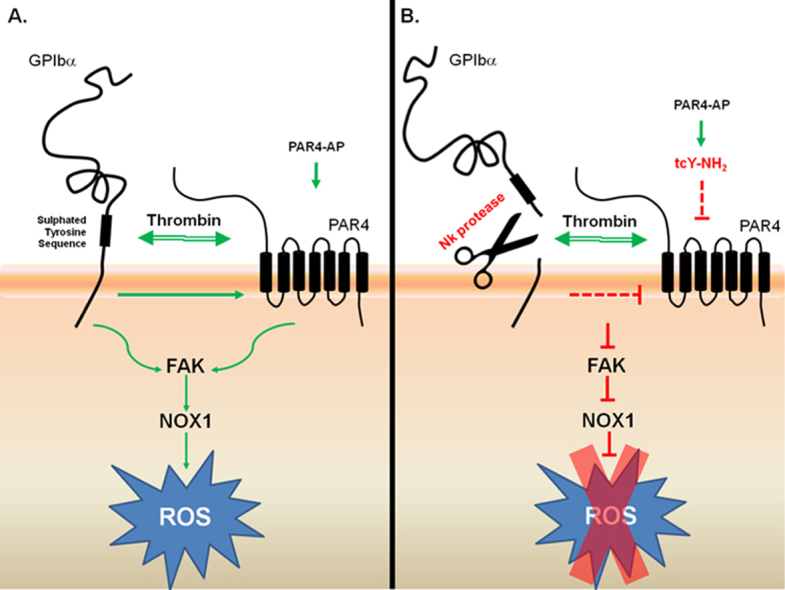
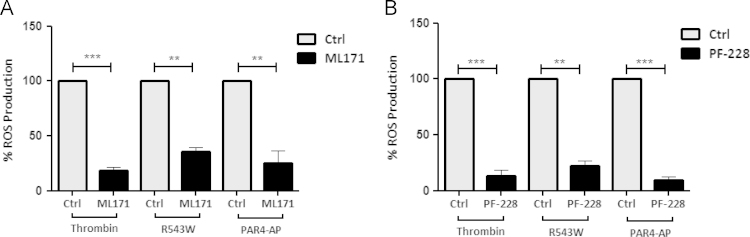
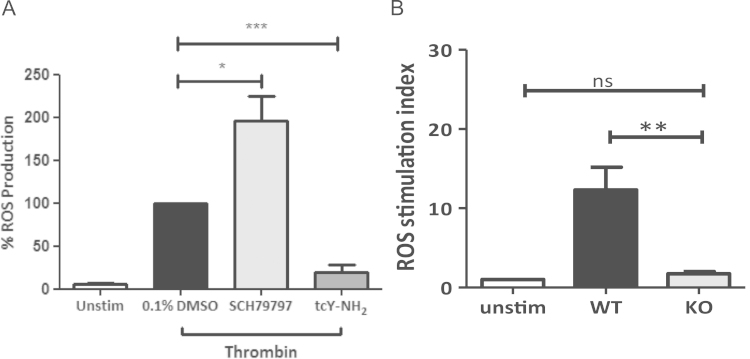
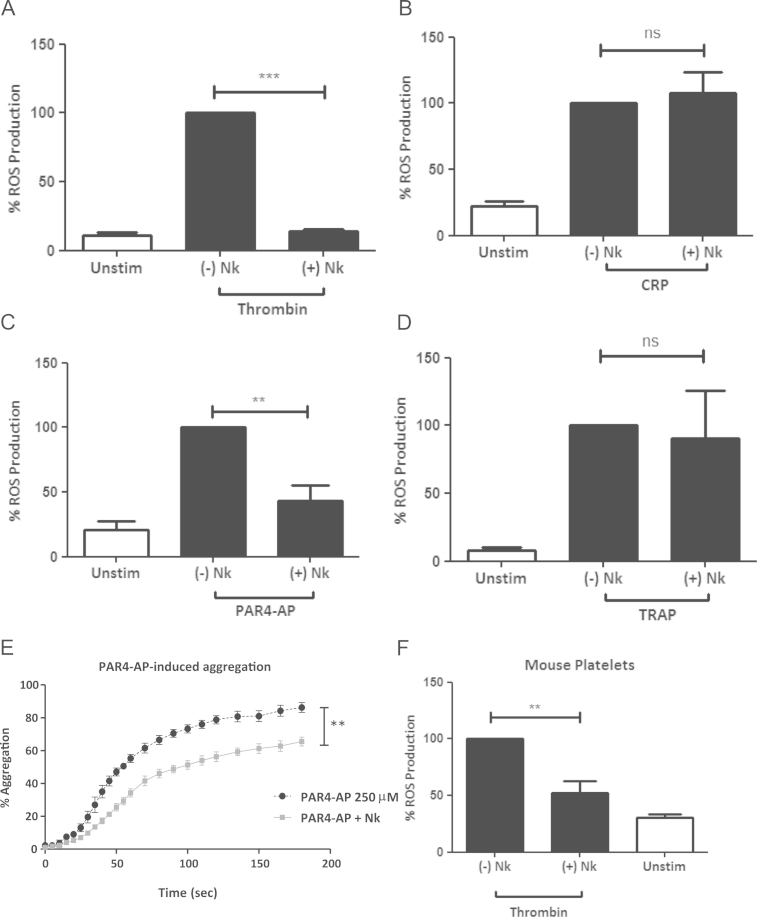
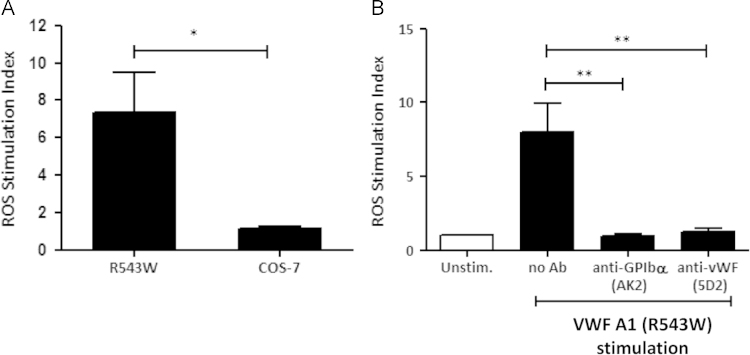
Highly specific antagonists targeting PAR1 and PAR4, and the GPIbα-cleaving enzyme, Naja kaouthia (Nk) protease, were used in quantitative flow cytometry assays of thrombin-induced ROS production. Antagonists of PAR4 but not PAR1, inhibited thrombin-derived ROS generation. Removal of the GPIbα ligand binding region attenuated PAR4-induced and completely inhibited thrombin-induced ROS formation. Similarly, PAR4 deficiency in mice abolished thrombin-induced ROS generation. Additionally, GPIbα and PAR4-dependent ROS formation were shown to be mediated through focal adhesion kinase (FAK) and NADPH oxidase 1 (NOX1) proteins.
Both GPIbα and PAR4 are required for thrombin-induced ROS formation, suggesting a novel functional cooperation between GPIbα and PAR4. Our study identifies a novel role for PAR4 in mediating thrombin-induced ROS production that was not shared by PAR1. This suggests an independent signalling pathway in platelet activation that may be targeted therapeutically.
血小板对于维持止血至关重要,并且在心血管疾病的发病机制中起关键作用。通过内皮下基质蛋白连接血小板受体后,细胞内活性氧(ROS)生成,进一步放大血小板激活反应。凝血酶是一种有效的血小板激活剂,可通过人血小板上的糖蛋白Ibα(GPIbα)和蛋白酶激活受体(PAR)1及PAR4发出信号,并且最近已被证明与ROS的生成有关。虽然已知ROS在血小板内信号传导及随后的血小板激活中起关键作用,但凝血酶诱导ROS生成所涉及的精确受体和信号通路尚未完全阐明。
研究血小板GPIbα和PARs对凝血酶诱导的活性氧(ROS)生成的相对贡献。
在凝血酶诱导的ROS生成的定量流式细胞术检测中,使用了靶向PAR1和PAR4的高度特异性拮抗剂以及切割GPIbα的酶——眼镜蛇毒蛋白酶(Nk蛋白酶)。PAR4而非PAR1的拮抗剂抑制了凝血酶衍生的ROS生成。去除GPIbα配体结合区域可减弱PAR4诱导的并完全抑制凝血酶诱导的ROS形成。同样,小鼠中PAR4缺陷消除了凝血酶诱导的ROS生成。此外,GPIbα和PAR4依赖性ROS形成被证明是通过粘着斑激酶(FAK)和NADPH氧化酶1(NOX1)蛋白介导的。
GPIbα和PAR4都是凝血酶诱导ROS形成所必需的,提示GPIbα和PAR4之间存在新的功能协同作用。我们的研究确定了PAR4在介导凝血酶诱导的ROS产生中的新作用,而PAR1不具有此作用。这表明在血小板激活中存在一条独立的信号通路,可能成为治疗靶点。