Muñoz-Ortega Martin Humberto, Llamas-Ramírez Raúl Wiliberto, Romero-Delgadillo Norma Isabel, Elías-Flores Tania Guadalupe, Tavares-Rodríguez Edgar de Jesus, Campos-Esparza María Del Rosario, Cervantes-García Daniel, Muñoz-Fernández Luis, Gerardo-Rodríguez Martin, Ventura-Juárez Javier
Department of Chemistry, Center of Basic Sciences, Autonomous University of Aguascalientes, Aguascalientes, Mexico.
Department of Morphology, Center of Basic Sciences, Autonomous University of Aguascalientes, Aguascalientes, Mexico.
Gut Liver. 2016 Jan;10(1):101-8. doi: 10.5009/gnl14459.
BACKGROUND/AIMS: The development of therapeutic strategies for the treatment of cirrhosis has become an important focus for basic and clinical researchers. Adrenergic receptor antagonists have been evaluated as antifibrotic drugs in rodent models of carbon tetrachloride (CCl4)-induced cirrhosis. The aim of the present study was to evaluate the effects of carvedilol and doxazosin on fibrosis/cirrhosis in a hamster animal model.
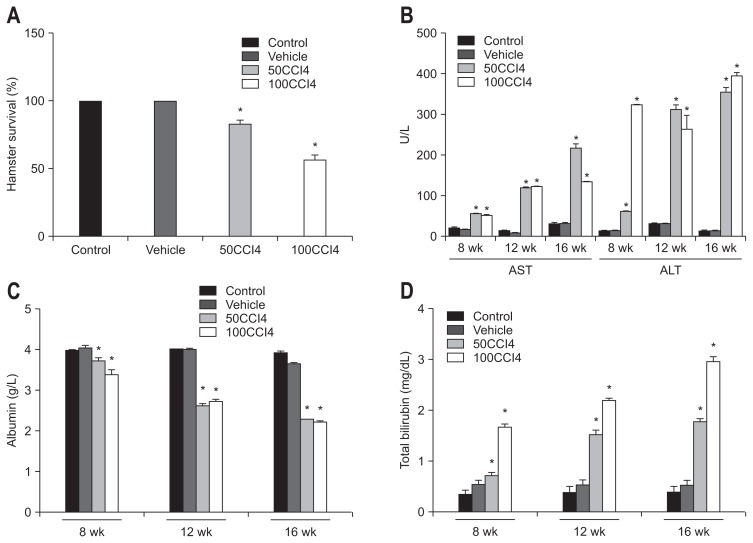
Cirrhotic-induced hamsters were treated by daily administration of carvedilol and doxazosin for 6 weeks. Hepatic function and histological evaluation were conducted by measuring biochemical markers, including total bilirubin, aspartate aminotransferase, alanine aminotransferase and albumin, and liver tissue slices. Additionally, transforming growth factor β (TGF-β) immunohistochemistry was analyzed.
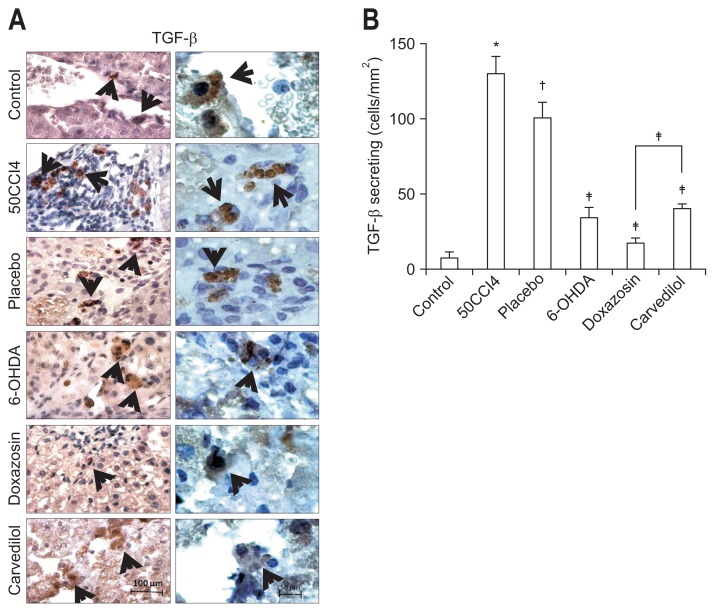
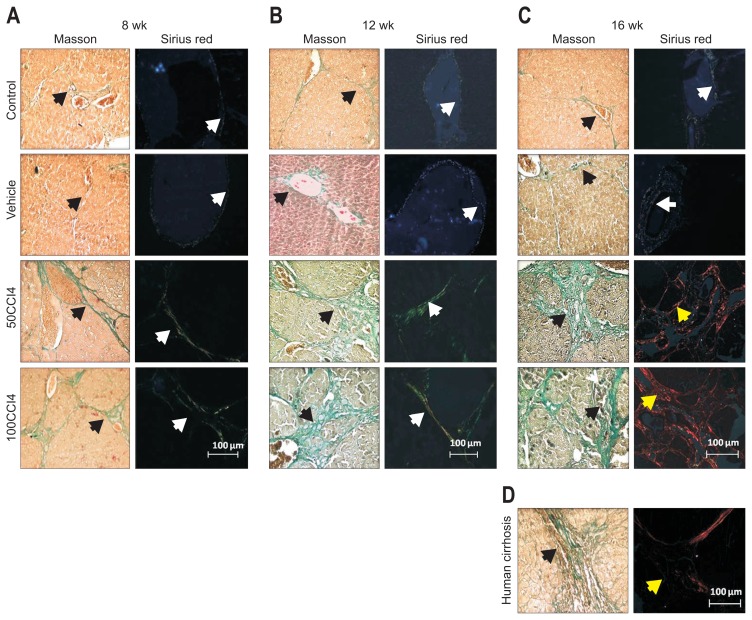
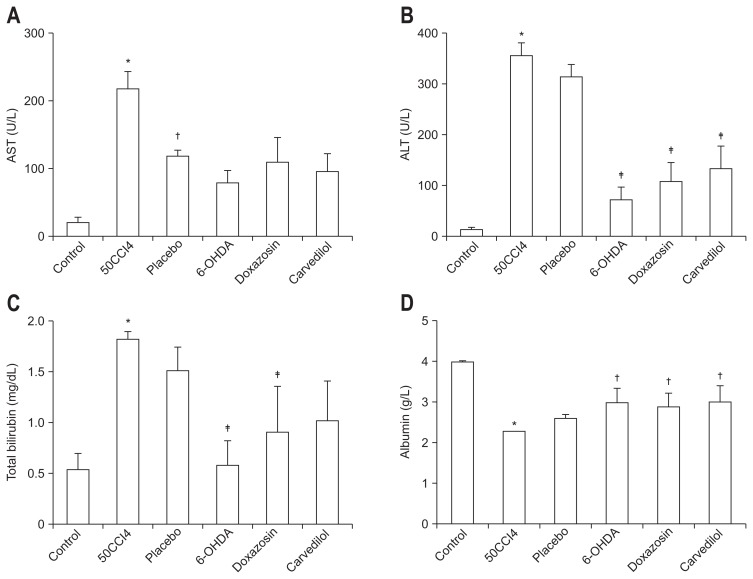
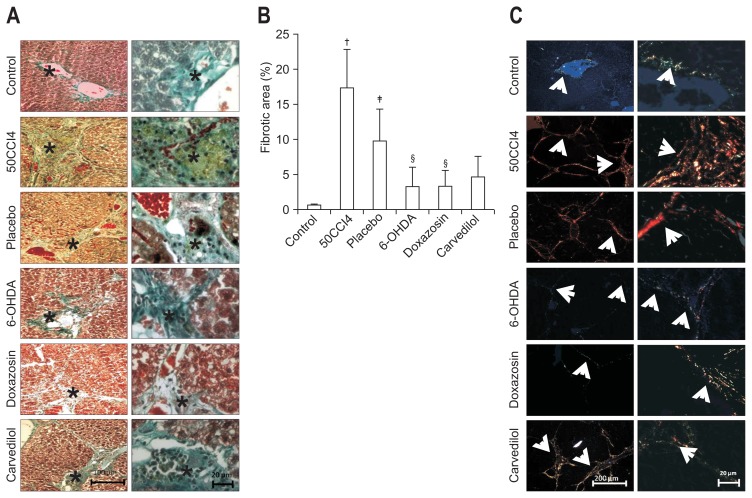
Biochemical markers revealed that hepatic function was restored after treatment with doxazosin and carvedilol. Histological evaluation showed a decrease in collagen type I deposits and TGF-β-secreting cells.
Taken together, these results suggest that the decrease in collagen type I following treatment with doxazosin or carvedilol is achieved by decreasing the profibrotic activities of TGF-β via the blockage of α1- and β-adrenergic receptor. Consequently, a diminution of fibrotic tissue in the CCl4-induced model of cirrhosis is achieved.
背景/目的:肝硬化治疗策略的开发已成为基础和临床研究人员的重要关注点。在四氯化碳(CCl4)诱导的肝硬化啮齿动物模型中,肾上腺素能受体拮抗剂已被评估为抗纤维化药物。本研究的目的是评估卡维地洛和多沙唑嗪对仓鼠动物模型中纤维化/肝硬化的影响。
对诱导肝硬化的仓鼠每日给予卡维地洛和多沙唑嗪治疗6周。通过测量包括总胆红素、天冬氨酸转氨酶、丙氨酸转氨酶和白蛋白在内的生化标志物以及肝组织切片来进行肝功能和组织学评估。此外,还分析了转化生长因子β(TGF-β)免疫组化。
生化标志物显示,多沙唑嗪和卡维地洛治疗后肝功能得到恢复。组织学评估显示I型胶原沉积和TGF-β分泌细胞减少。
综上所述,这些结果表明,多沙唑嗪或卡维地洛治疗后I型胶原的减少是通过阻断α1和β肾上腺素能受体降低TGF-β的促纤维化活性实现的。因此,在CCl4诱导的肝硬化模型中实现了纤维化组织的减少。