Burke Chantelle M, Montevecchi William A, Regular Paul M
Cognitive and Behavioural Ecology Program, Psychology Department, Memorial University, St. John's, Newfoundland and Labrador, Canada.
PLoS One. 2015 Nov 17;10(11):e0141190. doi: 10.1371/journal.pone.0141190. eCollection 2015.
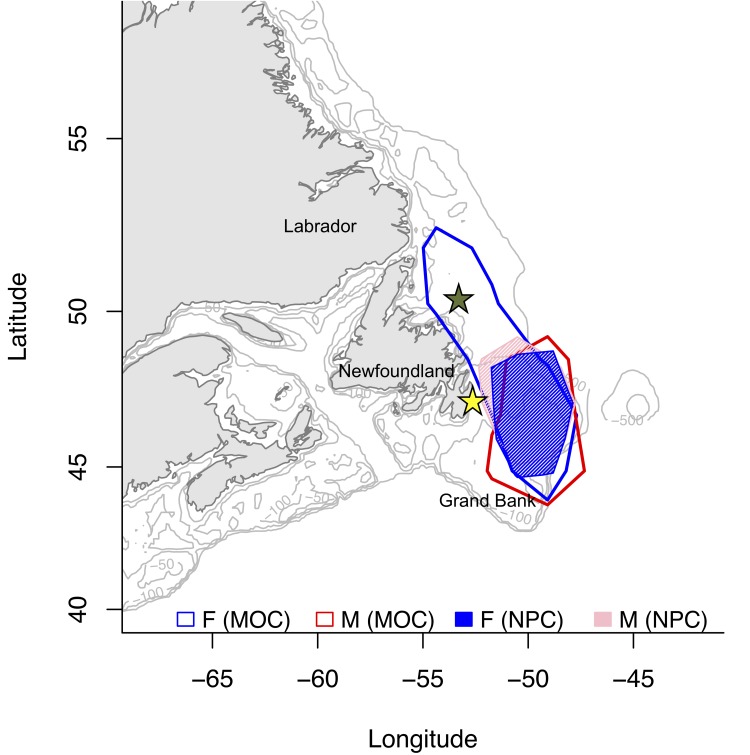
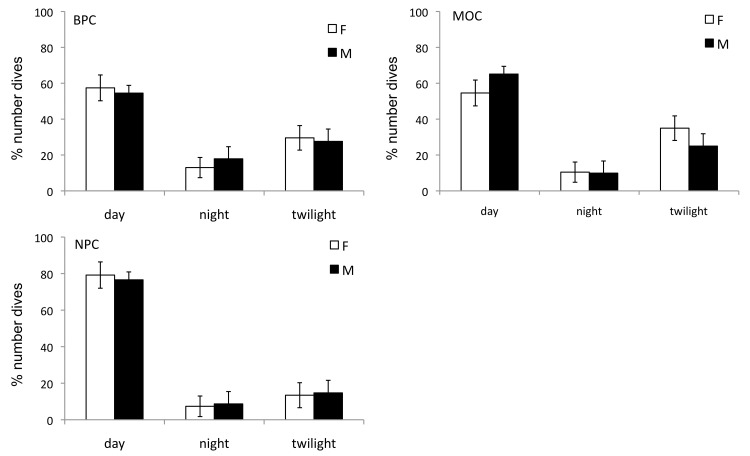
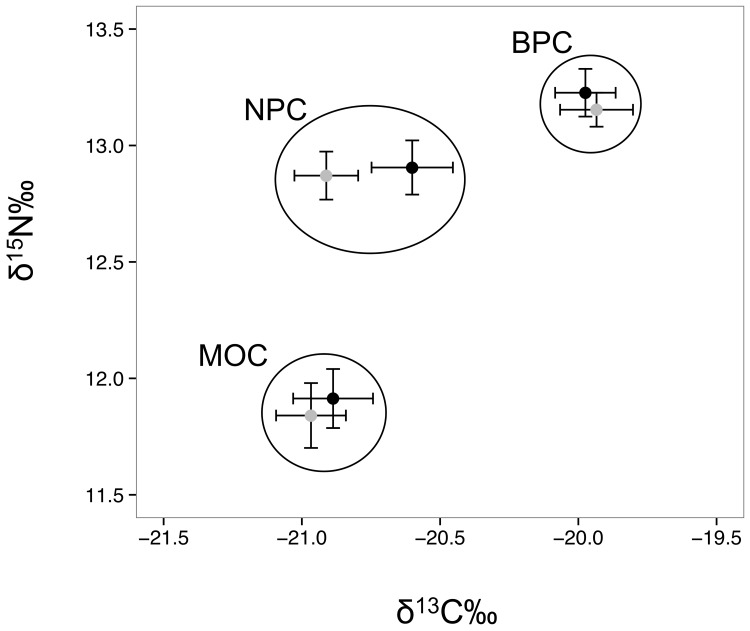
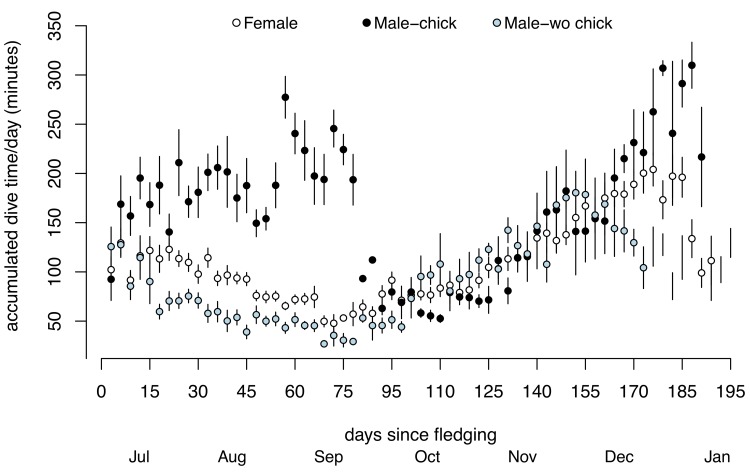
Evidence of sex-specific foraging in monomorphic seabirds is increasing though the underlying mechanisms remain poorly understood. We investigate differential parental care as a mechanism for sex-specific foraging in monomorphic Common Murres (Uria aalge), where the male parent alone provisions the chick after colony departure. Using a combination of geolocation-immersion loggers and stable isotopes, we assess two hypotheses: the reproductive role specialization hypothesis and the energetic constraint hypothesis. We compare the foraging behavior of females (n = 15) and males (n = 9) during bi-parental at the colony, post-fledging male-only parental care and winter when parental care is absent. As predicted by the reproductive role specialization hypothesis, we found evidence of sex-specific foraging during post-fledging only, the stage with the greatest divergence in parental care roles. Single-parenting males spent almost twice as much time diving per day and foraged at lower quality prey patches relative to independent females. This implies a potential energetic constraint for males during the estimated 62.8 ± 8.9 days of offspring dependence at sea. Contrary to the predictions of the energetic constraint hypothesis, we found no evidence of sex-specific foraging during biparental care, suggesting that male parents did not forage for their own benefit before colony departure in anticipation of post-fledging energy constraints. We hypothesize that unpredictable prey conditions at Newfoundland colonies in recent years may limit male parental ability to allocate additional time and energy to self-feeding during biparental care, without compromising chick survival. Our findings support differential parental care as a mechanism for sex-specific foraging in monomorphic murres, and highlight the need to consider ecological context in the interpretation of sex-specific foraging behavior.
在单态海鸟中,性别特异性觅食的证据越来越多,但其潜在机制仍知之甚少。我们研究了差异化亲代抚育,将其作为单态普通海鸦(厚嘴海鸦)性别特异性觅食的一种机制,在这种海鸟中,雄性亲鸟在离开繁殖地后独自为雏鸟提供食物。我们结合使用地理定位-浸入式记录器和稳定同位素,评估了两个假设:生殖角色专业化假设和能量限制假设。我们比较了雌性(n = 15)和雄性(n = 9)在繁殖地双亲抚育期间、雏鸟 fledging 后仅雄性亲代抚育期间以及无亲代抚育的冬季的觅食行为。正如生殖角色专业化假设所预测的,我们仅在雏鸟 fledging 后发现了性别特异性觅食的证据,这是亲代抚育角色差异最大的阶段。单亲雄性每天潜水的时间几乎是独立雌性的两倍,并且在质量较低的猎物斑块觅食。这意味着在估计的62.8±8.9天的海上后代依赖期内,雄性可能存在能量限制。与能量限制假设的预测相反,我们在双亲抚育期间没有发现性别特异性觅食的证据,这表明雄性亲鸟在离开繁殖地之前并没有为了自身利益而觅食,以应对雏鸟 fledging 后的能量限制。我们推测,近年来纽芬兰繁殖地不可预测的猎物状况可能会限制雄性亲鸟在双亲抚育期间分配额外时间和能量用于自我觅食的能力,同时又不影响雏鸟的生存。我们的研究结果支持差异化亲代抚育作为单态海鸦性别特异性觅食的一种机制,并强调在解释性别特异性觅食行为时需要考虑生态背景。