
运动性高血压
Exercise Hypertension.
作者信息
Schultz Martin G, Sharman James E
机构信息
Menzies Research Institute Tasmania, University of Tasmania, Hobart, Tas., Australia.
出版信息
Pulse (Basel). 2014 May;1(3-4):161-76. doi: 10.1159/000360975. Epub 2014 Apr 11.
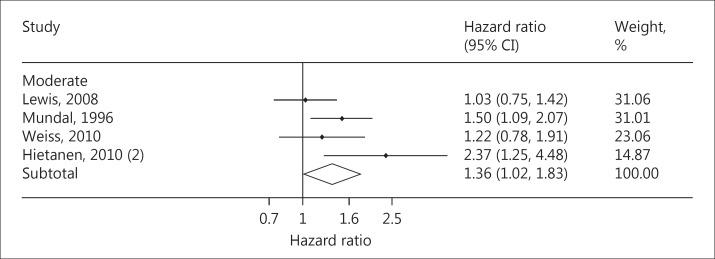
Irrespective of apparent 'normal' resting blood pressure (BP), some individuals may experience an excessive elevation in BP with exercise (i.e. systolic BP ≥210 mm Hg in men or ≥190 mm Hg in women or diastolic BP ≥110 mm Hg in men or women), a condition termed exercise hypertension or a 'hypertensive response to exercise' (HRE). An HRE is a relatively common condition that is identified during standard exercise stress testing; however, due to a lack of information with respect to the clinical ramifications of an HRE, little value is usually placed on such a finding. In this review, we discuss both the clinical importance and underlying physiological contributors of exercise hypertension. Indeed, an HRE is associated with an increased propensity for target organ damage and also predicts the future development of hypertension, cardiovascular events and mortality, independent of resting BP. Moreover, recent work has highlighted that some of the elevated cardiovascular risks associated with an HRE may be related to high-normal resting BP (pre-hypertension) or ambulatory 'masked' hypertension and that an HRE may be an early warning signal of abnormal BP control that is otherwise undetected with clinic BP. Whilst an HRE may be amenable to treatment via pharmacological and lifestyle interventions, the exact physiological mechanism of an HRE remains elusive, but it is likely a manifestation of multiple factors including large artery stiffness, increased peripheral resistance, neural circulatory control and metabolic irregularity. Future research focus may be directed towards determining threshold values to denote the increased risk associated with an HRE and further resolution of the underlying physiological factors involved in the pathogenesis of an HRE.
无论静息血压(BP)看似“正常”,一些人在运动时可能会出现血压过度升高的情况(即男性收缩压≥210毫米汞柱或女性收缩压≥190毫米汞柱,或男性或女性舒张压≥110毫米汞柱),这种情况被称为运动性高血压或“运动高血压反应”(HRE)。HRE是一种在标准运动应激试验中发现的相对常见的情况;然而,由于缺乏关于HRE临床后果的信息,通常对这一发现重视程度不高。在本综述中,我们讨论了运动性高血压的临床重要性和潜在生理因素。事实上,HRE与靶器官损害倾向增加相关,并且独立于静息血压,还能预测高血压、心血管事件和死亡率的未来发展。此外,最近的研究强调,与HRE相关的一些心血管风险升高可能与血压正常高值(高血压前期)或动态“隐匿性”高血压有关,并且HRE可能是血压控制异常的早期预警信号,而诊所血压检测不到这种异常。虽然HRE可能通过药物和生活方式干预进行治疗,但其确切的生理机制仍然难以捉摸,但它可能是多种因素的表现,包括大动脉僵硬度增加、外周阻力增加、神经循环控制和代谢紊乱。未来的研究重点可能是确定表示与HRE相关风险增加的阈值,并进一步解析HRE发病机制中涉及的潜在生理因素。


 Zotero 插件