
通过优化荧光共振能量转移相互作用开发快速荧光蛋白电压传感器。
Developing Fast Fluorescent Protein Voltage Sensors by Optimizing FRET Interactions.
作者信息
Sung Uhna, Sepehri-Rad Masoud, Piao Hong Hua, Jin Lei, Hughes Thomas, Cohen Lawrence B, Baker Bradley J
机构信息
Center for Functional Connectomics, Korea Institute of Science & Technology, Seoul, Korea.
Department of Molecular and Cellular Physiology, Yale University School of Medicine, New Haven, CT, United States of America.
出版信息
PLoS One. 2015 Nov 20;10(11):e0141585. doi: 10.1371/journal.pone.0141585. eCollection 2015.
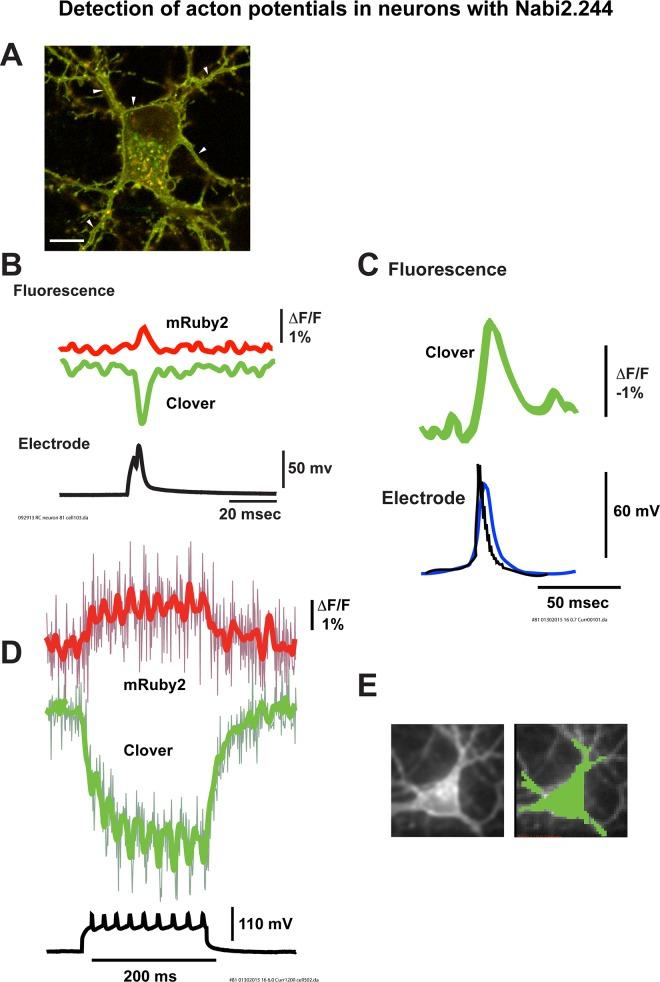
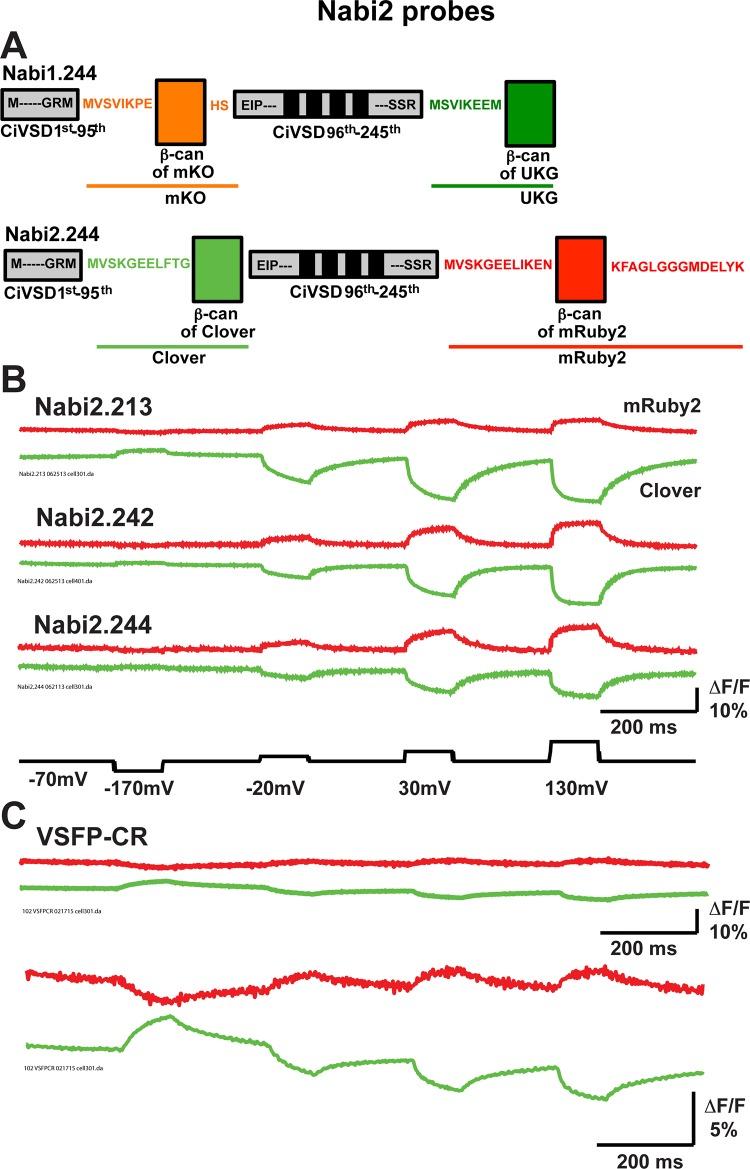
FRET (Förster Resonance Energy Transfer)-based protein voltage sensors can be useful for monitoring neuronal activity in vivo because the ratio of signals between the donor and acceptor pair reduces common sources of noise such as heart beat artifacts. We improved the performance of FRET based genetically encoded Fluorescent Protein (FP) voltage sensors by optimizing the location of donor and acceptor FPs flanking the voltage sensitive domain of the Ciona intestinalis voltage sensitive phosphatase. First, we created 39 different "Nabi1" constructs by positioning the donor FP, UKG, at 8 different locations downstream of the voltage-sensing domain and the acceptor FP, mKO, at 6 positions upstream. Several of these combinations resulted in large voltage dependent signals and relatively fast kinetics. Nabi1 probes responded with signal size up to 11% ΔF/F for a 100 mV depolarization and fast response time constants both for signal activation (2 ms) and signal decay (3 ms). We improved expression in neuronal cells by replacing the mKO and UKG FRET pair with Clover (donor FP) and mRuby2 (acceptor FP) to create Nabi2 probes. Nabi2 probes also had large signals and relatively fast time constants in HEK293 cells. In primary neuronal culture, a Nabi2 probe was able to differentiate individual action potentials at 45 Hz.
基于荧光共振能量转移(FRET)的蛋白质电压传感器可用于监测体内神经元活动,因为供体和受体对之间的信号比率可降低常见的噪声源,如心跳伪迹。我们通过优化海鞘电压敏感磷酸酶电压敏感结构域两侧供体和受体荧光蛋白(FP)的位置,提高了基于FRET的基因编码荧光蛋白电压传感器的性能。首先,我们通过将供体荧光蛋白UKG置于电压感应结构域下游的8个不同位置,以及将受体荧光蛋白mKO置于6个上游位置,创建了39种不同的“Nabi1”构建体。其中几种组合产生了较大的电压依赖性信号和相对较快的动力学。对于100 mV的去极化,Nabi1探针的信号大小响应高达11%ΔF/F,信号激活(约2毫秒)和信号衰减(约3毫秒)的响应时间常数都很快。我们通过用Clover(供体荧光蛋白)和mRuby2(受体荧光蛋白)取代mKO和UKG FRET对来创建Nabi2探针,从而提高了在神经元细胞中的表达。Nabi2探针在HEK293细胞中也具有较大的信号和相对较快的时间常数。在原代神经元培养中,一种Nabi2探针能够区分45 Hz的单个动作电位。



 Zotero 插件