Del Bianco Benedeti Pedro, Galoro da Silva Lorrayny, Marostegan de Paula Eduardo, Shenkoru Teshome, Marcondes Marcos Inácio, Monteiro Hugo Fernando, Amorati Brad, Yeh Yenling, Poulson Simon Roger, Faciola Antonio Pinheiro
Department of Agriculture, Nutrition, and Veterinary Sciences, University of Nevada, Reno, Nevada, United States of America.
Department of Animal Sciences, Federal University of Viçosa, Viçosa, Minas Gerais, Brazil.
PLoS One. 2015 Nov 23;10(11):e0143201. doi: 10.1371/journal.pone.0143201. eCollection 2015.
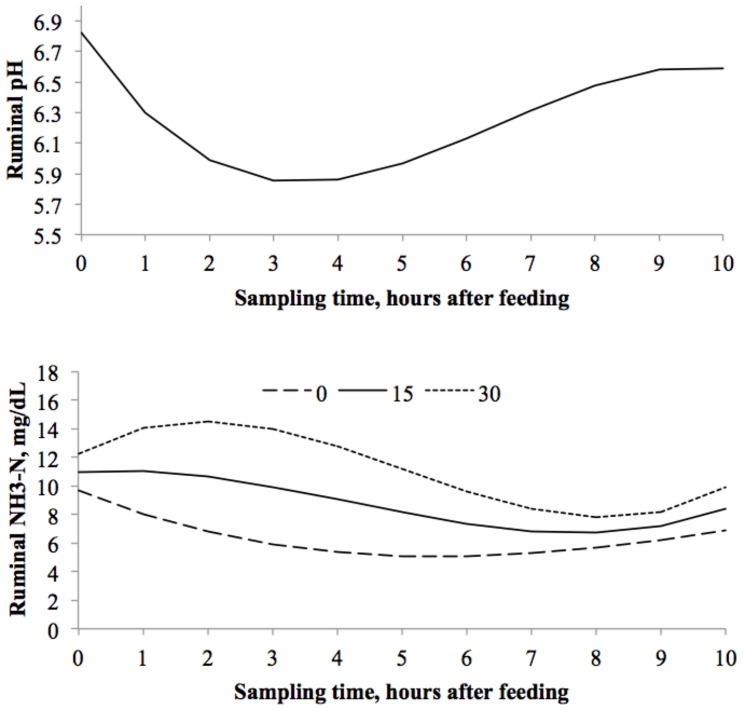
The objective of this study was to evaluate the effects of partially replacing dry ground corn with glycerin on ruminal fermentation using a dual-flow continuous culture system. Six fermenters (1,223 ± 21 ml) were used in a replicated 3x3 Latin square arrangement with three periods of 10 d each, with 7 d for diet adaptation and 3 d for sample collections. All diets contained 75% concentrate and three dietary glycerin levels (0, 15, and 30% on dry matter basis), totaling six replicates per treatment. Fermenters were fed 72 g of dry matter/d equally divided in two meals/d, at 0800 and 2000 h. Solid and liquid dilution rates were adjusted daily to 5.5 and 11%/h, respectively. On d 8, 9, and 10, samples of 500 ml of solid and liquid digesta effluent were mixed, homogenized, and stored at -20°C. Subsamples of 10 ml were collected and preserved with 0.2 mL of a 50% H2SO4 solution for later determination of NH3-N and volatile fatty acids. Microbial biomass was isolated from fermenters for chemical analysis at the end of each experimental period. Data were analyzed using the MIXED procedure in SAS with α = 0.05. Glycerin levels did not affect apparent digestibility of DM (PLin. = 0.13; PQuad. = 0.40), OM (PLin. = 0.72; PQuad. = 0.15), NDF (PLin. = 0.38; PQuad. = 0.50) and ADF (PLin. = 0.91; PQuad. = 0.18). Also, glycerin inclusion did not affect true digestibility of DM (PLin. = 0.35; PQuad. = 0.48), and OM (PLin. = 0.08; PQuad. = 0.19). Concentrations of propionate (P < 0.01) and total volatile fatty acids (P < 0.01) increased linearly and concentrations of acetate (P < 0.01), butyrate (P = 0.01), iso-valerate (P < 0.01), and total branched-chain volatile fatty acids, as well as the acetate: propionate ratio (P < 0.01) decreased with glycerin inclusion. Linear increases on NH3-N concentration in digesta effluent (P < 0.01) and on NH3-N flow (P < 0.01) were observed due to glycerin inclusion in the diets. Crude protein digestibility (P = 0.04) and microbial N flow (P = 0.04) were greater in the control treatment compared with the other treatments and responded quadratically with glycerin inclusion. Furthermore, the inclusion of glycerin linearly decreased (P = 0.02) non-ammonia N flow. Glycerin levels did not affect the flows of total N (PLin. = 0.79; PQuad. = 0.35), and dietary N (PLin. = 0.99; PQuad. = 0.07), as well as microbial efficiency (PLin. = 0.09; PQuad. = 0.07). These results suggest that partially replacing dry ground corn with glycerin may change ruminal fermentation, by increasing total volatile fatty acids, and propionate concentration without affecting microbial efficiency, which may improve glucogenic potential of beef cattle diets.
本研究的目的是使用双外流连续培养系统评估用甘油部分替代干磨玉米对瘤胃发酵的影响。六个发酵罐(1223±21毫升)采用重复的3×3拉丁方设计,共三个阶段,每个阶段10天,其中7天用于日粮适应,3天用于样本采集。所有日粮均含75%的精料以及三种甘油添加水平(基于干物质计为0、15%和30%),每个处理共有六个重复。发酵罐每日饲喂72克干物质,分两餐,于08:00和20:00投喂。固体和液体稀释率分别每日调整至5.5%和11%/小时。在第8、9和10天,采集500毫升固体和液体消化物流出物样本,混合、均质化并储存在-20°C。采集10毫升子样本,并用0.2毫升50%硫酸溶液保存,用于后续氨氮和挥发性脂肪酸的测定。在每个实验阶段结束时,从发酵罐中分离微生物生物量用于化学分析。数据使用SAS中的MIXED程序进行分析,α = 0.05。甘油水平不影响干物质(线性P值 = 0.13;二次项P值 = 0.40)、有机物(线性P值 = 0.72;二次项P值 = 0.15)、中性洗涤纤维(线性P值 = 0.38;二次项P值 = 0.50)和酸性洗涤纤维(线性P值 = 0.91;二次项P值 = 0.18)的表观消化率。此外,添加甘油也不影响干物质(线性P值 = 0.35;二次项P值 = 0.48)和有机物(线性P值 = 0.08;二次项P值 = 0.19)的真消化率。随着甘油添加,丙酸浓度(P < 0.01)和总挥发性脂肪酸浓度(P < 0.01)呈线性增加,而乙酸浓度(P < 0.01)、丁酸浓度(P = 0.01)、异戊酸浓度(P < 0.01)以及总支链挥发性脂肪酸浓度,还有乙酸:丙酸比值(P < 0.01)均降低。由于日粮中添加甘油,观察到消化物流出物中氨氮浓度(P < 0.01)和氨氮流量(P < 0.01)呈线性增加。与其他处理相比,对照处理的粗蛋白消化率(P = 0.04)和微生物氮流量(P = 0.04)更高,且随着甘油添加呈二次响应。此外,添加甘油使非氨氮流量呈线性降低(P = 0.02)。甘油水平不影响总氮流量(线性P值 = 0.79;二次项P值 = 0.35)、日粮氮流量(线性P值 = 0.99;二次项P值 = 0.07)以及微生物效率(线性P值 = 0.09;二次项P值 = 0.07)。这些结果表明,用甘油部分替代干磨玉米可能会改变瘤胃发酵,通过增加总挥发性脂肪酸和丙酸浓度,而不影响微生物效率,这可能会提高肉牛日粮的生糖潜力。