Balsiger Hans, Altwegg Kathrin, Bar-Nun Akiva, Berthelier Jean-Jacques, Bieler Andre, Bochsler Peter, Briois Christelle, Calmonte Ursina, Combi Michael, De Keyser Johan, Eberhardt Peter, Fiethe Björn, Fuselier Stephen A, Gasc Sébastien, Gombosi Tamas I, Hansen Kenneth C, Hässig Myrtha, Jäckel Annette, Kopp Ernest, Korth Axel, Le Roy Lena, Mall Urs, Marty Bernard, Mousis Olivier, Owen Tobias, Rème Henri, Rubin Martin, Sémon Thierry, Tzou Chia-Yu, Waite J Hunter, Wurz Peter
Physikalisches Institut, University of Bern, Sidlerstrasse 5, CH-3012 Bern, Switzerland.
Physikalisches Institut, University of Bern, Sidlerstrasse 5, CH-3012 Bern, Switzerland. ; Center for Space and Habitability, University of Bern, Sidlerstrasse 5, CH-3012 Bern, Switzerland.
Sci Adv. 2015 Sep 25;1(8):e1500377. doi: 10.1126/sciadv.1500377. eCollection 2015 Sep.
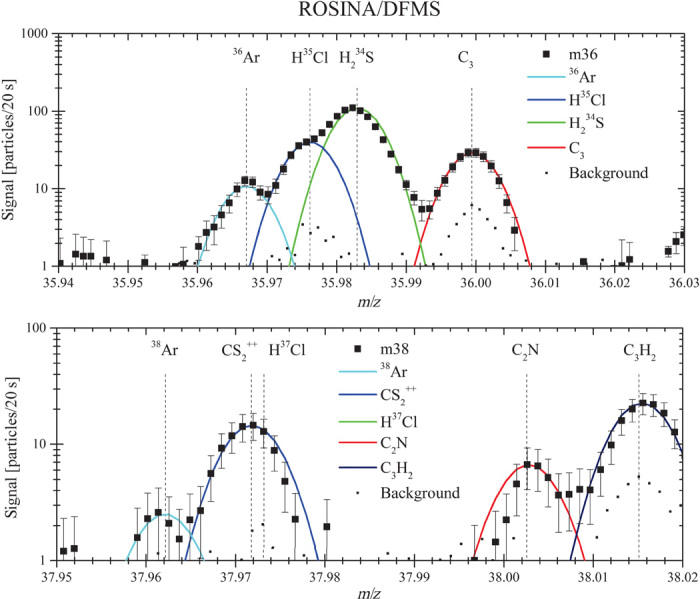
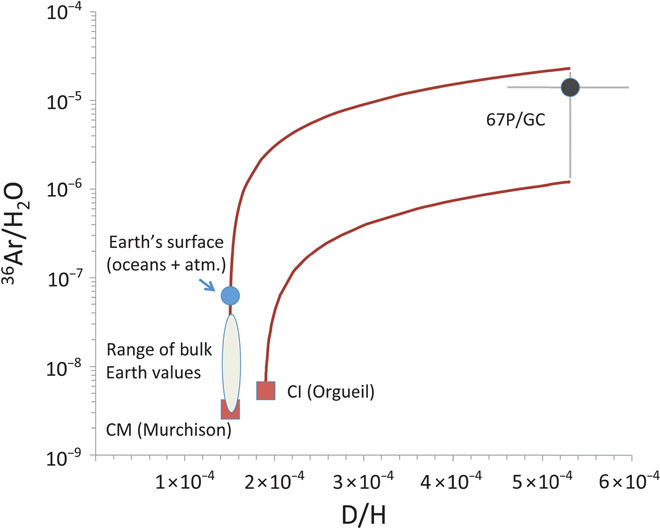
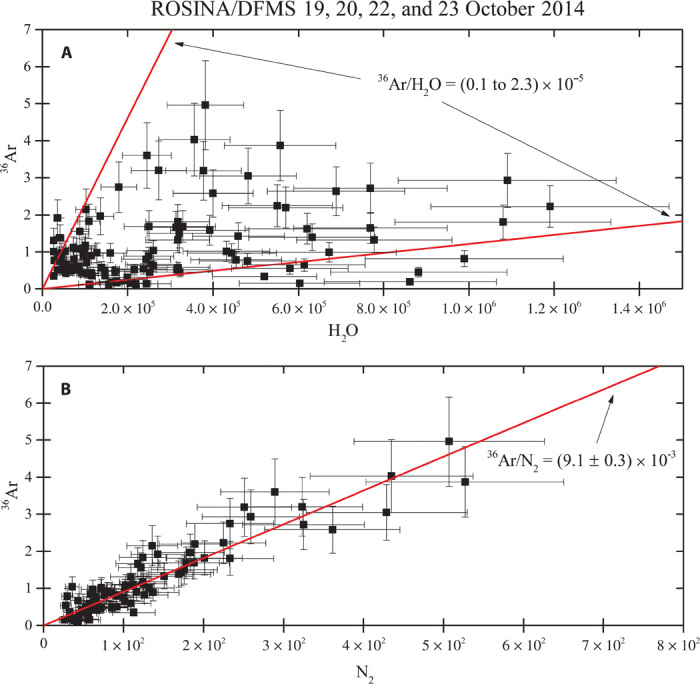
Comets have been considered to be representative of icy planetesimals that may have contributed a significant fraction of the volatile inventory of the terrestrial planets. For example, comets must have brought some water to Earth. However, the magnitude of their contribution is still debated. We report the detection of argon and its relation to the water abundance in the Jupiter family comet 67P/Churyumov-Gerasimenko by in situ measurement of the Rosetta Orbiter Spectrometer for Ion and Neutral Analysis (ROSINA) mass spectrometer aboard the Rosetta spacecraft. Despite the very low intensity of the signal, argon is clearly identified by the exact determination of the mass of the isotope (36)Ar and by the (36)Ar/(38)Ar ratio. Because of time variability and spatial heterogeneity of the coma, only a range of the relative abundance of argon to water can be given. Nevertheless, this range confirms that comets of the type 67P/Churyumov-Gerasimenko cannot be the major source of Earth's major volatiles.
彗星被认为是冰质小行星的代表,它们可能为类地行星的挥发性物质总量贡献了相当一部分。例如,彗星肯定给地球带来了一些水。然而,它们的贡献程度仍存在争议。我们报告了通过罗塞塔号航天器上的罗塞塔轨道器离子与中性分析光谱仪(ROSINA)质谱仪进行原位测量,探测到木星族彗星67P/丘留莫夫-格拉西缅科中的氩及其与水丰度的关系。尽管信号强度非常低,但通过对同位素(36)Ar质量的精确测定以及(36)Ar/(38)Ar比值,氩被明确识别出来。由于彗发的时间变化性和空间不均匀性,只能给出氩与水相对丰度的一个范围。尽管如此,这个范围证实了67P/丘留莫夫-格拉西缅科这类彗星不可能是地球主要挥发性物质的主要来源。