Baumgartner Heidi K, Trinder Kinsey M, Galimanis Carly E, Post Annalisa, Phang Tzu, Ross Randal G, Winn Virginia D
Department of Obstetrics and Gynecology, Division of Reproductive Sciences, University of Colorado Denver School of Medicine, 13001 E. 17th Place, Aurora, CO 80045, USA.
Division of Pulmonary Sciences and Critical Care Medicine, University of Colorado Denver School of Medicine, 13001 E. 17th Place, Aurora, CO 80045, USA.
Placenta. 2015 Dec;36(12):1362-9. doi: 10.1016/j.placenta.2015.10.001. Epub 2015 Oct 9.
The developing fetus relies on the maternal blood supply to provide the choline it requires for making membrane lipids, synthesizing acetylcholine, and performing important methylation reactions. It is vital, therefore, that the placenta is efficient at transporting choline from the maternal to the fetal circulation. Although choline transporters have been found in term placenta samples, little is known about what cell types express specific choline transporters and how expression of the transporters may change over gestation. The objective of this study was to characterize choline transporter expression levels and localization in the human placenta throughout placental development.
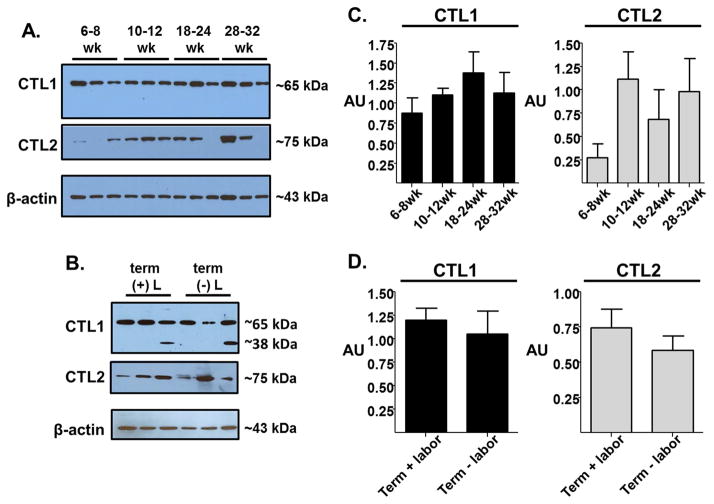
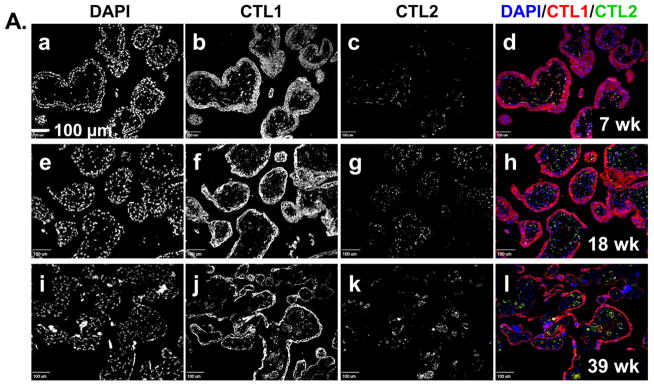
We analyzed CTL1 and -2 expression over gestation in human placental biopsies from 6 to 40 weeks gestation (n = 6-10 per gestational window) by immunoblot analysis. To determine the cellular expression pattern of the choline transporters throughout gestation, immunofluorescence analysis was then performed.
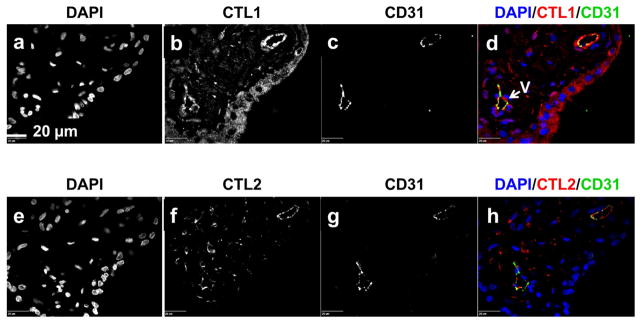
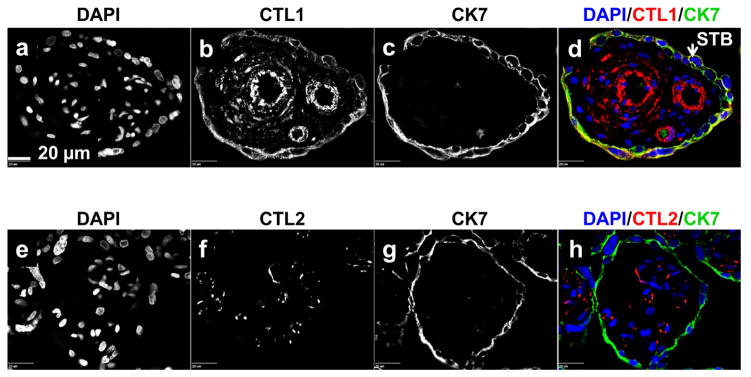
Both CTL1 and CTL2 were expressed in the chorionic villi from 6 weeks gestation to term. Labor did not alter expression levels of either transporter. CTL1 localized to the syncytial trophoblasts and the endothelium of the fetal vasculature within the chorionic villous structure. CTL2 localized mainly to the stroma early in gestation and by the second trimester co-localized with CTL1 at the fetal vasculature.
The differential expression pattern of CTL1 and CTL2 suggests that CTL1 is the key transporter involved in choline transport from maternal circulation and both transporters are likely involved in stromal and endothelial cell choline transport.
发育中的胎儿依赖母体血液供应来获取合成膜脂、乙酰胆碱以及进行重要甲基化反应所需的胆碱。因此,胎盘高效地将胆碱从母体循环转运至胎儿循环至关重要。尽管在足月胎盘样本中已发现胆碱转运体,但对于哪些细胞类型表达特定的胆碱转运体以及这些转运体的表达在孕期如何变化却知之甚少。本研究的目的是在胎盘发育全过程中对人胎盘胆碱转运体的表达水平及定位进行表征。
我们通过免疫印迹分析,对妊娠6至40周的人胎盘活检组织(每个妊娠窗口n = 6 - 10)在整个孕期的CTL1和CTL2表达进行了分析。为确定胆碱转运体在整个孕期的细胞表达模式,随后进行了免疫荧光分析。
CTL1和CTL2在妊娠6周直至足月的绒毛膜绒毛中均有表达。分娩并未改变任一转运体的表达水平。CTL1定位于绒毛膜绒毛结构内合体滋养层细胞和胎儿血管内皮。CTL2在妊娠早期主要定位于基质,到妊娠中期与CTL1在胎儿血管处共定位。
CTL1和CTL2的差异表达模式表明,CTL1是参与从母体循环转运胆碱的关键转运体,且这两种转运体可能均参与基质和内皮细胞的胆碱转运。