Tian Rui, Ye Hong Xun, Zhang Bao Guo, Gu Dong Ying, Zhang Bing Wen, Teng Zhi Pan, Jin Mao Yong, Chen Jin Fei, Qi Jian Wei
Department of E.N.T., Nanjing First Hospital, Nanjing Medical University, Nanjing, People's Republic of China.
Department of Oncology, The People's Hospital of Taixing, Taixing, People's Republic of China.
Onco Targets Ther. 2015 Nov 5;8:3255-63. doi: 10.2147/OTT.S92109. eCollection 2015.
Taxane-containing induction chemotherapy (IC) regimens in combination with concurrent chemoradiotherapy (CCRT) have been compared with non-taxane-containing IC combined with CCRT in randomized controlled trials (RCTs) in Chinese patients with advanced nasopharyngeal carcinoma (NPC). This meta-analysis aimed to systematically evaluate their clinical efficacy and safety profiling in this ethnic population.
The electronic databases, PubMed, Embase, MEDLINE, and Chinese Biomedical Database, were searched for eligible studies. The outcomes included overall response rate (ORR), 1-year survival rate, and different types of adverse events. Odds ratios (ORs) and 95% confidence intervals (CIs) were calculated to evaluate the strength of the associations.
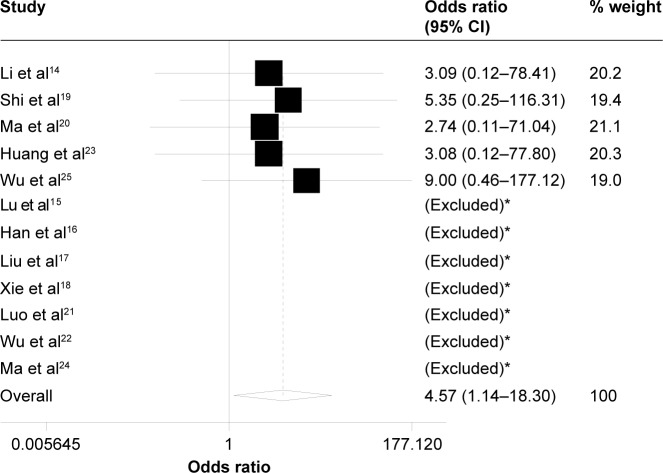
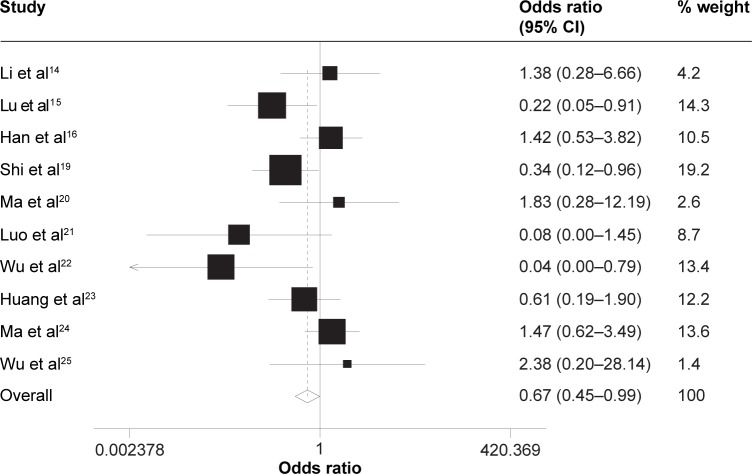
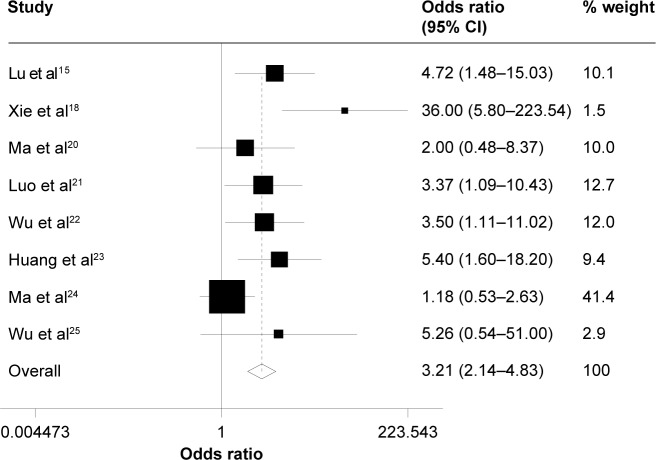
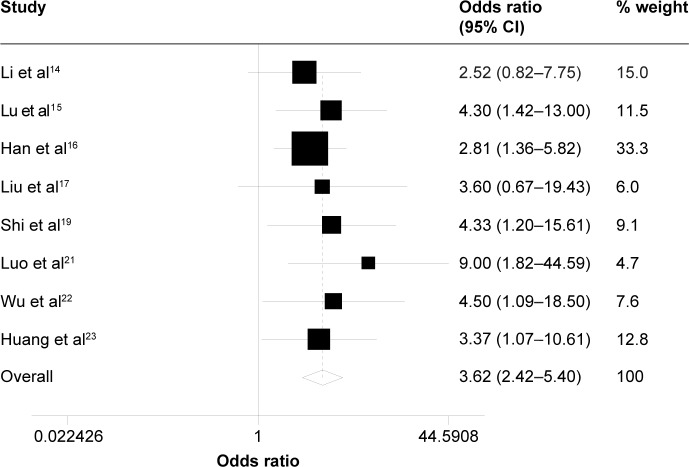
A total of 12 RCTs (representing 835 patients) were identified. The pooled analysis showed that taxane-containing regimens had a significant improvement in ORR for nasopharyngeal lesion (OR =4.57, 95% CI =1.14-18.30, P=0.032, z=2.15) but not in cervical lymph nodes (OR =1.23, 95% CI =0.65-2.36, P=0.532, z=0.64) and in 1-year survival rates (OR =1.19, 95% CI =0.10-14.82, P=0.893, z=0.13) compared with non-taxane-containing regimens. Regarding the adverse events and toxicities, grade 3-4 leukopenia and neutropenia were significantly different between the two groups (P<0.001) in favor of the non-taxane-containing regimens, but grade 3-4 vomiting was significantly different between the two groups (P<0.005) in favor of the taxane-containing regimens.
When combined with CCRT, taxane-containing IC regimens may be more efficient for short-term local control in Chinese patients with locally advanced NPC than the non-taxane-containing IC regimens. Moreover, the major toxic effects, which were bone marrow suppression, could be tolerated by majority of patients. More long-term follow-up and high-quality trials of NPC are needed to validate our findings.
在针对中国晚期鼻咽癌(NPC)患者的随机对照试验(RCT)中,已将含紫杉烷的诱导化疗(IC)方案与同步放化疗(CCRT)联合使用的情况,与不含紫杉烷的IC联合CCRT的情况进行了比较。这项荟萃分析旨在系统评估它们在该种族人群中的临床疗效和安全性概况。
检索电子数据库PubMed、Embase、MEDLINE和中国生物医学数据库,以查找符合条件的研究。结局指标包括总缓解率(ORR)、1年生存率以及不同类型的不良事件。计算优势比(OR)和95%置信区间(CI)以评估关联强度。
共确定了12项RCT(涉及835例患者)。汇总分析表明,与不含紫杉烷的方案相比,含紫杉烷的方案在鼻咽癌病变的ORR方面有显著改善(OR = 4.57,95% CI = 1.14 - 18.30,P = 0.032,z = 2.15),但在颈部淋巴结方面(OR = 1.23,95% CI = 0.65 - 2.36,P = 0.532,z = 0.64)以及1年生存率方面(OR = 1.19,95% CI = 0.10 - 14.82,P = 0.893,z = 0.13)没有显著改善。关于不良事件和毒性,两组之间3 - 4级白细胞减少和中性粒细胞减少有显著差异(P < 0.001),有利于不含紫杉烷的方案,但两组之间3 - 4级呕吐有显著差异(P < 0.005),有利于含紫杉烷的方案。
与CCRT联合使用时,含紫杉烷的IC方案对于中国局部晚期NPC患者的短期局部控制可能比不含紫杉烷的IC方案更有效。此外,主要的毒性作用即骨髓抑制,大多数患者可以耐受。需要更多关于NPC的长期随访和高质量试验来验证我们的发现。