Caruso Ciro, Ostacolo Carmine, Epstein Robert L, Barbaro Gaetano, Troisi Salvatore, Capobianco Decio
*Corneal Transplant Center, Pellegrini Hospital, Naples, Italy; †Department of Pharmacy, University of Naples Federico II, Naples, Italy; ‡Mercy Center for Corrective Eye Surgery, McHenry, IL; §I.R.O.S. (Institute of Refractive and Ophthalmic Surgery), Naples, Italy; ¶Department of Ophthalmology, Salerno University Hospital, Salerno, Italy; and ‖Ophthalmic Center Med Laser Caserta, Caserta, Italy.
Cornea. 2016 Feb;35(2):145-50. doi: 10.1097/ICO.0000000000000699.
To report the clinical outcomes with 24-month follow-up of transepithelial cross-linking using a combination of a D-alpha-tocopheryl polyethylene-glycol 1000 succinate (vitamin E-TPGS)-enhanced riboflavin solution and abbreviated low fluence UV-A treatment.
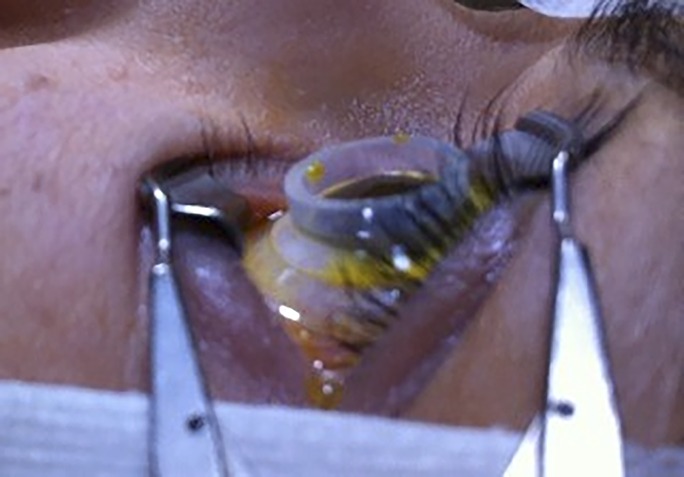
In a nonrandomized clinical trial, 25 corneas of 19 patients with topographically proven, progressive, mild to moderate keratoconus over the previous 6 months were cross-linked, and all patients were examined at 1, 3, 6, 12, and 24 months. The treatments were performed using a patented solution of riboflavin and vitamin E-TPGS, topically applied for 15 minutes, followed by two 5-minute UV-A treatments with separate doses both at fluence below 3 mW/cm(2) that were based on preoperative central pachymetry.
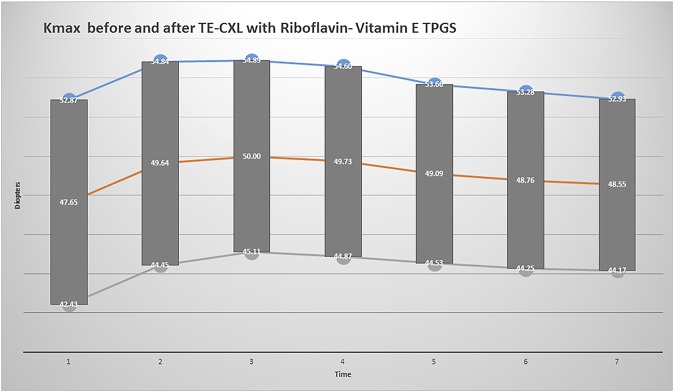
During the 6-month pretreatment observation, the average Kmax increased by +1.99 ± 0.29 D (diopter). Postoperatively, the average Kmax decreased, changing by -0.55 ± 0.94 D, by -0.88 ± 1.02 D and by -1.01 ± 1.22 D at 6, 12, and 24 months. Postoperatively, Kmax decreased in 19, 20, and 20 of the 25 eyes at 6 months, 12 months, and 24 months, respectively. Refractive cylinder was decreased by 3 months postoperatively and afterward, changing by -1.35 ± 0.69 D at 24 months. Best spectacle-corrected visual acuity (BSCVA) improved at 6, 12, and 24 months, including an improvement of -0.19 ± 0.13 logarithm of the minimum angle of resolution units at 24 months. There was no reduction in endothelial cell count. No corneal abrasions occurred, and no bandage contact lenses or prescription analgesics were used during postoperative recovery.
Transepithelial cross-linking using the riboflavin-vitamin E solution and brief, low-dose, pachymetry-dependent UV-A treatment safely stopped keratoconus progression.
报告使用D-α-生育酚聚乙二醇1000琥珀酸酯(维生素E-TPGS)增强型核黄素溶液和缩短的低能量紫外线A治疗进行上皮下交联并随访24个月的临床结果。
在一项非随机临床试验中,对19例在过去6个月内经地形图证实为进展性、轻度至中度圆锥角膜患者的25只角膜进行交联,所有患者在1、3、6、12和24个月时接受检查。使用一种核黄素和维生素E-TPGS的专利溶液进行治疗,局部应用15分钟,然后根据术前中央角膜厚度进行两次5分钟的紫外线A治疗,每次剂量单独给予,能量密度低于3 mW/cm²。
在6个月的预处理观察期间,平均最大角膜曲率(Kmax)增加了+1.99±0.29 D(屈光度)。术后,平均Kmax在6、12和24个月时分别下降了-0.55±0.94 D、-0.88±1.02 D和-1.01±1.22 D。术后,25只眼中分别有19、20和20只眼在6个月、12个月和24个月时Kmax下降。术后3个月及之后屈光柱镜度数下降,在24个月时下降了-1.35±0.69 D。最佳矫正视力(BSCVA)在6、12和24个月时有所改善,包括在24个月时最小分辨角对数单位提高了-0.19±0.13。内皮细胞计数没有减少。没有发生角膜擦伤,术后恢复期间未使用绷带角膜接触镜或处方镇痛药。
使用核黄素-维生素E溶液和短暂、低剂量、依赖角膜厚度的紫外线A治疗进行上皮下交联可安全地阻止圆锥角膜进展。