Moore Wesley S, Popma Jeffrey J, Roubin Gary S, Voeks Jenifer H, Cutlip Donald E, Jones Michael, Howard George, Brott Thomas G
Division of Vascular Surgery, UCLA Medical Center, Los Angeles, Calif.
Cardiac Service, Beth Israel Deaconess Medical Center, Boston, Mass.
J Vasc Surg. 2016 Apr;63(4):851-7, 858.e1. doi: 10.1016/j.jvs.2015.08.119. Epub 2015 Nov 21.
The Carotid Revascularization Endarterectomy versus Stenting Trial (CREST) demonstrated a higher periprocedural stroke and death (S+D) rate among patients randomized to carotid artery stenting (CAS) than to carotid endarterectomy (CEA). Herein, we seek factors that affect the CAS-CEA treatment differences and potentially to identify a subgroup of patients for whom CAS and CEA have equivalent periprocedural S+D risk.
Patient and arterial characteristics were assessed as effect modifiers of the CAS-CEA treatment difference in 2502 patients by the addition of factor-by-treatment interaction terms to a logistic regression model.
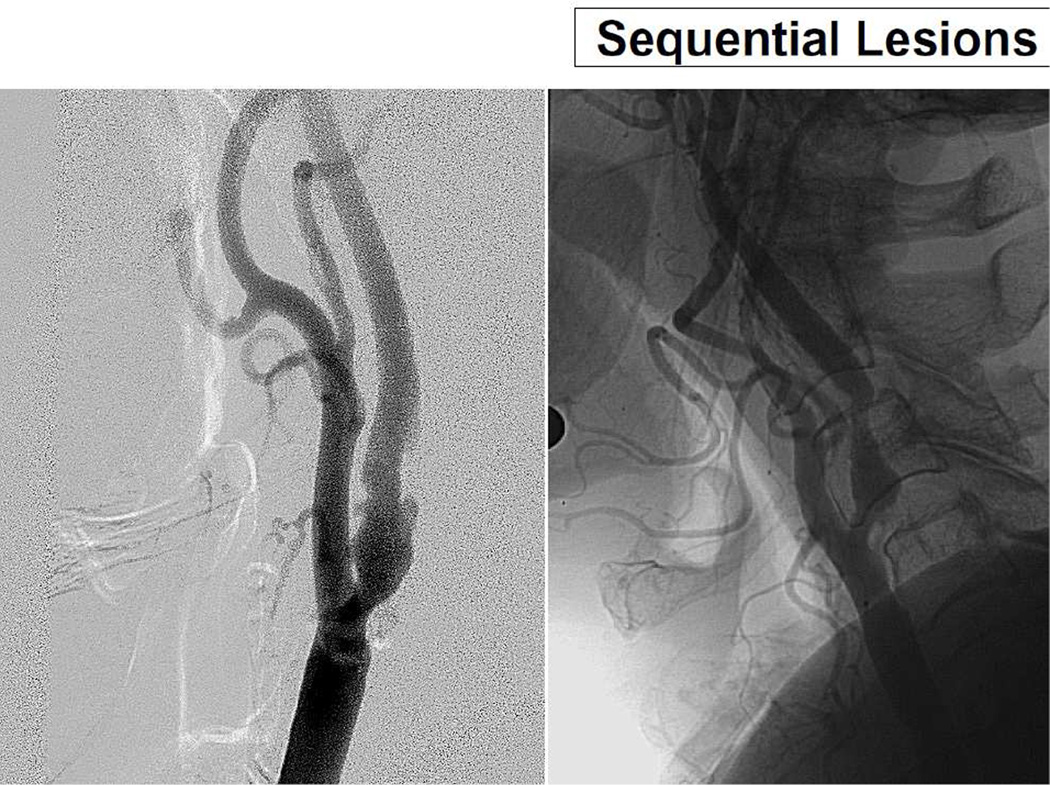
Lesion length and lesions that were contiguous or were sequential and noncontiguous extending remote from the bulb were identified as influencing the CAS-to-CEA S+D treatment difference. For those with longer lesion length (≥12.85 mm), the risk of CAS was higher than that of CEA (odds ratio [OR], 3.42; 95% confidence interval [CI], 1.19-9.78). Among patients with sequential or remote lesions extending beyond the bulb, the risk for S+D was higher for CAS relative to CEA (OR, 9.01; 95% CI, 1.20-67.8). For the 37% of patients with lesions that were both short and contiguous, the odds of S+D in those treated with CAS was nonsignificantly 28% lower than for CEA (OR, 0.72; 95% CI, 0.21-2.46).
The higher S+D risk for those treated with CAS appears to be largely isolated to those with longer lesion length and/or those with sequential and remote lesions. In the absence of those lesion characteristics, CAS appears to be as safe as CEA with regard to periprocedural risk of S+D.
颈动脉血运重建内膜切除术与支架置入术试验(CREST)表明,随机接受颈动脉支架置入术(CAS)的患者围手术期卒中及死亡(S+D)率高于接受颈动脉内膜切除术(CEA)的患者。在此,我们寻找影响CAS与CEA治疗差异的因素,并有可能识别出一组CAS和CEA围手术期S+D风险相当的患者亚组。
通过在逻辑回归模型中添加因素与治疗的交互项,评估2502例患者的患者及动脉特征作为CAS与CEA治疗差异的效应修饰因素。
病变长度以及连续或顺序且不连续且远离球部延伸的病变被确定为影响CAS与CEA的S+D治疗差异。对于病变长度较长(≥12.85 mm)的患者,CAS的风险高于CEA(比值比[OR],3.42;95%置信区间[CI],1.19 - 9.78)。在病变连续或远离球部延伸的患者中,CAS的S+D风险相对于CEA更高(OR,9.01;95% CI,1.20 - 67.8)。对于37%病变短且连续的患者,接受CAS治疗的患者S+D的几率比接受CEA治疗的患者低28%,但无统计学意义(OR,0.72;95% CI,0.21 - 2.46)。
接受CAS治疗的患者较高的S+D风险似乎主要局限于病变长度较长和/或病变连续且远离球部的患者。在没有这些病变特征的情况下,就围手术期S+D风险而言,CAS似乎与CEA一样安全。