Chibueze Ezinne C, Parsons Alexander J Q, Ota Erika, Swa Toshiyuki, Oladapo Olufemi T, Mori Rintaro
Department of Health Policy, National Center for Child Health and Development, 10-1-2 Okura, Setagaya-ku, Tokyo, 157-8535, Japan.
Department of Global Health Policy, Graduate School of Medicine, University of Tokyo, Tokyo, Japan.
BMC Pregnancy Childbirth. 2015 Nov 26;15:313. doi: 10.1186/s12884-015-0752-4.
Manual removal of the placenta is an invasive obstetric procedure commonly used for the management of retained placenta. However, it is unclear whether antibiotic prophylaxis is beneficial in preventing infectious morbidity. We conducted a systematic review to determine the efficacy and safety of routine use of antibiotics for preventing adverse maternal outcomes related to manual placenta removal following vaginal birth.
A detailed search of MEDLINE, EMBASE, Cochrane library and the CINAHL databases was conducted for non-randomized studies involving women undergoing manual placenta delivery after vaginal births and where antibiotic prophylaxis use was compared with no treatment or placebo to prevent maternal infection. Search terms including 'delivery, obstetric', 'placenta, retained', 'anti-infective agents', and 'chemoprevention' were used.
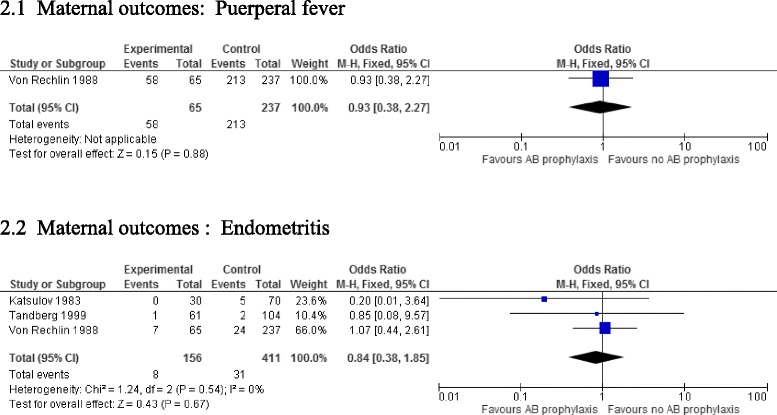
Of the 407 citations that resulted after elimination of duplicates, 81 full texts were potentially eligible after independent assessment of the title and abstracts. Independent review of the full texts identified three eligible cohort studies which were retrospective in design. These studies contained data on two of the pre-specified outcomes, endometritis and puerperal fever. Other secondary outcomes such as perineal infection and/or any infection, hospital stay duration, sepsis, hemorrhage >1000 ml or hospital readmissions were not reported on excluding puerperal fever. A meta-analysis showed no significant reduction in the incidence of endometritis (odds ratio [OR] 0.84, 95% confidence interval [CI] 0.38 to 1.85, three studies, 567 women) and puerperal fever (OR 0.99, 95% CI 0.38 to 2.27, one study, 302 women).
There is currently no evidence to suggest beneficial effects for routine antibiotic use in women undergoing manual placental removal following vaginal birth. In appropriate settings, further research is required to determine whether a policy of routine antibiotic prophylaxis for the procedure should be maintained or discouraged.
人工剥离胎盘是一种侵入性产科操作,常用于处理胎盘滞留。然而,抗生素预防在预防感染性发病方面是否有益尚不清楚。我们进行了一项系统评价,以确定常规使用抗生素预防阴道分娩后人工剥离胎盘相关不良母体结局的有效性和安全性。
对MEDLINE、EMBASE、Cochrane图书馆和CINAHL数据库进行详细检索,查找涉及阴道分娩后接受人工胎盘剥离的妇女的非随机研究,这些研究将抗生素预防用药与未治疗或安慰剂进行比较,以预防母体感染。使用的检索词包括“产科分娩”、“胎盘滞留”、“抗感染药”和“化学预防”。
在消除重复文献后得到的407条引用文献中,经独立评估标题和摘要后,有81篇全文可能符合要求。对全文进行独立审查后确定了3项符合要求的队列研究,这些研究均为回顾性设计。这些研究包含了两个预先指定的结局的数据,即子宫内膜炎和产褥热。除产褥热外,未报告其他次要结局,如会阴感染和/或任何感染、住院时间、败血症、出血量>1000 ml或再次入院情况。荟萃分析显示,子宫内膜炎的发生率没有显著降低(比值比[OR] 0.84,95%置信区间[CI] 0.38至1.85,3项研究,567名妇女),产褥热的发生率也没有显著降低(OR 0.99,95% CI 0.38至2.27,1项研究,302名妇女)。
目前没有证据表明常规使用抗生素对阴道分娩后接受人工胎盘剥离的妇女有有益影响。在适当的情况下,需要进一步研究以确定是否应维持或不鼓励对该操作进行常规抗生素预防的政策。