Reginold William, Luedke Angela C, Tam Angela, Itorralba Justine, Fernandez-Ruiz Juan, Reginold Jennifer, Islam Omar, Garcia Angeles
Memory Clinics, Division of Geriatric Medicine, Department of Medicine, Ont., Canada.
Centre for Neuroscience Studies, Kingston General Hospital, Queen's University, Kingston, Ont., Canada.
Dement Geriatr Cogn Dis Extra. 2015 Oct 21;5(3):387-94. doi: 10.1159/000439045. eCollection 2015 Sep-Dec.
BACKGROUND/AIMS: This study used 3-Tesla magnetic resonance imaging (MRI) tractography to determine if there was an association between tracts crossing white matter hyperintensities (WMH) and cognitive function in elderly persons.
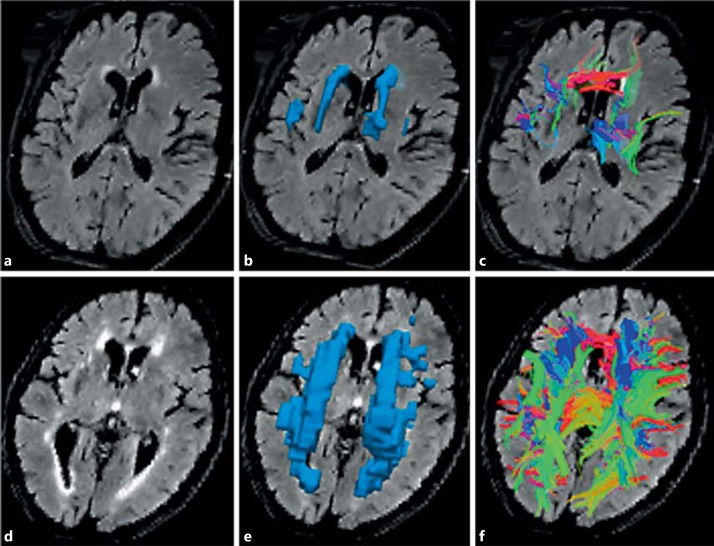
Brain T2-weighted fluid-attenuated inversion recovery (FLAIR) and diffusion tensor MRI scans were acquired in participants above the age of 60 years. Twenty-six persons had WMH identified on T2 FLAIR scans. They completed a battery of neuropsychological tests and were classified as normal controls (n = 15) or with Alzheimer's dementia (n = 11). Tractography was generated by the Fiber Assignment by Continuous Tracking method. All tracts that crossed WMH were segmented. The average fractional anisotropy and average mean diffusivity of these tracts were quantified. We studied the association between cognitive test scores with the average mean diffusivity and average fractional anisotropy of tracts while controlling for age, total WMH volume and diagnosis.
An increased mean diffusivity of tracts crossing WMH was associated with worse performance on the Wechsler Memory Scale-III Longest Span Forward (p = 0.02). There was no association between the fractional anisotropy of tracts and performance on cognitive testing.
The mean diffusivity of tracts crossing WMH measured by tractography is a novel correlate of performance on the Wechsler Memory Scale-III Longest Span Forward in elderly persons.
背景/目的:本研究使用3特斯拉磁共振成像(MRI)纤维束成像技术,以确定老年人中穿过白质高信号(WMH)的纤维束与认知功能之间是否存在关联。
对60岁以上的参与者进行脑部T2加权液体衰减反转恢复(FLAIR)和扩散张量MRI扫描。26人在T2 FLAIR扫描中发现有WMH。他们完成了一系列神经心理学测试,并被分类为正常对照组(n = 15)或患有阿尔茨海默病痴呆症(n = 11)。通过连续追踪纤维分配法生成纤维束成像。所有穿过WMH的纤维束都进行了分割。对这些纤维束的平均各向异性分数和平均扩散率进行了量化。在控制年龄、总WMH体积和诊断的同时,我们研究了认知测试分数与纤维束的平均扩散率和平均各向异性分数之间的关联。
穿过WMH的纤维束平均扩散率增加与韦氏记忆量表第三版最长顺背跨度测试成绩较差相关(p = 0.02)。纤维束的各向异性分数与认知测试成绩之间没有关联。
通过纤维束成像测量的穿过WMH的纤维束平均扩散率是老年人韦氏记忆量表第三版最长顺背跨度测试成绩的一个新的相关因素。