
估算大规模监测网络的占用动态:美国东北部保护区内两栖动物繁殖地的占用情况
Estimating occupancy dynamics for large-scale monitoring networks: amphibian breeding occupancy across protected areas in the northeast United States.
作者信息
Miller David A W, Grant Evan H Campbell
机构信息
Department of Ecosystem Science and Management Pennsylvania State University University Park Pennsylvania 16802.
U.S. Geological Survey Patuxent Wildlife Research Center SO Conte Anadromous Fish Laboratory 1 Migratory Way Turners Falls Massachusetts 01360.
出版信息
Ecol Evol. 2015 Sep 27;5(21):4735-46. doi: 10.1002/ece3.1679. eCollection 2015 Nov.
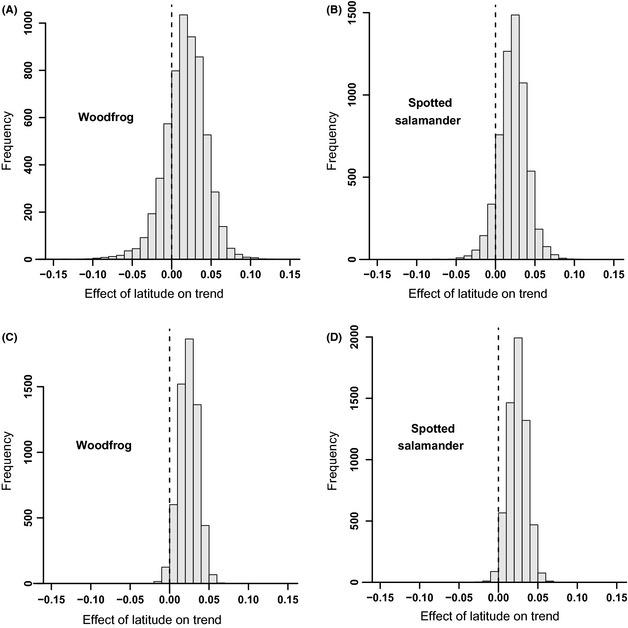
Regional monitoring strategies frequently employ a nested sampling design where a finite set of study areas from throughout a region are selected and intensive sampling occurs within a subset of sites within the individual study areas. This sampling protocol naturally lends itself to a hierarchical analysis to account for dependence among subsamples. Implementing such an analysis using a classic likelihood framework is computationally challenging when accounting for detection errors in species occurrence models. Bayesian methods offer an alternative approach for fitting models that readily allows for spatial structure to be incorporated. We demonstrate a general approach for estimating occupancy when data come from a nested sampling design. We analyzed data from a regional monitoring program of wood frogs (Lithobates sylvaticus) and spotted salamanders (Ambystoma maculatum) in vernal pools using static and dynamic occupancy models. We analyzed observations from 2004 to 2013 that were collected within 14 protected areas located throughout the northeast United States. We use the data set to estimate trends in occupancy at both the regional and individual protected area levels. We show that occupancy at the regional level was relatively stable for both species. However, substantial variation occurred among study areas, with some populations declining and some increasing for both species. In addition, When the hierarchical study design is not accounted for, one would conclude stronger support for latitudinal gradient in trends than when using our approach that accounts for the nested design. In contrast to the model that does not account for nesting, the nested model did not include an effect of latitude in the 95% credible interval. These results shed light on the range-level population status of these pond-breeding amphibians, and our approach provides a framework that can be used to examine drivers of local and regional occurrence dynamics.
区域监测策略经常采用嵌套抽样设计,即从整个区域中选择一组有限的研究区域,并在各个研究区域内的一部分地点进行密集抽样。这种抽样方案自然适合进行分层分析,以考虑子样本之间的依赖性。在物种出现模型中考虑检测误差时,使用经典似然框架实施这种分析在计算上具有挑战性。贝叶斯方法提供了一种拟合模型的替代方法,该方法很容易纳入空间结构。我们展示了一种在数据来自嵌套抽样设计时估计占有率的通用方法。我们使用静态和动态占有率模型分析了来自春季池塘中林蛙(Lithobates sylvaticus)和虎纹钝口螈(Ambystoma maculatum)区域监测项目的数据。我们分析了2004年至2013年在美国东北部14个保护区内收集的观测数据。我们使用该数据集估计区域和各个保护区层面的占有率趋势。我们表明,两个物种在区域层面的占有率相对稳定。然而,研究区域之间存在很大差异,两个物种的一些种群数量下降,而另一些则增加。此外,当不考虑分层研究设计时,与使用我们考虑嵌套设计的方法相比,人们会得出对趋势中纬度梯度的支持更强的结论。与不考虑嵌套的模型相比,嵌套模型在95%可信区间内不包括纬度效应。这些结果揭示了这些池塘繁殖两栖动物在分布范围层面的种群状况,我们的方法提供了一个可用于研究局部和区域出现动态驱动因素的框架。



 Zotero 插件