Sustainable Perennial Crops Laboratory, USDA-ARS, Beltsville Agricultural Research Center , Beltsville, MD 20705, USA ; College of Horticulture, Nanjing Agricultural University , Nanjing 210095, Jiangsu, China.
Daniel K. Inouye Pacific Basin Agricultural Research Center, USDA-ARS , Hilo, HI 96720, USA.
Hortic Res. 2015 Nov 25;2:15056. doi: 10.1038/hortres.2015.56. eCollection 2015.
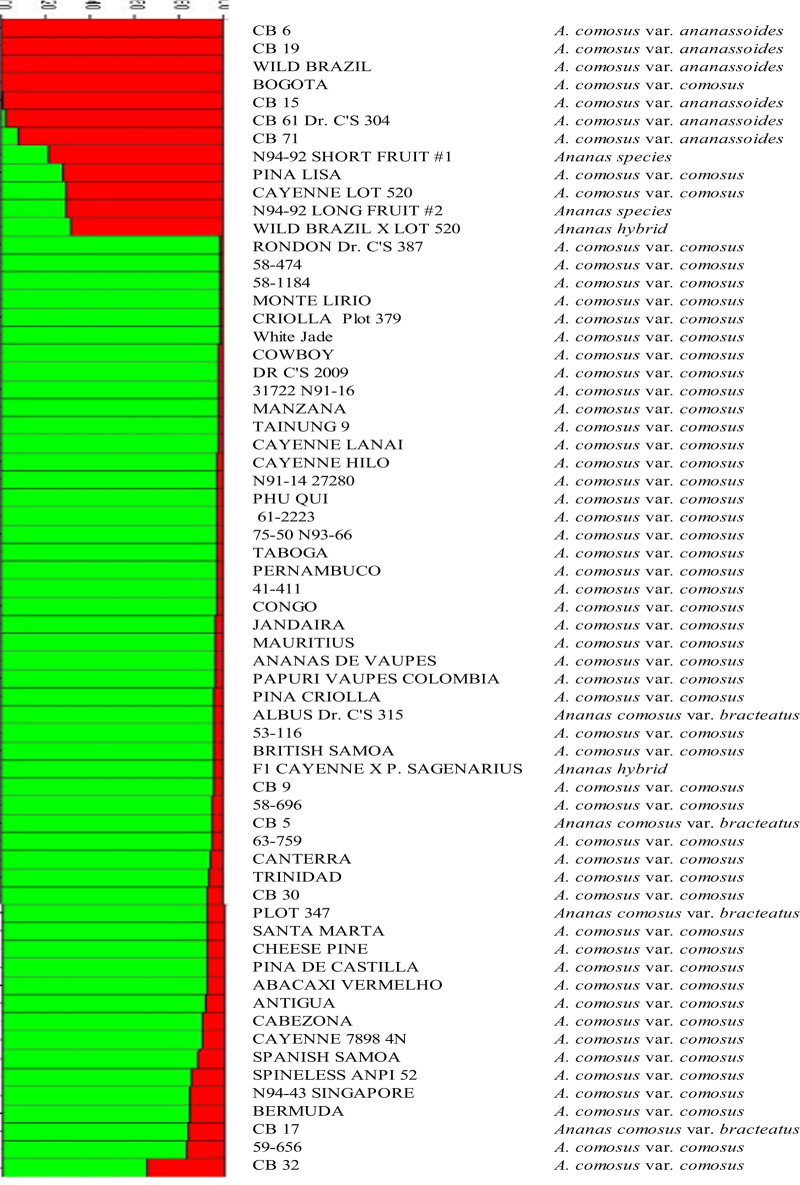
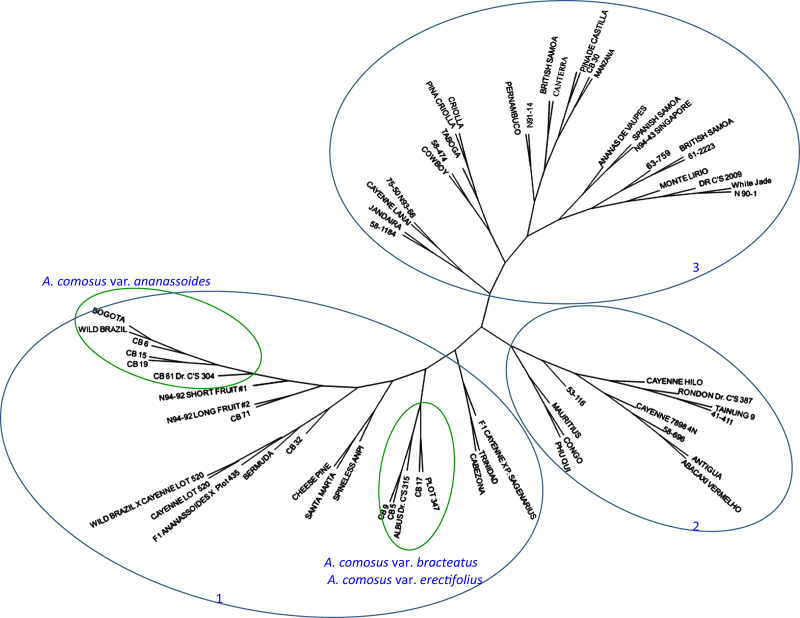
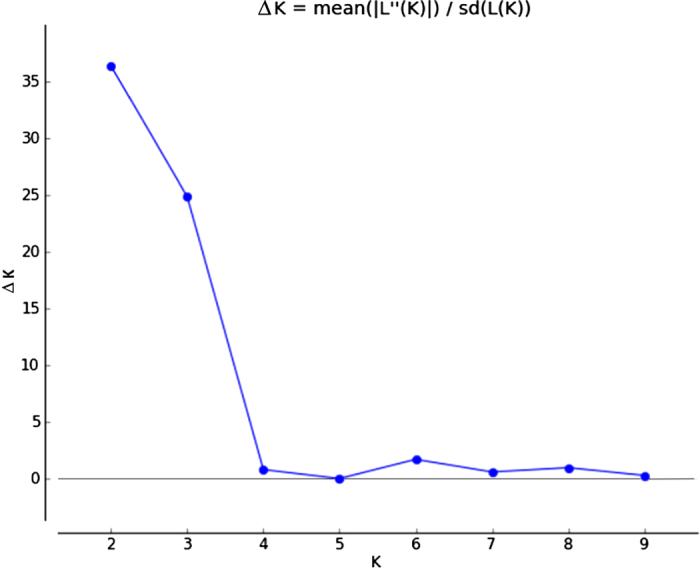
Pineapple (Ananas comosus [L.] Merr.) is the third most important tropical fruit in the world after banana and mango. As a crop with vegetative propagation, genetic redundancy is a major challenge for efficient genebank management and in breeding. Using expressed sequence tag and nucleotide sequences from public databases, we developed 213 single nucleotide polymorphism (SNP) markers and validated 96 SNPs by genotyping the United States Department of Agriculture - Agricultural Research Service pineapple germplasm collection, maintained in Hilo, Hawaii. The validation resulted in designation of a set of 57 polymorphic SNP markers that revealed a high rate of duplicates in this pineapple collection. Twenty-four groups of duplicates were detected, encompassing 130 of the total 170 A cosmos accessions. The results show that somatic mutation has been the main source of intra-cultivar variations in pineapple. Multivariate clustering and a model-based population stratification suggest that the modern pineapple cultivars are comprised of progenies that are derived from different wild Ananas botanical varieties. Parentage analysis further revealed that both A. comosus var. bracteatus and A. comosus var. ananassoides are likely progenitors of pineapple cultivars. However, the traditional classification of cultivated pineapple into horticultural groups (e.g. 'Cayenne', 'Spanish', 'Queen') was not well supported by the present study. These SNP markers provide robust and universally comparable DNA fingerprints; thus, they can serve as an efficient genotyping tool to assist pineapple germplasm management, propagation of planting material, and pineapple cultivar protection. The high rate of genetic redundancy detected in this pineapple collection suggests the potential impact of applying this technology on other clonally propagated perennial crops.
菠萝(Ananas comosus [L.] Merr.)是继香蕉和芒果之后世界上第三重要的热带水果。作为一种具有营养繁殖的作物,遗传冗余是高效基因库管理和育种的主要挑战。我们利用来自公共数据库的表达序列标签和核苷酸序列,开发了 213 个单核苷酸多态性(SNP)标记,并通过对位于夏威夷希洛的美国农业部农业研究局菠萝种质资源库进行基因分型,验证了其中的 96 个 SNP。验证结果确定了一组 57 个多态 SNP 标记,这些标记揭示了该菠萝资源中存在很高的重复率。检测到 24 个重复组,包含了 170 个菠萝品种中的 130 个。结果表明体细胞突变是菠萝品种内变异的主要来源。多元聚类和基于模型的群体分层表明,现代菠萝品种是由不同野生菠萝植物品种的后代组成的。亲代分析进一步表明,菠萝的亲本是菠萝蜜变种(A. comosus var. bracteatus)和野菠萝变种(A. comosus var. ananassoides)。然而,本研究不支持传统上将栽培菠萝分为园艺组(如“卡宴”、“西班牙”、“皇后”)的分类方法。这些 SNP 标记提供了稳健且可普遍比较的 DNA 指纹图谱;因此,它们可以作为一种有效的基因分型工具,辅助菠萝种质资源管理、种植材料的繁殖以及菠萝品种的保护。在该菠萝资源中检测到的高遗传冗余率表明,该技术在其他无性繁殖的多年生作物上的应用具有潜在的影响。