Veas-Pérez de Tudela Miguel, Maestre Carolina, Delgado-Esteban María, Bolaños Juan P, Almeida Angeles
Institute of Biomedical Research of Salamanca (IBSAL), University Hospital of Salamanca - University of Salamanca, 37007 Salamanca, Spain.
Institute of Functional Biology and Genomics (IBFG), University of Salamanca - CSIC, 37007 Salamanca, Spain.
Sci Rep. 2015 Dec 10;5:18180. doi: 10.1038/srep18180.
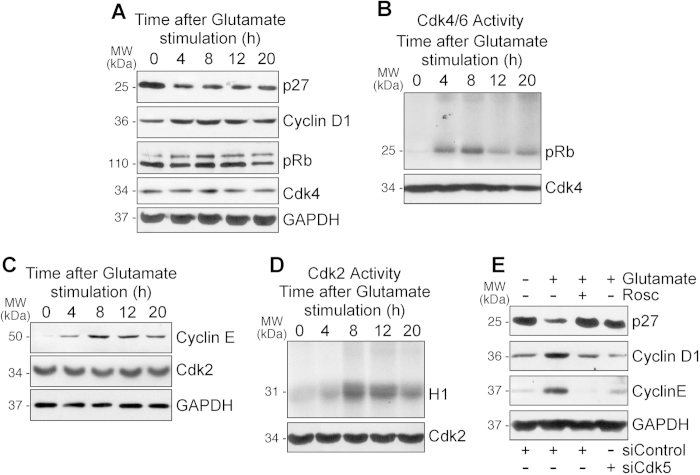
The anaphase-promoting complex/cyclosome (APC/C) is an E3 ubiquitin ligase that regulates cell cycle progression in proliferating cells. To enter the S-phase, APC/C must be inactivated by phosphorylation of its cofactor, Cdh1. In post-mitotic cells such as neurons APC/C-Cdh1 complex is highly active and responsible for the continuous degradation of mitotic cyclins. However, the specific molecular pathway that determines neuronal cell cycle blockade in post-mitotic neurons is unknown. Here, we show that activation of glutamatergic receptors in rat cortical primary neurons endogenously triggers cyclin-dependent kinase-5 (Cdk5)-mediated phosphorylation of Cdh1 leading to its cytoplasmic accumulation and disassembly from the APC3 core protein, causing APC/C inactivation. Conversely, pharmacological or genetic inhibition of Cdk5 promotes Cdh1 ubiquitination and proteasomal degradation. Furthermore, we show that Cdk5-mediated phosphorylation and inactivation of Cdh1 leads to p27 depletion, which switches on the cyclin D1-cyclin-dependent kinase-4 (Cdk4)-retinoblastoma protein (pRb) pathway to allow the S-phase entry of neurons. However, neurons do not proceed through the cell cycle and die by apoptosis. These results indicate that APC/C-Cdh1 actively suppresses an aberrant cell cycle entry and death of neurons, highlighting its critical function in neuroprotection.
后期促进复合物/细胞周期体(APC/C)是一种E3泛素连接酶,可调节增殖细胞中的细胞周期进程。为了进入S期,APC/C必须通过其辅因子Cdh1的磷酸化而失活。在诸如神经元等有丝分裂后细胞中,APC/C-Cdh1复合物高度活跃,并负责有丝分裂周期蛋白的持续降解。然而,决定有丝分裂后神经元中神经元细胞周期阻滞的具体分子途径尚不清楚。在这里,我们表明,大鼠皮质原代神经元中谷氨酸能受体的激活内源性地触发细胞周期蛋白依赖性激酶5(Cdk5)介导的Cdh1磷酸化,导致其在细胞质中积累并从APC3核心蛋白上解离,从而导致APC/C失活。相反,Cdk5的药理学或遗传学抑制促进Cdh1的泛素化和蛋白酶体降解。此外,我们表明,Cdk5介导的Cdh1磷酸化和失活导致p27耗竭,从而开启细胞周期蛋白D1-细胞周期蛋白依赖性激酶4(Cdk4)-视网膜母细胞瘤蛋白(pRb)途径,以允许神经元进入S期。然而,神经元不会继续通过细胞周期,而是通过凋亡死亡。这些结果表明,APC/C-Cdh1积极抑制神经元异常的细胞周期进入和死亡,突出了其在神经保护中的关键功能。