Franco-Villanueva Ana, Wandosell Francisco, Antón Inés M
Centro Nacional de Biotecnología (CNB-CSIC) Darwin 3 Campus Cantoblanco 28049 Madrid Spain ; CIBERNED, Centro Investigación Biomédica en Red de Enfermedades Neurodegenerativas Madrid Spain.
CIBERNED, Centro Investigación Biomédica en Red de Enfermedades Neurodegenerativas Madrid Spain ; Centro de Biología Molecular Severo Ochoa (CBMSO) (CSIC-UAM) Nicolás Cabrera 1 Campus Cantoblanco 28049 Madrid Spain.
Brain Behav. 2015 Oct 3;5(11):e00359. doi: 10.1002/brb3.359. eCollection 2015 Nov.
Neuronal morphogenesis is governed mainly by two interconnected processes, cytoskeletal reorganization, and signal transduction. The actin-binding molecule WIP (Wiskott-Aldrich syndrome protein [WASP]-interacting protein) was identified as a negative regulator of neuritogenesis. Although WIP controls activity of the actin-nucleation-promoting factor neural WASP (N-WASP) during neuritic differentiation, its implication in signal transduction remains unknown.
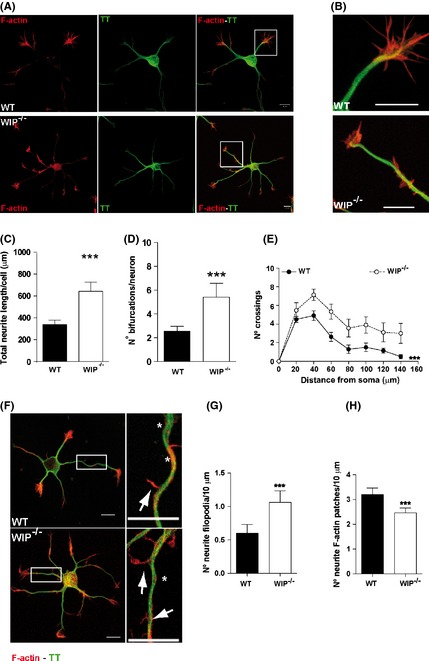
Using primary neurons from WIP-deficient and wild-type mice we did an immunofluorescence, morphometric, and biochemical analysis of the signaling modified by WIP deficiency.
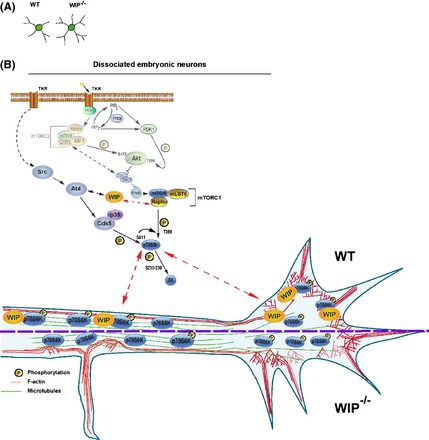
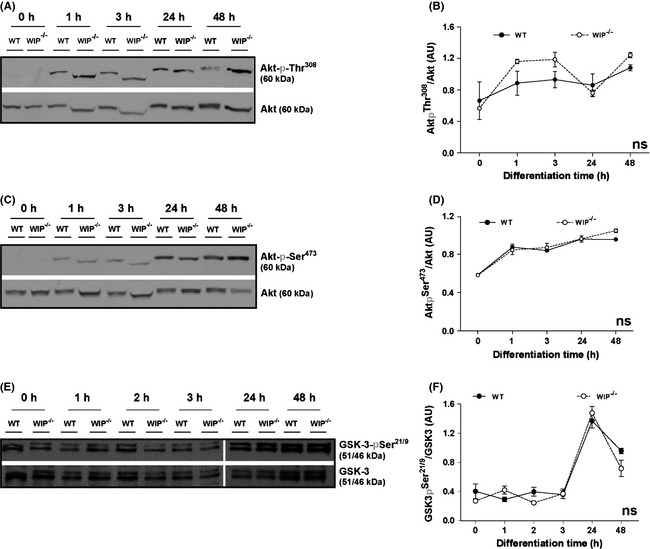
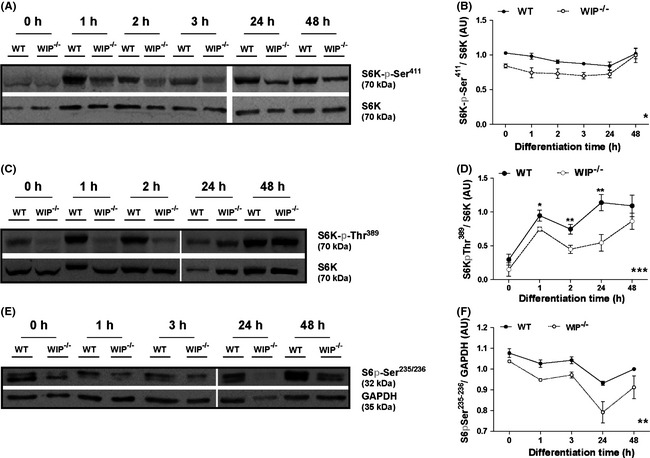
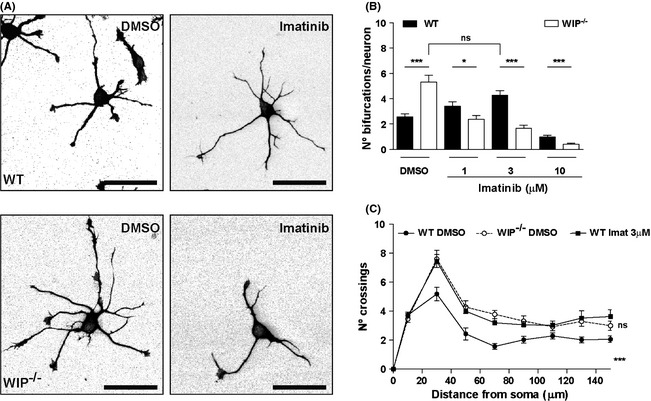
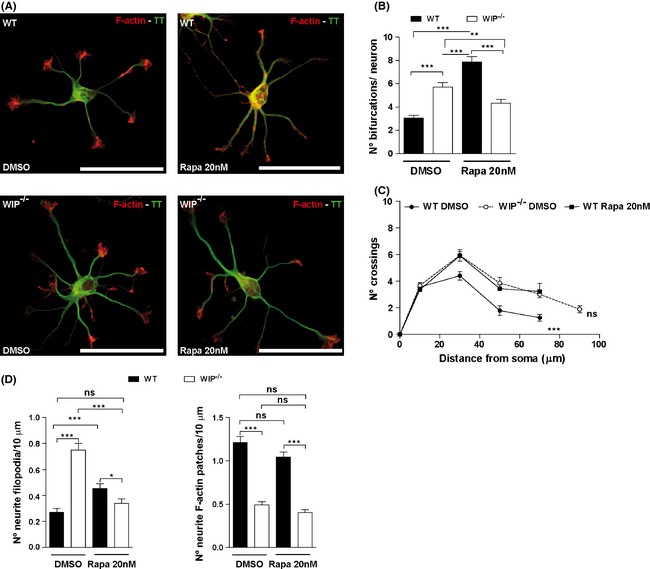
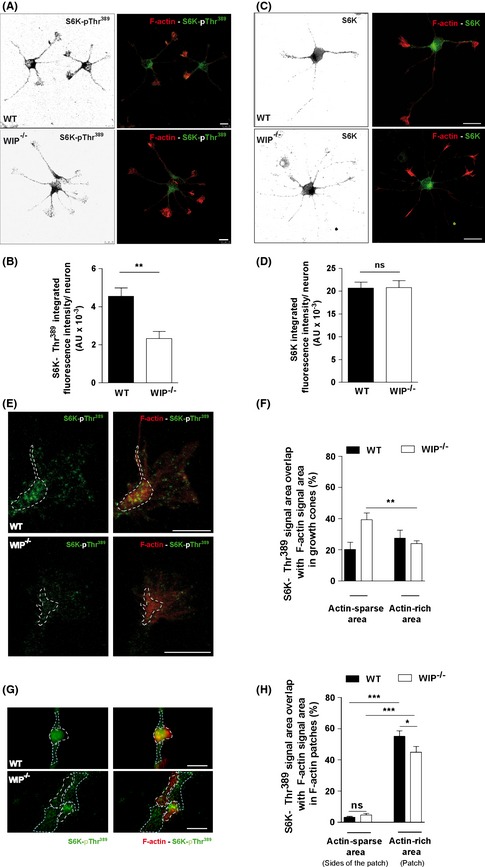
Here, we describe the WIP contribution to the regulation of neuritic elaboration and ramification through modification in phosphorylation levels of several kinases that participate in the mammalian target of rapamycin complex 1 (mTORC1)-p70S6K (phosphoprotein 70 ribosomal protein S6 kinase, S6K) intracellular signaling pathway. WIP deficiency induces an increase in the number of neuritic bifurcations and filopodial protrusions in primary embryonic neurons. This phenotype is not due to modifications in the activity of the phosphoinositide 3 kinase (PI3K)-Akt pathway, but to reduced phosphorylation of the S6K residues Ser(411) and Thr(389). The resulting decrease in kinase activity leads to reduced S6 phosphorylation in the absence of WIP. Incubation of control neurons with pharmacological inhibitors of mTORC1 or Abl, two S6K regulators, conferred a morphology resembling that of WIP-deficient neurons. Moreover, the preferential co-distribution of phospho-S6K with polymerized actin is altered in WIP-deficient neurons.
These experiments identify WIP as a member of a signaling cascade comprised of Abl family kinases, mTORC1 and S6K, which regulates neuron development and specifically, neuritic branching and complexity. Thus, we postulated a new role for WIP protein.
神经元形态发生主要受两个相互关联的过程调控,即细胞骨架重组和信号转导。肌动蛋白结合分子WIP(威斯科特-奥尔德里奇综合征蛋白[WASP]相互作用蛋白)被确定为神经突发生的负调节因子。尽管WIP在神经突分化过程中控制肌动蛋白成核促进因子神经WASP(N-WASP)的活性,但其在信号转导中的作用仍不清楚。
我们使用来自WIP缺陷型和野生型小鼠的原代神经元,对因WIP缺陷而改变的信号进行了免疫荧光、形态测量和生化分析。
在此,我们描述了WIP通过参与雷帕霉素复合物1(mTORC1)-p70S6K(磷蛋白70核糖体蛋白S6激酶,S6K)细胞内信号通路的几种激酶磷酸化水平的改变,对神经突细化和分支调节的贡献。WIP缺陷导致原代胚胎神经元中神经突分支和丝状伪足突起数量增加。这种表型不是由于磷酸肌醇3激酶(PI3K)-Akt通路活性的改变,而是由于S6K残基Ser(411)和Thr(389)的磷酸化减少。在没有WIP的情况下,激酶活性的降低导致S6磷酸化减少。用mTORC1或Abl(两种S6K调节剂)的药理抑制剂处理对照神经元,可赋予其类似于WIP缺陷型神经元的形态。此外,在WIP缺陷型神经元中,磷酸化S6K与聚合肌动蛋白的优先共分布发生改变。
这些实验确定WIP是由Abl家族激酶、mTORC1和S6K组成的信号级联的成员,该信号级联调节神经元发育,特别是神经突分支和复杂性。因此,我们推测了WIP蛋白的新作用。