Inoguchi Noriko, Chaiseeda Kittichai, Yamanishi Mamoru, Kim Moon Ki, Jang Yunho, Bajaj Mamta, Chia Catherine P, Becker Donald F, Moriyama Hideaki
School of Biological Sciences, University of Nebraska-Lincoln, Lincoln, NE, USA.
Department of Chemistry, University of Nebraska-Lincoln, Lincoln, NE, USA.
BMC Res Notes. 2015 Dec 15;8:784. doi: 10.1186/s13104-015-1760-1.
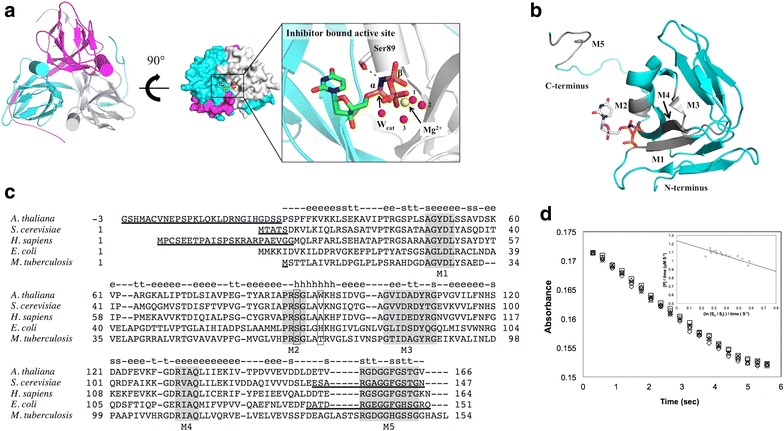
Deoxyuridine triphosphate nucleotidohydrolase (dUTPase) hydrolyzes dUTP to dUMP and pyrophosphate to maintain the cellular thymine-uracil ratio. dUTPase is also a target for cancer chemotherapy. However, the mechanism defining its substrate affinity remains unclear. Sequence comparisons of various dUTPases revealed that Arabidopsis thaliana dUTPase has a unique tryptophan at position 93, which potentially contributes to its degree of substrate affinity. To better understand the roles of tryptophan 93, A. thaliana dUTPase was studied.
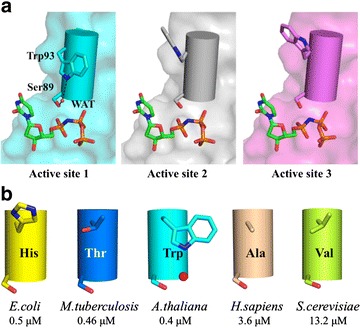
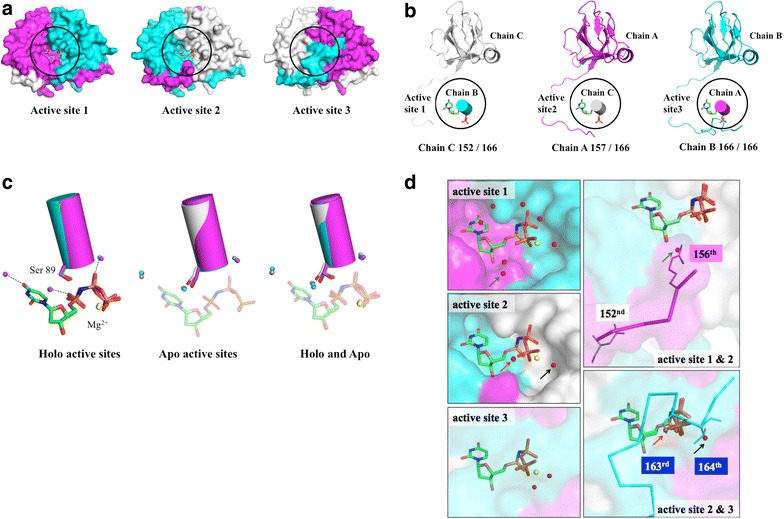
Enzyme assays showed that A. thaliana dUTPase belongs to a high-affinity group of isozymes, which also includes the enzymes from Escherichia coli and Mycobacterium tuberculosis. Enzymes from Homo sapiens and Saccharomyces cerevisiae are grouped as low-affinity dUTPases. The structure of the homo-trimeric A. thaliana dUTPase showed three active sites, each with a different set of ligand interactions between the amino acids and water molecules. On an α-helix, tryptophan 93 appears to keep serine 89 in place via a water molecule and to specifically direct the ligand. Upon being oriented in the active site, the C-terminal residues close the active site to promote the reaction.
In the high-affinity group, the prefixed direction of the serine residues was oriented by a positively charged residue located four amino acids away, while low-affinity enzymes possess small hydrophobic residues at the corresponding sites.
脱氧尿苷三磷酸核苷酸水解酶(dUTPase)将dUTP水解为dUMP和焦磷酸,以维持细胞内胸腺嘧啶与尿嘧啶的比例。dUTPase也是癌症化疗的一个靶点。然而,决定其底物亲和力的机制仍不清楚。对各种dUTPase的序列比较显示,拟南芥dUTPase在第93位有一个独特的色氨酸,这可能有助于其底物亲和力的程度。为了更好地理解色氨酸93的作用,对拟南芥dUTPase进行了研究。
酶活性测定表明,拟南芥dUTPase属于高亲和力同工酶组,该组还包括来自大肠杆菌和结核分枝杆菌的酶。来自人类和酿酒酵母的酶被归类为低亲和力dUTPase。同源三聚体拟南芥dUTPase的结构显示有三个活性位点,每个活性位点在氨基酸和水分子之间具有不同的配体相互作用组。在一条α螺旋上,色氨酸93似乎通过一个水分子使丝氨酸89保持在原位,并特异性地引导配体。当在活性位点定向时,C端残基关闭活性位点以促进反应。
在高亲和力组中,丝氨酸残基的预先确定的方向由位于四个氨基酸远处的带正电荷的残基定向,而低亲和力酶在相应位点具有小的疏水残基。