About Frédégonde, Oudot-Mellakh Tiphaine, Niay Jonathan, Rabiéga Pascaline, Pedergnana Vincent, Duffy Darragh, Sultanik Philippe, Cagnot Carole, Carrat Fabrice, Marcellin Patrick, Zoulim Fabien, Larrey Dominique, Hézode Christophe, Fontaine Hélène, Bronowicki Jean-Pierre, Pol Stanislas, Albert Matthew L, Theodorou Ioannis, Cobat Aurélie, Abel Laurent
Laboratory of Human Genetics of Infectious Diseases, Necker Branch, Institut National de la Santé et de la Recherche Médicale (INSERM) U1163, Paris, France.
Paris Descartes University, Imagine Institute, Paris, France.
PLoS One. 2015 Dec 15;10(12):e0145105. doi: 10.1371/journal.pone.0145105. eCollection 2015.
Human genetic factors influence the outcome of pegylated interferon and ribavirin hepatitis C therapy. We explored the role of IL28B, APOH and ITPA SNPs on the outcomes of triple therapy including telaprevir or boceprevir in patients with compensated cirrhosis chronically infected with HCV-1.
A total of 256 HCV-1 Caucasian treatment-experienced patients with compensated cirrhosis from the ANRS CO20-CUPIC cohort were genotyped for a total of 10 candidate SNPs in IL28B (rs12979860 and rs368234815), APOH (rs8178822, rs12944940, rs10048158, rs52797880, rs1801689 and rs1801690) and ITPA (rs1127354 and rs7270101). We tested the association of IL28B and APOH SNPs with sustained virological response and of ITPA SNPs with anemia related phenotypes by means of logistic regression assuming an additive genetic model.
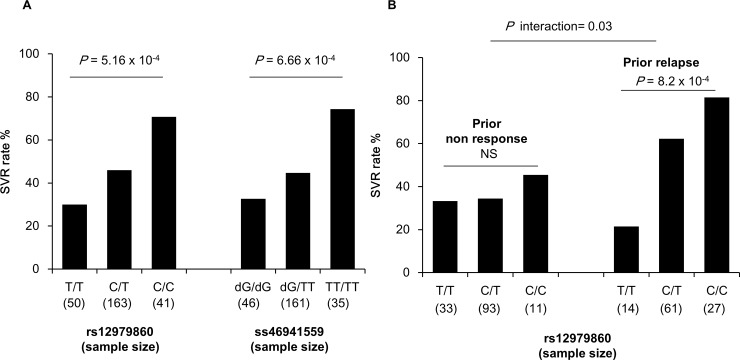
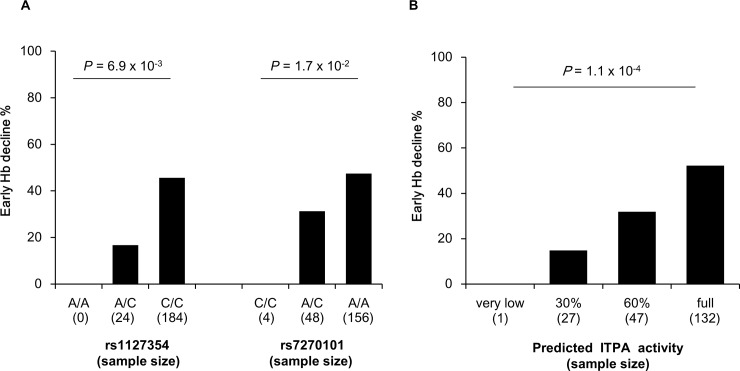
None of the six APOH SNPs were associated with sustained virological response. The favorable alleles of the IL28B SNPs rs12979860 and rs368234815 were associated with sustained virological response (rs12979860: OR = 2.35[1.50-3.70], P = 2x10(-4)). Refined analysis showed that the effect of IL28B SNPs on sustained virological response was restricted to prior PegIFN/RBV relapse (OR = 3.80[1.82-8.92], P = 8x10(-4)). We also confirmed the association between ITPA low activity alleles and protection against early hemoglobin decline in triple therapy (P = 2x10(-5)).
Our results suggest that the screening of rs12979860 may remain interesting for decision making in prior relapse HCV-1 Caucasian patients with compensated cirrhosis eligible for a telaprevir- or boceprevir-based therapy.
人类遗传因素会影响聚乙二醇干扰素和利巴韦林治疗丙型肝炎的效果。我们探讨了白细胞介素28B(IL28B)、载脂蛋白H(APOH)和次黄嘌呤-鸟嘌呤磷酸核糖转移酶(ITPA)基因单核苷酸多态性(SNP)在丙型肝炎病毒1型(HCV-1)慢性感染的代偿期肝硬化患者接受包含特拉匹韦或博赛匹韦的三联疗法时对治疗结果的作用。
对法国国家艾滋病和肝炎研究机构(ANRS)CO20-CUPIC队列中的256例有治疗经验的HCV-1白种人代偿期肝硬化患者进行基因分型,检测IL28B(rs12979860和rs368234815)、APOH(rs8178822、rs12944940、rs10048158、rs52797880、rs1801689和rs1801690)和ITPA(rs1127354和rs7270101)中的总共10个候选SNP。我们采用logistic回归并假定为加性遗传模型,来检验IL28B和APOH基因SNP与持续病毒学应答的相关性,以及ITPA基因SNP与贫血相关表型的相关性。
6个APOH基因SNP均与持续病毒学应答无关。IL28B基因SNP rs12979860和rs368234815的有利等位基因与持续病毒学应答相关(rs12979860:比值比[OR]=2.35[1.50 - 3.70],P = 2×10⁻⁴)。精细分析显示,IL28B基因SNP对持续病毒学应答的影响仅限于既往聚乙二醇干扰素/利巴韦林治疗复发的患者(OR = 3.80[1.82 - 8.92],P = 8×10⁻⁴)。我们还证实了ITPA低活性等位基因与三联疗法中预防早期血红蛋白下降之间的相关性(P = 2×10⁻⁵)。
我们的结果表明,对于符合基于特拉匹韦或博赛匹韦治疗条件的既往复发的HCV-1白种人代偿期肝硬化患者,筛查rs12979860可能仍有助于决策。