King Daniel W, King Lynda A, Park Crystal L, Lee Lewina O, Kaiser Anica Pless, Spiro Avron, Moore Jeffrey L, Kaloupek Danny G, Keane Terence M
National Center for PTSD, VA Boston Healthcare System, & Boston University School of Medicine.
University of Connecticut.
Clin Psychol Sci. 2015 Nov 1;3(6):861-876. doi: 10.1177/2167702614554448. Epub 2014 Dec 5.
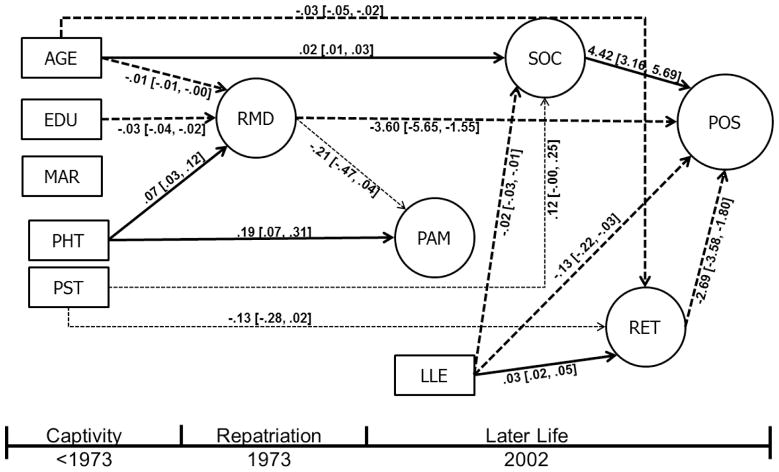
A longitudinal lifespan model of factors contributing to later-life positive adjustment was tested on 567 American repatriated prisoners from the Vietnam War. This model encompassed demographics at time of capture and attributes assessed after return to the U.S. (reports of torture and mental distress) and approximately 3 decades later (later-life stressors, perceived social support, positive appraisal of military experiences, and positive adjustment). Age and education at time of capture and physical torture were associated with repatriation mental distress, which directly predicted poorer adjustment 30 years later. Physical torture also had a salutary effect, enhancing later-life positive appraisals of military experiences. Later-life events were directly and indirectly (through concerns about retirement) associated with positive adjustment. Results suggest that the personal resources of older age and more education and early-life adverse experiences can have cascading effects over the lifespan to impact well-being in both positive and negative ways.
我们对567名越战归国美国战俘进行了一项关于促成晚年积极适应因素的纵向寿命模型测试。该模型涵盖被俘时的人口统计学特征以及返回美国后评估的属性(酷刑和精神痛苦报告),以及大约30年后的情况(晚年压力源、感知到的社会支持、对军事经历的积极评价和积极适应)。被俘时的年龄、教育程度和身体酷刑与归国后的精神痛苦相关,而精神痛苦直接预示着30年后较差的适应情况。身体酷刑也有有益影响,增强了晚年对军事经历的积极评价。晚年事件与积极适应直接和间接相关(通过对退休的担忧)。结果表明,年龄较大、受教育程度较高的个人资源以及早年的不良经历在整个生命历程中可能产生连锁效应,以积极和消极的方式影响幸福感。