Rojas-Caraballo Jose, López-Abán Julio, Fernández-Soto Pedro, Vicente Belén, Collía Francisco, Muro Antonio
Centro de Investigación en Salud para el Trópico (CIST), Carretera Troncal del Caribe, Sector Mamatoco, Santa Marta, Magdalena, Colombia ; Facultad de Medicina, Universidad Cooperativa de Colombia, Carretera Troncal del Caribe, Sector Mamatoco, Santa Marta, Magdalena, Colombia.
Instituto de Investigación Biomédica de Salamanca - Centro de Investigación de Enfermedades Tropicales de la Universidad de Salamanca (IBSAL-CIETUS), Facultad de Farmacia, Universidad de Salamanca, Salamanca, Castilla y León, Spain.
Genom Data. 2015 Aug 22;6:89-91. doi: 10.1016/j.gdata.2015.08.020. eCollection 2015 Dec.
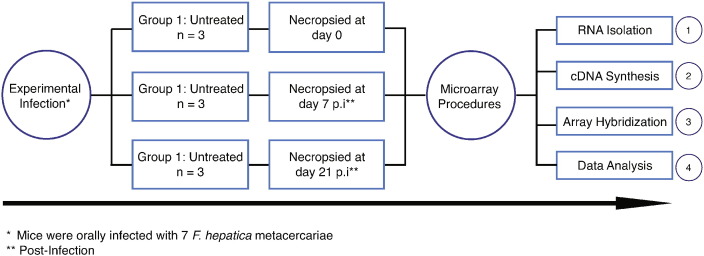
Fasciolosis is listed as one of the most important neglected tropical diseases according with the World Health Organization and is also considered as a reemerging disease in the human beings. Despite there are several studies describing the immune response induced by Fasciola hepatica in the mammalian host, investigations aimed at identifying the expression profile of genes involved in inducing hepatic injury are currently scarce. Data presented here belong to a time-course investigation of the gene expression profile in the liver of BALB/c mice infected with F. hepatica metacercariae at 7 and 21 days after experimental infection. The data published here have been deposited in NCBI's Gene Expression Omnibus and are accessible through GEO Series accession number GSE69588, previously published by Rojas-Caraballo et al. (2015) in PLoS One [1].
根据世界卫生组织的定义,片形吸虫病被列为最重要的被忽视热带病之一,并且也被认为是一种在人类中重新出现的疾病。尽管有多项研究描述了肝片吸虫在哺乳动物宿主中诱导的免疫反应,但目前旨在鉴定参与诱导肝损伤的基因表达谱的研究仍然很少。此处呈现的数据属于对感染肝片吸虫囊蚴的BALB/c小鼠肝脏在实验感染后7天和21天的基因表达谱进行的时间进程研究。此处发表的数据已存入NCBI的基因表达综合数据库,可通过GEO系列登录号GSE69588获取,该登录号先前由Rojas-Caraballo等人于2015年发表在《公共科学图书馆·综合》[1]上。