Kashyap Mahendra, Yoshimura Naoki, Smith Phillip P, Chancellor Michael, Tyagi Pradeep
Department of Urology, University of Pittsburgh, Pittsburgh, PA, USA.
Department of Surgery, University of Connecticut Health Center, Farmington, CT, USA.
Bladder (San Franc). 2015;2(2). doi: 10.14440/bladder.2015.44. Epub 2015 Jul 17.
The second messenger cAMP is involved in both β3 adrenoceptor (β3-AR) mediated detrusor relaxation and the kinetics of Hyperpolarization-activated cyclic nucleotide-gated (HCN) channels. Here we characterized the effect HCN channel activation and possible interaction with β3-AR in bladder.
Bladder tissues from Sprague-Dawley rats and Human organ donors were obtained for studying species-specific expression of HCN channels by real-time qPCR and Western Blot. Effect of β3-agonist on rat bladder strips (0.5 × 0.5 × 7 mm in size) was studied during activation and blockade of HCN channels by Lamotrigine and ZD7288, respectively.
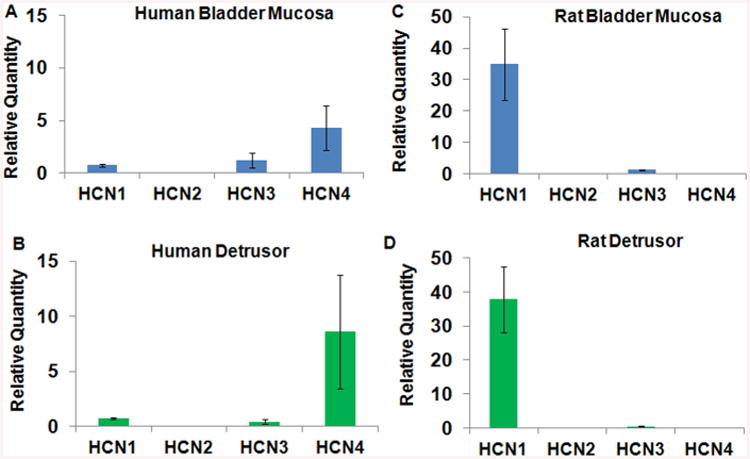
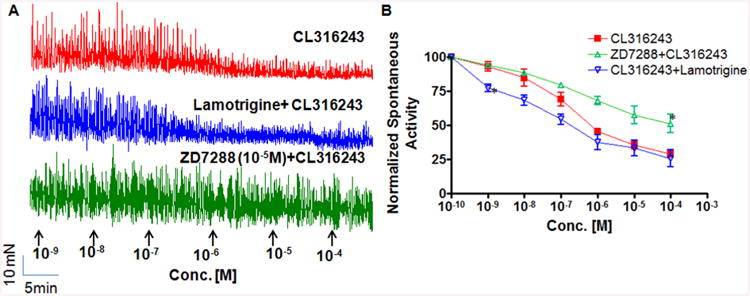
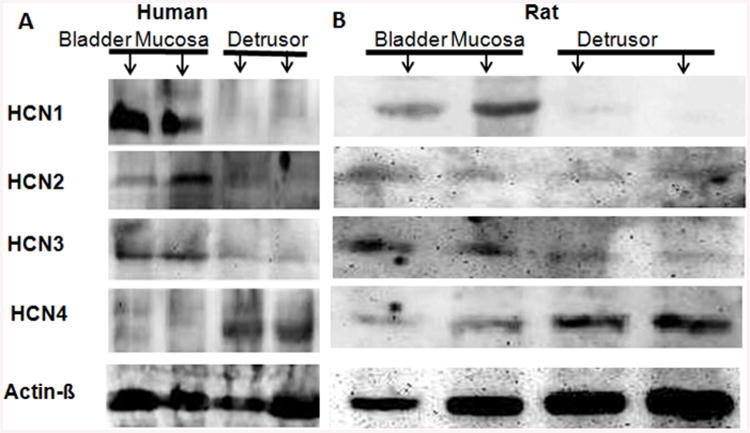
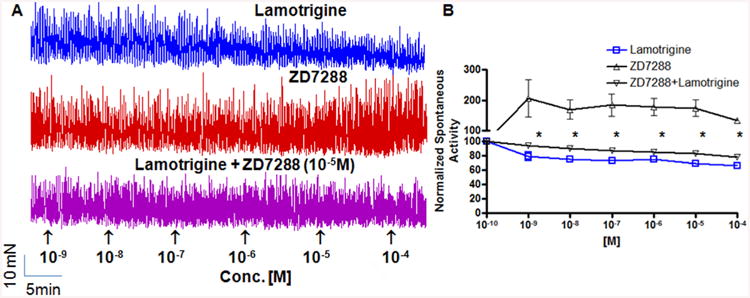
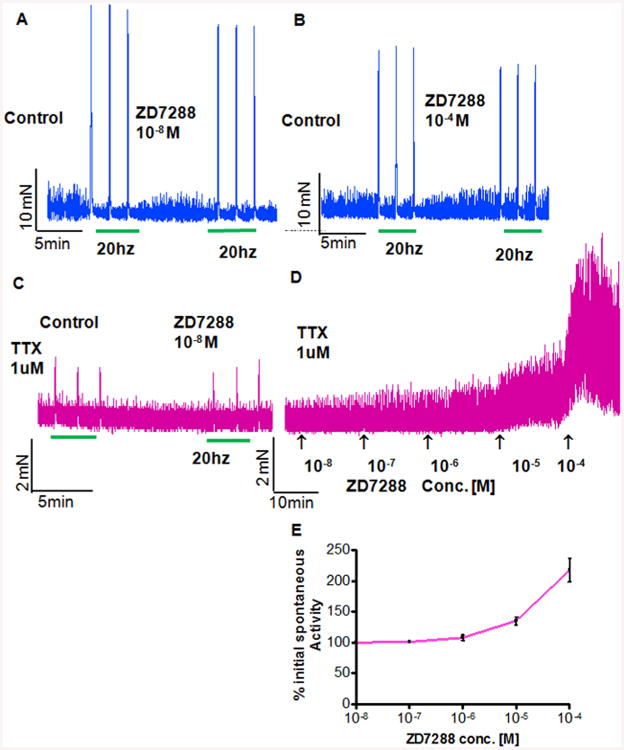
Expression of all four genes encoding for HCN channels (HCN1-4) was detected separately in bladder mucosa and detrusor from human and rat bladders. Species based differences were evident from relatively higher expression of HCN4 isoform in human bladder and that of HCN1 in rat bladder. Western blot confirmed the findings at mRNA level. Cumulative application β3-AR agonist CL316,243 produced a concentration dependent decrease in resting tension of rat bladder strips expressed as integral of mechanical activity. Pre-incubation of HCN channel blocker ZD 7288 opposed the relaxant effect of CL316,243, whereas co-administration of lamotrigine with CL316,243 at equal molar concentrations caused an additive decrease in resting tension. Cumulative addition of ZD7288 and lamotrigine in absence of CL316,243 showed opposing effects on detrusor contractility.
Species-specific differences were noted in expression of HCN channels in bladder. Opposing effects ZD7288 and Lamotrigine in the action of β3-AR agonist demonstrate possible functional interaction of HCN channels and β3-AR in detrusor contractility.
第二信使环磷酸腺苷(cAMP)参与β3肾上腺素能受体(β3-AR)介导的逼尿肌舒张以及超极化激活的环核苷酸门控(HCN)通道的动力学过程。在此,我们对HCN通道激活的作用及其与膀胱中β3-AR可能的相互作用进行了表征。
获取来自Sprague-Dawley大鼠和人类器官供体的膀胱组织,通过实时定量聚合酶链反应(qPCR)和蛋白质免疫印迹法(Western Blot)研究HCN通道的物种特异性表达。分别在使用拉莫三嗪和ZD7288激活和阻断HCN通道期间,研究β3激动剂对大鼠膀胱条带(尺寸为0.5×0.5×7毫米)的作用。
在人和大鼠膀胱的膀胱黏膜和逼尿肌中分别检测到编码HCN通道的所有四个基因(HCN1-4)的表达。基于物种的差异很明显,HCN4亚型在人膀胱中的表达相对较高,而HCN1在大鼠膀胱中的表达相对较高。蛋白质免疫印迹法在mRNA水平证实了这些发现。累积应用β3-AR激动剂CL316,243使大鼠膀胱条带的静息张力呈浓度依赖性降低,以机械活动积分表示。预先孵育HCN通道阻滞剂ZD 7288可对抗CL316,243的舒张作用,而将拉莫三嗪与CL316,243以等摩尔浓度共同给药会导致静息张力进一步降低。在不存在CL316,243的情况下,累积添加ZD7288和拉莫三嗪对逼尿肌收缩性显示出相反的作用。
在膀胱中HCN通道的表达存在物种特异性差异。ZD7288和拉莫三嗪在β3-AR激动剂作用中的相反作用表明HCN通道与β3-AR在逼尿肌收缩性方面可能存在功能相互作用。