Naveen Vandanapu, Vengamma Bhuma, Mohan Alladi, Vanajakshamma Velam
Department of Neurology, Sri Venkateswara Institute of Medical Sciences, Tirupati, Andhra Pradesh, India.
Department of Medicine, Sri Venkateswara Institute of Medical Sciences, Tirupati, Andhra Pradesh, India.
Ann Indian Acad Neurol. 2015 Oct-Dec;18(4):435-40. doi: 10.4103/0972-2327.165478.
Sparse published data are available regarding the prognostic importance of plasma N-terminal pro-brain natriuretic peptide (NT-proBNP) in patients with acute ischemic stroke.
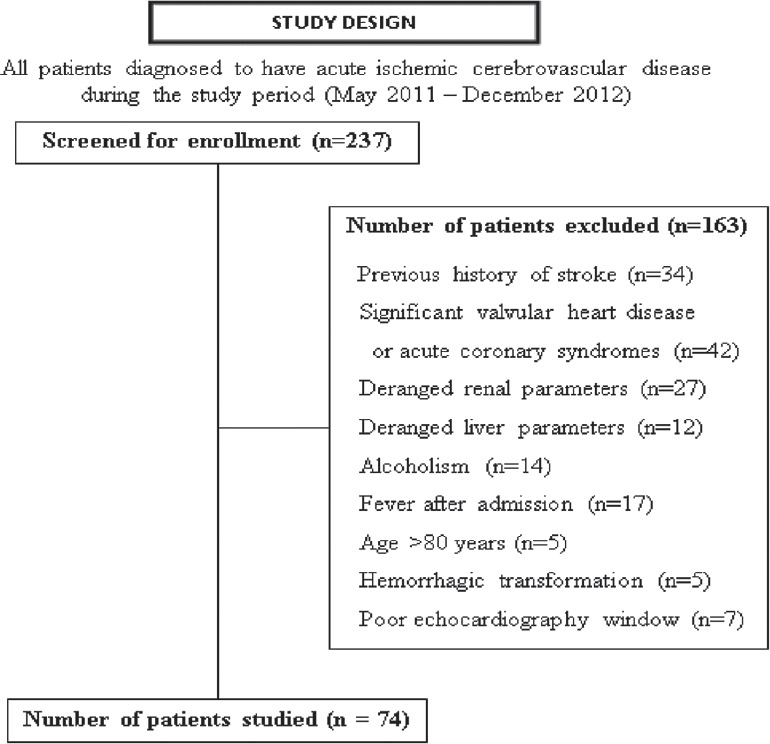
We prospectively studied 74 consecutive patients presenting with acute ischemic stroke within 24 hours of onset. All of them underwent laboratory and imaging evaluation and were treated as per guidelines. In all subjects, plasma NT-proBNP levels were measured at initial admission and again on day 7.
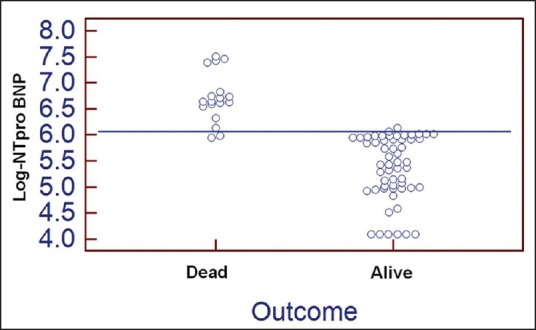
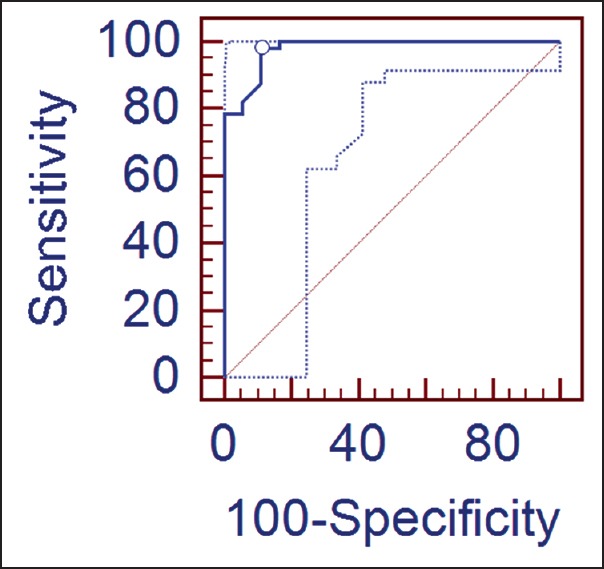
Their mean age was 54 ± 13.5years; there were 49 males; 18 (24%) patients died during the hospital stay. A statistically significant negative correlation between log NT-proBNP and Glasgow coma scale (GCS) score (P < 0.001); and a significant positive correlation between log NT-proBNP and National Institutes of Health Stroke Scale (NIHSS) score (P < 0.001) were observed. Baseline log NT-proBNP levels were higher among non-survivors compared with survivors (6.7 ± 0.47 vs. 5.37 ± 0.62; P = 0.06); day 7 log NT-proBNP levels were significantly higher in non-survivors compared with survivors (7.3 ± 0.26 vs. 4.5 ± 0.4; P = 0.000). In survivors, there was a statistically significant decline in log NT-proBNP levels from baseline to day 7 (5.3710 ± 0.620 vs. 4.5320 ± 0.451; P < 0.001). In contrast, among non-survivors, log NT-proBNP levels showed a statistically significant increase from baseline to day 7 (4.5322 ± 0.451 vs. 7.2992 ± 0.263; P < 0.001). On receiver operator characteristic curve (ROC) analysis, at a cut-off value of ≥ 6.0661, log NT-proBNP had a sensitivity and specificity of 98.2 and 88.9, respectively, in predicting death.
Plasma log NT-pro-BNP level appears to be a useful biological marker for predicting in-hospital mortality inpatients presenting with acute ischemic stroke.
关于血浆N端前脑钠肽(NT-proBNP)在急性缺血性脑卒中患者预后中的重要性,现有数据较少。
我们前瞻性地研究了74例在发病24小时内出现急性缺血性脑卒中的连续患者。所有患者均接受了实验室和影像学评估,并按照指南进行治疗。在所有受试者中,入院时和第7天均测量了血浆NT-proBNP水平。
他们的平均年龄为54±13.5岁;男性49例;18例(24%)患者在住院期间死亡。观察到log NT-proBNP与格拉斯哥昏迷量表(GCS)评分之间存在统计学显著负相关(P<0.001);log NT-proBNP与美国国立卫生研究院卒中量表(NIHSS)评分之间存在显著正相关(P<0.001)。与幸存者相比,非幸存者的基线log NT-proBNP水平更高(6.7±0.47对5.37±0.62;P=0.06);与幸存者相比,非幸存者第7天的log NT-proBNP水平显著更高(7.3±0.26对4.5±0.4;P=0.000)。在幸存者中,从基线到第7天,log NT-proBNP水平有统计学显著下降(5.3710±0.620对4.5320±0.451;P<0.001)。相比之下,在非幸存者中,log NT-proBNP水平从基线到第7天有统计学显著升高(4.5322±0.451对7.2992±0.263;P<0.001)。在受试者工作特征曲线(ROC)分析中,在临界值≥6.0661时,log NT-proBNP预测死亡的敏感性和特异性分别为98.2和88.9。
血浆log NT-pro-BNP水平似乎是预测急性缺血性脑卒中患者院内死亡率的有用生物学标志物。