
一种基于剂量体积直方图的放疗治疗计划剂量学比较决策支持系统。
A dose-volume histogram based decision-support system for dosimetric comparison of radiotherapy treatment plans.
作者信息
Alfonso J C L, Herrero M A, Núñez L
机构信息
Center for Information Services and High Performance Computing (ZIH), Technische Universität Dresden, Nöthnitzer Str. 46, Dresden, 01062, Germany.
Department of Applied Mathematics, Faculty of Mathematical Sciences, Universidad Complutense de Madrid (UCM), Ciudad Universitaria, Plaza Ciencias 3, Madrid, 28040, Spain.
出版信息
Radiat Oncol. 2015 Dec 29;10:263. doi: 10.1186/s13014-015-0569-3.
BACKGROUND
The choice of any radiotherapy treatment plan is usually made after the evaluation of a few preliminary isodose distributions obtained from different beam configurations. Despite considerable advances in planning techniques, such final decision remains a challenging task that would greatly benefit from efficient and reliable assessment tools.
METHODS
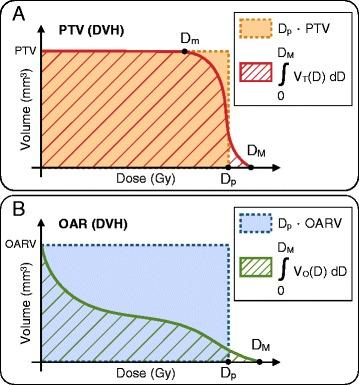
For any dosimetric plan considered, data on dose-volume histograms supplied by treatment planning systems are used to provide estimates on planning target coverage as well as on sparing of organs at risk and the remaining healthy tissue. These partial metrics are then combined into a dose distribution index (DDI), which provides a unified, easy-to-read score for each competing radiotherapy plan. To assess the performance of the proposed scoring system, DDI figures for fifty brain cancer patients were retrospectively evaluated. Patients were divided in three groups depending on tumor location and malignancy. For each patient, three tentative plans were designed and recorded during planning, one of which was eventually selected for treatment. We thus were able to compare the plans with better DDI scores and those actually delivered.
RESULTS
When planning target coverage and organs at risk sparing are considered as equally important, the tentative plan with the highest DDI score is shown to coincide with that actually delivered in 32 of the 50 patients considered. In 15 (respectively 3) of the remaining 18 cases, the plan with highest DDI value still coincides with that actually selected, provided that organs at risk sparing is given higher priority (respectively, lower priority) than target coverage.
CONCLUSIONS
DDI provides a straightforward and non-subjective tool for dosimetric comparison of tentative radiotherapy plans. In particular, DDI readily quantifies differences among competing plans with similar-looking dose-volume histograms and can be easily implemented for any tumor type and localization, irrespective of the planning system and irradiation technique considered. Moreover, DDI permits to estimate the dosimetry impact of different priorities being assigned to sparing of organs at risk or to better target coverage.
背景
任何放射治疗计划的选择通常都是在评估了从不同射束配置获得的一些初步等剂量分布之后做出的。尽管在计划技术方面取得了相当大的进展,但这样的最终决策仍然是一项具有挑战性的任务,而高效可靠的评估工具将使其受益匪浅。
方法
对于任何考虑的剂量计划,利用治疗计划系统提供的剂量体积直方图数据来估计计划靶区的覆盖情况以及危及器官和其余健康组织的受照剂量。然后将这些部分指标合并为一个剂量分布指数(DDI),该指数为每个竞争性放射治疗计划提供一个统一、易于读取的分数。为了评估所提出评分系统的性能,对50例脑癌患者的DDI数据进行了回顾性评估。根据肿瘤位置和恶性程度将患者分为三组。对于每位患者,在计划过程中设计并记录了三个暂定计划,其中一个最终被选定用于治疗。因此,我们能够比较具有更好DDI分数的计划和实际实施的计划。
结果
当将计划靶区覆盖和危及器官的保护视为同等重要时,在所考虑的50例患者中,有32例最高DDI分数的暂定计划与实际实施的计划一致。在其余18例中的15例(分别为3例)中,如果将危及器官的保护给予比靶区覆盖更高(分别为更低)的优先级,具有最高DDI值的计划仍然与实际选定的计划一致。
结论
DDI为暂定放射治疗计划的剂量学比较提供了一种直接且非主观的工具。特别是,DDI能够轻松量化具有相似剂量体积直方图的竞争性计划之间的差异,并且可以针对任何肿瘤类型和位置轻松实施,而无需考虑所使用的计划系统和照射技术。此外,DDI允许估计将不同优先级分配给危及器官的保护或更好的靶区覆盖时对剂量学的影响。



 Zotero 插件