Li Jing-yi, Liao Ren
Department of Dermatovenereology, West China Hospital of Sichuan University, 37 Guoxue Lane, Chengdu, 610041, Sichuan Province, People's Republic of China.
Department of Anesthesiology, West China Hospital of Sichuan University, 37 Guoxue Lane, Chengdu, 610041, Sichuan Province, People's Republic of China.
Trials. 2015 Dec 30;16:596. doi: 10.1186/s13063-015-1130-2.
Catheter-related bladder discomfort (CRBD) is common in male patients under general anesthesia, and it may cause patient agitation and exacerbated postoperative pain. In this study, we will enroll male patients undergoing elective surgery with urinary catheterization after anesthetic induction and compare the efficacy of a dorsal penile nerve block (DPNB) and intravenous tramadol for the prevention of CRBD.
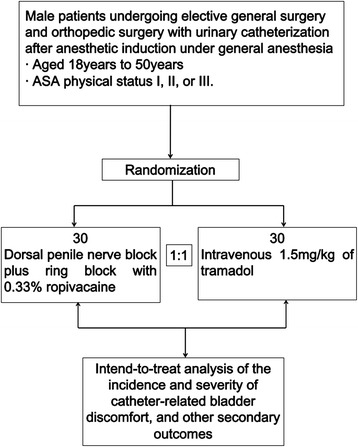
METHODS/DESIGN: This trial is a prospective, open-label, randomized controlled trial that will test the superiority of a dorsal penile nerve block with 0.33% ropivacaine to the use of intravenous tramadol 1.5 mg/kg for CRBD prevention. A total of 60 male patients undergoing elective surgery with urinary catheterization after anesthetic induction will be randomized to receive either DPNB with 0.33% ropivacaine (DPNB group) or intravenous tramadol 1.5 mg/kg (TRAM group) after the completion of surgery but before extubation. The primary outcome is the incidence and severity of CRBD. Secondary outcomes include Visual Analog Score (VAS) for postoperative pain, number of patients requiring sulfentanil after operation, acceptance of an indwelling urinary catheter after extraction of the catheter, and postoperative side effects, which include postoperative nausea/vomiting (PONV), vertigo, sedation, drowsiness, and dry mouth.
For CRBD prevention, this trial is planned to test the superiority of a dorsal penile nerve block with 0.33% ropivacaine to the use of intravenous tramadol 1.5 mg/kg. The results will provide new insight into the mechanism of CRBD and new clinical practice for the prevention of CRBD.
The registration number is NCT01721031, which was assigned by the National Institutes of Health Clinical Trials Registry (ClinicalTrials.gov) on 27 October 27.
导尿管相关膀胱不适(CRBD)在全身麻醉的男性患者中很常见,可能导致患者躁动并加重术后疼痛。在本研究中,我们将纳入麻醉诱导后接受择期手术并留置导尿管的男性患者,比较阴茎背神经阻滞(DPNB)和静脉注射曲马多预防CRBD的效果。
方法/设计:本试验是一项前瞻性、开放标签、随机对照试验,将测试0.33%罗哌卡因阴茎背神经阻滞相对于静脉注射1.5mg/kg曲马多预防CRBD的优越性。共有60例麻醉诱导后接受择期手术并留置导尿管的男性患者,将在手术结束后但拔管前随机分为接受0.33%罗哌卡因阴茎背神经阻滞(DPNB组)或静脉注射1.5mg/kg曲马多(TRAM组)。主要结局是CRBD的发生率和严重程度。次要结局包括术后疼痛视觉模拟评分(VAS)、术后需要舒芬太尼的患者数量、拔管后对留置导尿管的接受情况以及术后副作用,包括术后恶心/呕吐(PONV)、眩晕、镇静、嗜睡和口干。
对于CRBD的预防,本试验计划测试0.33%罗哌卡因阴茎背神经阻滞相对于静脉注射1.5mg/kg曲马多的优越性。结果将为CRBD的机制提供新的见解,并为CRBD的预防提供新的临床实践方法。
注册号为NCT01721031,由美国国立卫生研究院临床试验注册中心(ClinicalTrials.gov)于10月27日分配。