The MARCS Institute for Brain, Behaviour and Development , Western Sydney University , Penrith, New South Wales 2751, Australia.
The MARCS Institute for Brain, Behaviour and Development , Western Sydney University , Penrith, New South Wales 2751, Australia ; School of Social Sciences and Psychology , Western Sydney University , Penrith, New South Wales 2751, Australia.
R Soc Open Sci. 2015 Nov 18;2(11):150286. doi: 10.1098/rsos.150286. eCollection 2015 Nov.
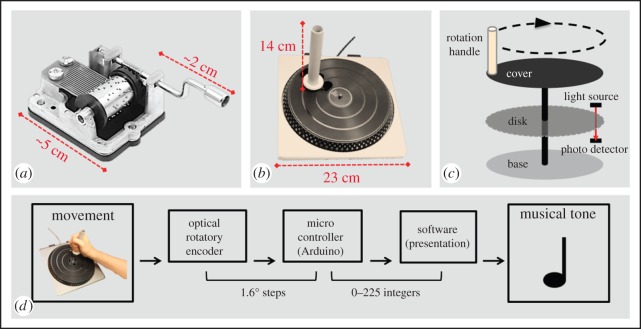
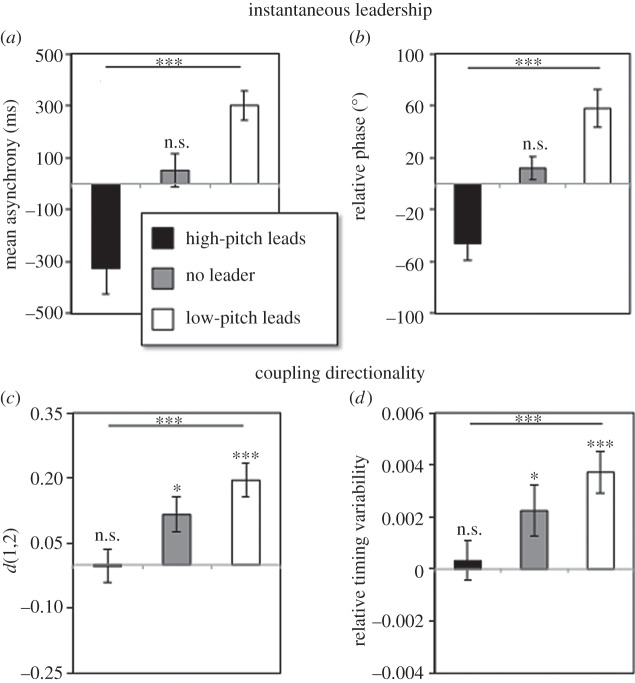
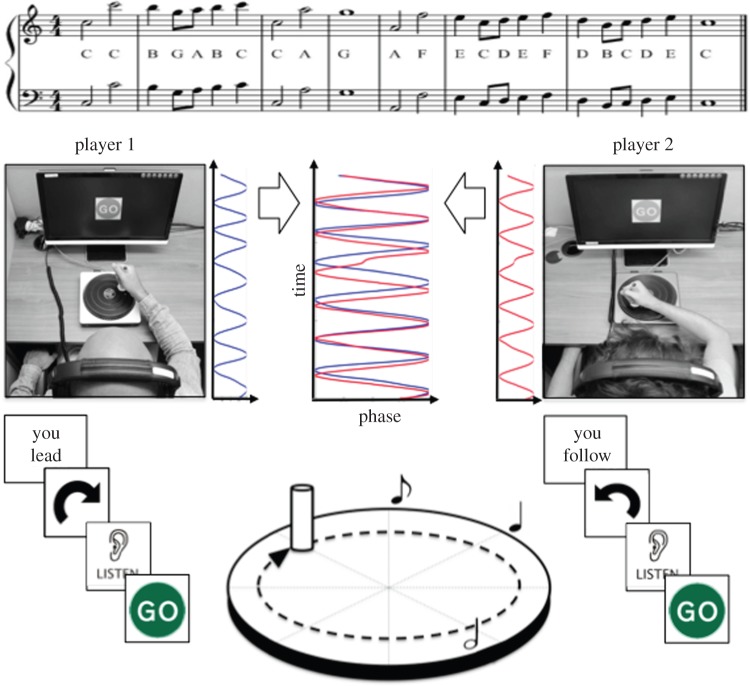
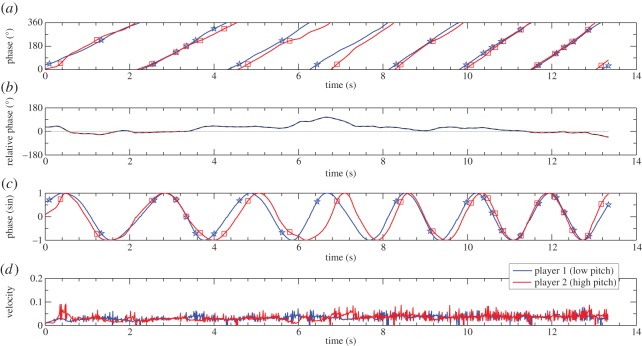
Humans are assumed to have a natural-universal-predisposition for making music and for musical interaction. Research in this domain is, however, typically conducted with musically trained individuals, and therefore confounded with expertise. Here, we present a rediscovered and updated invention-the E-music box-that we establish as an empirical method to investigate musical production and interaction in everyone. The E-music box transforms rotatory cyclical movements into pre-programmable digital musical output, with tempo varying according to rotation speed. The user's movements are coded as continuous oscillatory data, which can be analysed using linear or nonlinear analytical tools. We conducted a proof-of-principle experiment to demonstrate that, using this method, pairs of non-musically trained individuals can interact according to conventional musical practices (leader/follower roles and lower-pitch dominance). The results suggest that the E-music box brings 'active' and 'interactive' musical capacities within everyone's reach. We discuss the potential of this method for exploring the universal predisposition for music making and interaction in developmental and cross-cultural contexts, and for neurologic musical therapy and rehabilitation.
人类被认为具有天生的、普遍的音乐创作和音乐互动倾向。然而,该领域的研究通常是在受过音乐训练的个体中进行的,因此与专业知识有关。在这里,我们提出了一种重新发现和更新的发明——电子音乐盒,我们将其确立为一种实证方法,以研究每个人的音乐创作和互动。电子音乐盒将旋转循环运动转化为可预编程的数字音乐输出,其节奏根据旋转速度而变化。用户的动作被编码为连续的振荡数据,可以使用线性或非线性分析工具进行分析。我们进行了一项原理验证实验,以证明使用这种方法,非音乐训练的两个人可以根据传统的音乐实践(领导者/追随者角色和较低音域的主导地位)进行互动。结果表明,电子音乐盒使每个人都能发挥“主动”和“互动”的音乐能力。我们讨论了这种方法在发展和跨文化背景下探索音乐创作和互动的普遍倾向、神经音乐治疗和康复方面的潜力。