Geiger Jessica L, Grandis Jennifer R, Bauman Julie E
Department of Internal Medicine, Division of Hematology/Oncology, University of Pittsburgh Cancer Institute, Pittsburgh, PA, United States.
Department of Otolaryngology, University of California San Francisco, San Francisco, CA, United States.
Oral Oncol. 2016 May;56:84-92. doi: 10.1016/j.oraloncology.2015.11.022. Epub 2015 Dec 28.
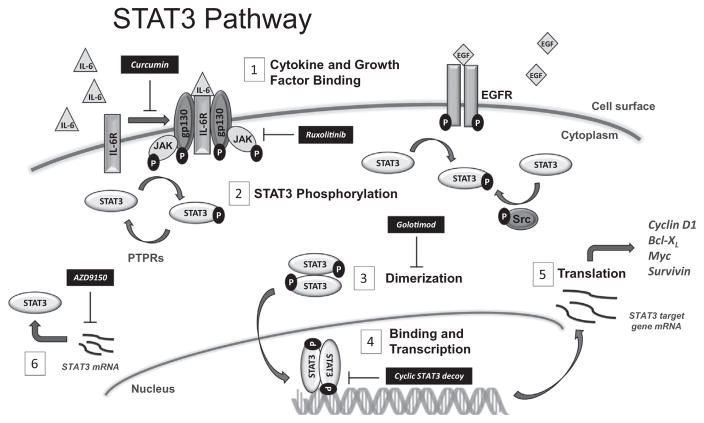
Proteins of the signal transducer and activator of transcription (STAT) family mediate cellular responses to cytokines and growth factors. Aberrant regulation of the STAT3 oncogene contributes to tumor formation and progression in many cancers, including head and neck squamous cell carcinoma (HNSCC), where hyperactivation of STAT3 is implicated in both treatment resistance and immune escape. There are no oncogenic gain-of-function mutations in HNSCC. Rather, aberrant STAT3 signaling is primarily driven by upstream growth factor receptors, such as Janus kinase (JAK) and epidermal growth factor receptor (EGFR). Moreover, genomic silencing of select protein tyrosine phosphatase receptors (PTPRs), tumor suppressors that dephosphorylate STAT3, may lead to prolonged phosphorylation and activation of STAT3. This review will summarize current knowledge of the STAT3 pathway and its contribution to HNSCC growth, survival, and resistance to standard therapies, and discuss STAT3-targeting agents in various phases of clinical development.
信号转导与转录激活因子(STAT)家族的蛋白质介导细胞对细胞因子和生长因子的反应。STAT3癌基因的异常调控在包括头颈部鳞状细胞癌(HNSCC)在内的许多癌症中促进肿瘤形成和进展,其中STAT3的过度激活与治疗耐药性和免疫逃逸均有关联。HNSCC中不存在致癌性功能获得性突变。相反,异常的STAT3信号传导主要由上游生长因子受体驱动,如Janus激酶(JAK)和表皮生长因子受体(EGFR)。此外,选择性蛋白酪氨酸磷酸酶受体(PTPR)的基因组沉默,即使STAT3去磷酸化的肿瘤抑制因子,可能导致STAT3的磷酸化和激活延长。本综述将总结目前关于STAT3通路的知识及其对HNSCC生长、存活和对标准疗法耐药性的影响,并讨论处于临床开发不同阶段的STAT3靶向药物。