Rose Sean C, Fischer Anastasia N, Heyer Geoffrey L
Division of Pediatric Neurology, Nationwide Children's Hospital, and Department of Neurology, The Ohio State University, Columbus, Ohio.
Division of Sports Medicine, Nationwide Children's Hospital, and Department of Pediatrics, The Ohio State University, Columbus, Ohio.
Sports Health. 2016 Jan-Feb;8(1):37-42. doi: 10.1177/1941738115591948. Epub 2015 Jun 26.
Concussion guidelines recommend physical and cognitive rest until all postconcussion symptoms resolve, in part because of potential health risks, including catastrophic injury related to a second impact. However, when postconcussion symptoms persist for weeks or months, these risks are poorly characterized.
Physicians' perceived health risks and management strategies for patients with persistent postconcussion symptoms will vary.
Cross-sectional study.
Level 3.
A survey of the physician members of the American College of Sports Medicine assessed the perceived health risks related to advancing activity, the indications for neuroimaging, and the referral patterns for patients with persistent postconcussion symptoms.
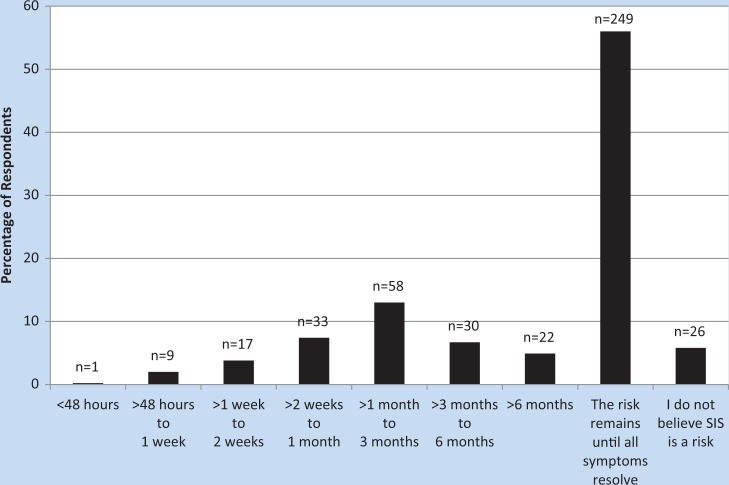
A total of 572 physicians completed the survey (response rate, 27.2%). The majority of physicians recommended physical rest (97.4%) and cognitive rest (93.8%) within the first week of injury. Perceived health risks related to advancing activity in the symptomatic patient differed at 2 weeks versus 3 months after injury (P < 0.001 for all comparisons). Respondents from the United States were more likely to list second impact syndrome as a potential health risk at 2 weeks compared with respondents from other countries (P = 0.04). The majority (56%) responded that the risk of second impact syndrome remains until all symptoms resolve. When postconcussion symptoms persist beyond 1 month, 61.9% of physicians responded that neuroimaging is indicated. Approximately 60% of respondents had access to a multidisciplinary concussion clinic within 60 miles of their practice.
When postconcussion symptoms persist, the perceived health risks, management practices, and access to multidisciplinary care vary among physicians.
脑震荡指南建议进行身体和认知休息,直至所有脑震荡后症状消失,部分原因是存在潜在健康风险,包括与二次撞击相关的灾难性损伤。然而,当脑震荡后症状持续数周或数月时,这些风险的特征尚不明确。
医生对有持续脑震荡后症状患者的感知健康风险和管理策略会有所不同。
横断面研究。
3级。
对美国运动医学学院的医生会员进行一项调查,评估与增加活动相关的感知健康风险、神经影像学检查的指征以及有持续脑震荡后症状患者的转诊模式。
共有572名医生完成了调查(回复率为27.2%)。大多数医生建议在受伤后的第一周内进行身体休息(97.4%)和认知休息(93.8%)。受伤后2周与3个月时,有症状患者增加活动所感知到的健康风险有所不同(所有比较的P<0.001)。与其他国家的受访者相比,美国的受访者在受伤2周时更有可能将二次撞击综合征列为潜在健康风险(P = 0.04)。大多数(56%)受访者表示,二次撞击综合征的风险在所有症状消失之前一直存在。当脑震荡后症状持续超过1个月时,61.9%的医生表示需要进行神经影像学检查。约60%的受访者在其诊所60英里范围内可使用多学科脑震荡诊所。
当脑震荡后症状持续时,医生对健康风险的感知、管理方法以及获得多学科护理的情况各不相同。