Driessen Alexandria K, Farrell Michael J, Mazzone Stuart B, McGovern Alice E
School of Biomedical Sciences, The University of Queensland St Lucia, QLD, Australia.
Monash Biomedicine Discovery Institute and Department of Medical Imaging and Radiation Sciences, Monash University Clayton, VIC Australia.
Front Physiol. 2015 Dec 21;6:378. doi: 10.3389/fphys.2015.00378. eCollection 2015.
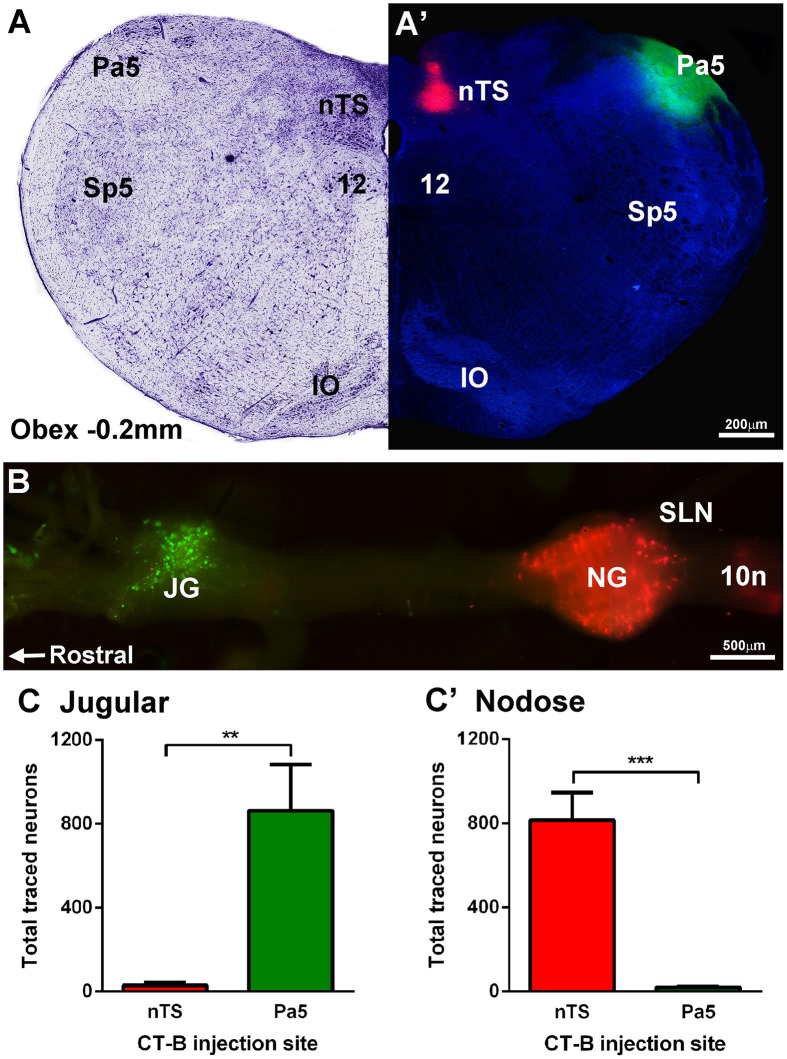
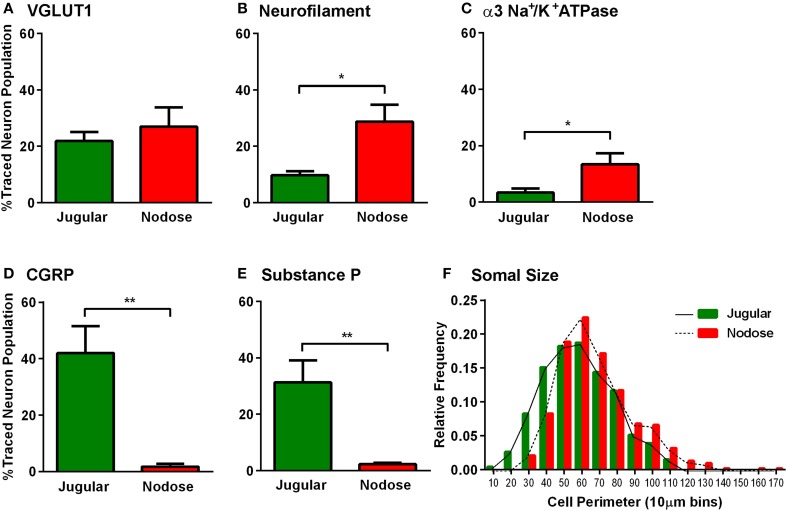
The respiratory tree receives sensory innervation from the jugular and nodose vagal sensory ganglia. Neurons of these ganglia are derived from embryologically distinct origins and as such demonstrate differing molecular, neurochemical and physiological phenotypes. Furthermore, whereas nodose afferent neurons project to the nucleus of the solitary tract (nTS), recent neuroanatomical studies in rats suggest that jugular neurons have their central terminations in the paratrigeminal nucleus (Pa5). In the present study we confirm that guinea pigs demonstrate a comparable distinction between the brainstem terminations of nodose and jugular ganglia afferents. Thus, microinjection of fluorescently conjugated cholera toxin B (CT-B) neural tracers into the caudal nTS and Pa5 resulted in highly specific retrograde labeling of neurons in the nodose and jugular ganglia, respectively. Whereas, nodose neurons more often expressed 160 KD neurofilament proteins and the alpha3 subunit of Na(+)/K(+) ATPase, significantly more jugular neurons expressed the neuropeptides substance P (SP) and, especially, Calcitonin Gene-Related Peptide (CGRP). Indeed, terminal fibers in the Pa5 compared to the nTS were characterized by their significantly greater expression of CGRP, further supporting the notion that jugular afferents project to trigeminal-related brainstem regions. Electrical stimulation of the guinea pig larynx following selective surgical denervation of the nodose afferent innervation to the larynx (leaving intact the jugular innervation) resulted in stimulus dependent respiratory slowing and eventual apnea. This jugular ganglia neuron mediated response was unaffected by bilateral microinjections of the GABAA agonist muscimol into the nTS, but was abolished by muscimol injected into the Pa5. Taken together these data confirm that jugular and nodose vagal ganglia afferent neurons innervate distinct central circuits and support the notion that multiple peripheral and central pathways mediate sensory responses associated with airway irritations.
呼吸树接受来自颈静脉和结节状迷走神经感觉神经节的感觉神经支配。这些神经节的神经元起源于胚胎学上不同的来源,因此表现出不同的分子、神经化学和生理表型。此外,虽然结节传入神经元投射到孤束核(nTS),但最近对大鼠的神经解剖学研究表明,颈静脉神经元的中枢终末位于三叉旁核(Pa5)。在本研究中,我们证实豚鼠在结节状和颈静脉神经节传入纤维的脑干终末之间表现出类似的差异。因此,将荧光共轭霍乱毒素B(CT-B)神经示踪剂微量注射到尾侧nTS和Pa5中,分别导致结节状和颈静脉神经节中神经元的高度特异性逆行标记。结节状神经元更常表达160 KD神经丝蛋白和Na(+)/K(+) ATP酶的α3亚基,而颈静脉神经元明显更多地表达神经肽P物质(SP),尤其是降钙素基因相关肽(CGRP)。事实上,与nTS相比,Pa5中的终末纤维以其CGRP的显著更高表达为特征,进一步支持了颈静脉传入纤维投射到与三叉神经相关的脑干区域的观点。在选择性手术切断结节状传入神经对喉部的支配(保留颈静脉神经支配)后,对豚鼠喉部进行电刺激,导致刺激依赖性呼吸减慢并最终呼吸暂停。这种颈静脉神经节神经元介导的反应不受双侧向nTS微量注射GABAA激动剂蝇蕈醇的影响,但被注射到Pa5中的蝇蕈醇所消除。这些数据综合起来证实,颈静脉和结节状迷走神经节传入神经元支配不同的中枢回路,并支持多种外周和中枢途径介导与气道刺激相关的感觉反应的观点。