Xavier Jean, Vignaud Violaine, Ruggiero Rosa, Bodeau Nicolas, Cohen David, Chaby Laurence
Département de Psychiatrie de l'Enfant et l'Adolescent, APHP, Groupe Hospitalier Pitié-SalpêtrièreParis, France; Institut des Systèmes Intelligents et Robotique, CNRS UMR 7222, Paris DescartesParis, France.
Département de Psychiatrie de l'Enfant et l'Adolescent, APHP, Groupe Hospitalier Pitié-Salpêtrière Paris, France.
Front Psychol. 2015 Dec 24;6:1954. doi: 10.3389/fpsyg.2015.01954. eCollection 2015.
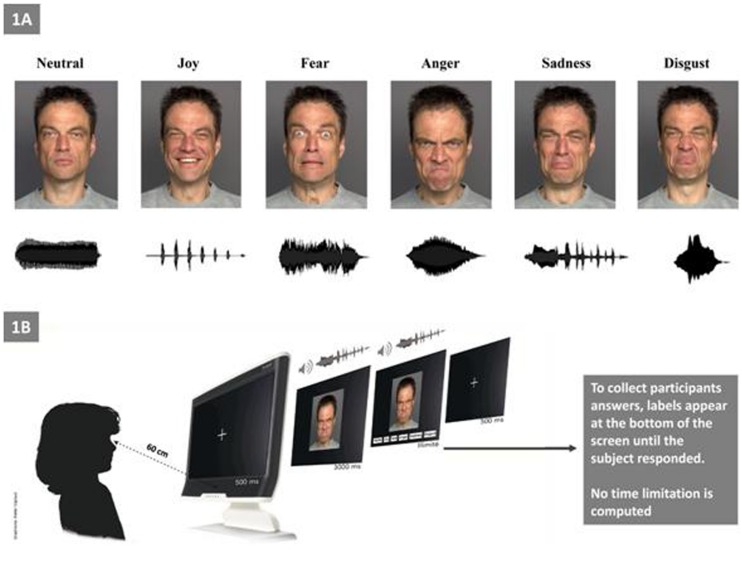
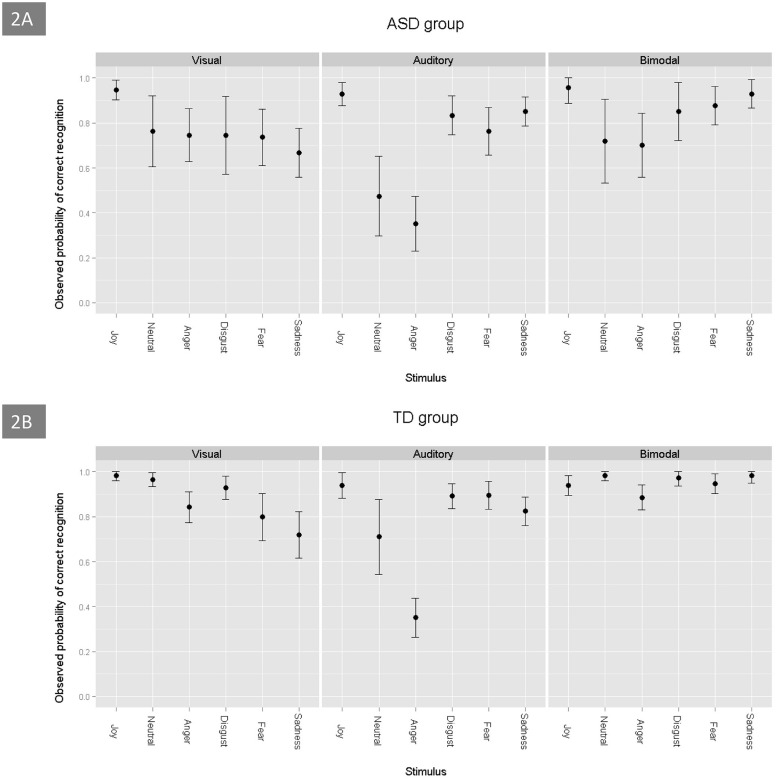
Although deficits in emotion recognition have been widely reported in autism spectrum disorder (ASD), experiments have been restricted to either facial or vocal expressions. Here, we explored multimodal emotion processing in children with ASD (N = 19) and with typical development (TD, N = 19), considering uni (faces and voices) and multimodal (faces/voices simultaneously) stimuli and developmental comorbidities (neuro-visual, language and motor impairments). Compared to TD controls, children with ASD had rather high and heterogeneous emotion recognition scores but showed also several significant differences: lower emotion recognition scores for visual stimuli, for neutral emotion, and a greater number of saccades during visual task. Multivariate analyses showed that: (1) the difficulties they experienced with visual stimuli were partially alleviated with multimodal stimuli. (2) Developmental age was significantly associated with emotion recognition in TD children, whereas it was the case only for the multimodal task in children with ASD. (3) Language impairments tended to be associated with emotion recognition scores of ASD children in the auditory modality. Conversely, in the visual or bimodal (visuo-auditory) tasks, the impact of developmental coordination disorder or neuro-visual impairments was not found. We conclude that impaired emotion processing constitutes a dimension to explore in the field of ASD, as research has the potential to define more homogeneous subgroups and tailored interventions. However, it is clear that developmental age, the nature of the stimuli, and other developmental comorbidities must also be taken into account when studying this dimension.
尽管自闭症谱系障碍(ASD)患者在情绪识别方面的缺陷已被广泛报道,但实验仅限于面部或声音表情。在此,我们探讨了ASD儿童(N = 19)和发育正常儿童(TD,N = 19)的多模态情绪处理,考虑了单模态(面部和声音)和多模态(面部/声音同时出现)刺激以及发育共病(神经视觉、语言和运动障碍)。与TD对照组相比,ASD儿童的情绪识别得分较高且参差不齐,但也存在一些显著差异:视觉刺激、中性情绪的情绪识别得分较低,以及视觉任务期间的扫视次数较多。多变量分析表明:(1)他们在视觉刺激方面遇到的困难在多模态刺激下部分得到缓解。(2)发育年龄与TD儿童的情绪识别显著相关,而在ASD儿童中仅与多模态任务相关。(3)语言障碍往往与ASD儿童在听觉模态下的情绪识别得分相关。相反,在视觉或双模态(视觉-听觉)任务中,未发现发育协调障碍或神经视觉障碍的影响。我们得出结论,情绪处理受损是ASD领域有待探索的一个维度,因为该研究有可能定义更同质的亚组并制定针对性的干预措施。然而,显然在研究这一维度时,还必须考虑发育年龄、刺激的性质以及其他发育共病。