Zhang Chun-Dong, Wang Ji-Nan, Sui Bai-Qiang, Zeng Yong-Ji, Chen Jun-Qing, Dai Dong-Qiu
From the Department of Gastrointestinal Surgery, the Fourth Affiliated Hospital of China Medical University, Shenyang (C-DZ, B-QS, Y-JZ, D-QD); Department of General Surgery, Dalian Friendship Hospital, Dalian (J-NW); Cancer Center, the Fourth Affiliated Hospital of China Medical University (D-QD); and Cancer Research Institute, China Medical University, Shenyang, PR China (D-QD, J-QC).
Medicine (Baltimore). 2016 Jan;95(1):e2190. doi: 10.1097/MD.0000000000002190.
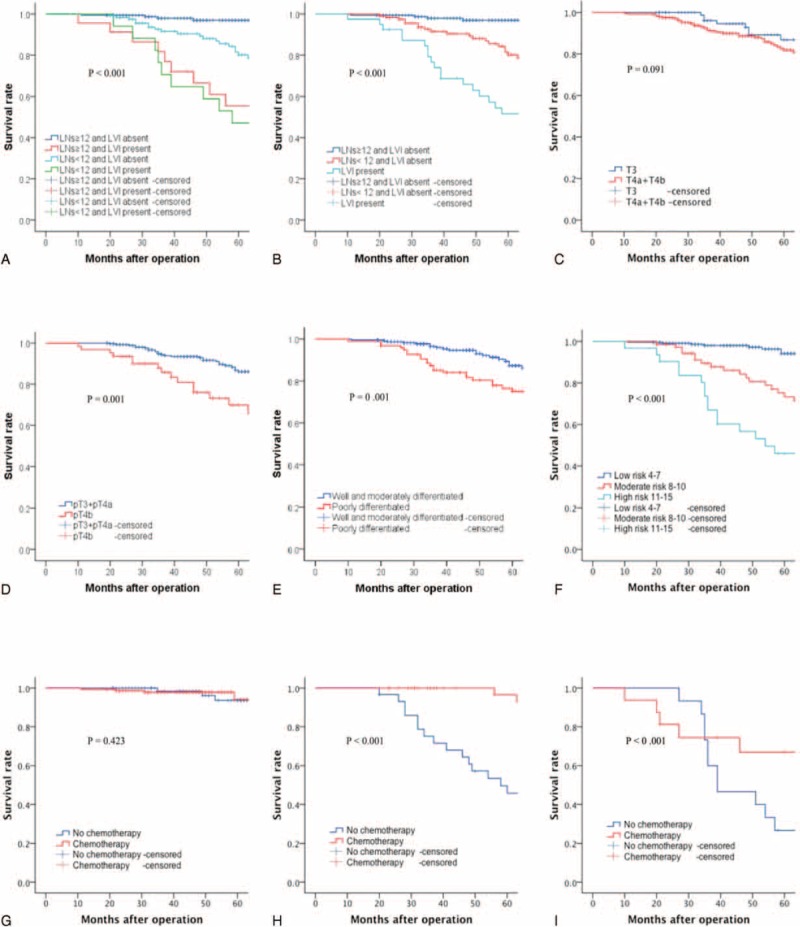
No ideal prognostic model has been applied to clearly identify which suitable high-risk stage II colon cancer patients with negative margins undergoing nonemergent surgery should receive adjuvant chemotherapy routinely. Clinicopathologic and prognostic data of 333 stage II colon cancer patients who underwent D2 or D3 lymphadenectomy during nonemergent surgery were retrospectively analyzed. Four pathologically determined factors, including adjacent organ involvement (RR 2.831, P = 0.001), histologic differentiation (RR 2.151, P = 0.009), lymphovascular invasion (RR 4.043, P < 0.001), and number of lymph nodes retrieved (RR 2.161, P = 0.011), were identified as independent prognostic factors on multivariate analysis. Importantly, a simple cumulative scoring system clearly categorizing prognostic risk groups was generated: risk score = ∑ coefficient' × status (AOI + histological differentiated + lymphovascular invasion + LNs retrieved). Our new prognostic model may provide valuable information on the impact of lymphovascular invasion, as well as powerfully and reliably predicting prognosis and recurrence for this particular cohort of patients. This model may identify suitable patients with an R0 resection who should receive routine postoperative adjuvant therapy and may help clinicians to facilitate individualized treatment. In this study, we aim to provide an ideal and quantifiable method for clinical decision making in the nonemergent surgical treatment of stage II colon cancer. Our prognostic and predictive model should be applied in multicenter, prospective studies with large sample sizes, in order to obtain a more reliable clinical recommendation.
尚未应用理想的预后模型来明确识别哪些切缘阴性、接受非急诊手术的合适高危II期结肠癌患者应常规接受辅助化疗。回顾性分析了333例在非急诊手术期间接受D2或D3淋巴结清扫的II期结肠癌患者的临床病理和预后数据。多因素分析确定了四个病理决定因素为独立预后因素,包括邻近器官受累(风险比[RR] 2.831,P = 0.001)、组织学分化(RR 2.151,P = 0.009)、淋巴管侵犯(RR 4.043,P < 0.001)和检出淋巴结数量(RR 2.161,P = 0.011)。重要的是,生成了一个简单的累积评分系统,可明确划分预后风险组:风险评分=∑系数'×状态(邻近器官受累+组织学分化+淋巴管侵犯+检出淋巴结数)。我们的新预后模型可能会提供有关淋巴管侵犯影响的有价值信息,并能有力且可靠地预测该特定患者群体的预后和复发情况。该模型可识别适合接受R0切除且应接受术后常规辅助治疗的患者,并可能有助于临床医生实施个体化治疗。在本研究中,我们旨在为II期结肠癌的非急诊手术治疗提供一种理想且可量化的临床决策方法。我们的预后和预测模型应应用于多中心、大样本量的前瞻性研究,以获得更可靠的临床建议。