Cui Qinna, Lv Huinan, Qi Zhuangzhuang, Jiang Bei, Xiao Bo, Liu Linde, Ge Yihe, Hu Xiaomei
Department of Applied and Environmental Microbiology, School of Biological Sciences, Ludong University, Yantai, China.
Department of Microbiology, College of Basic Medical Sciences, Third Military Medical University, Chongqing, China.
PLoS One. 2016 Jan 6;11(1):e0144447. doi: 10.1371/journal.pone.0144447. eCollection 2016.
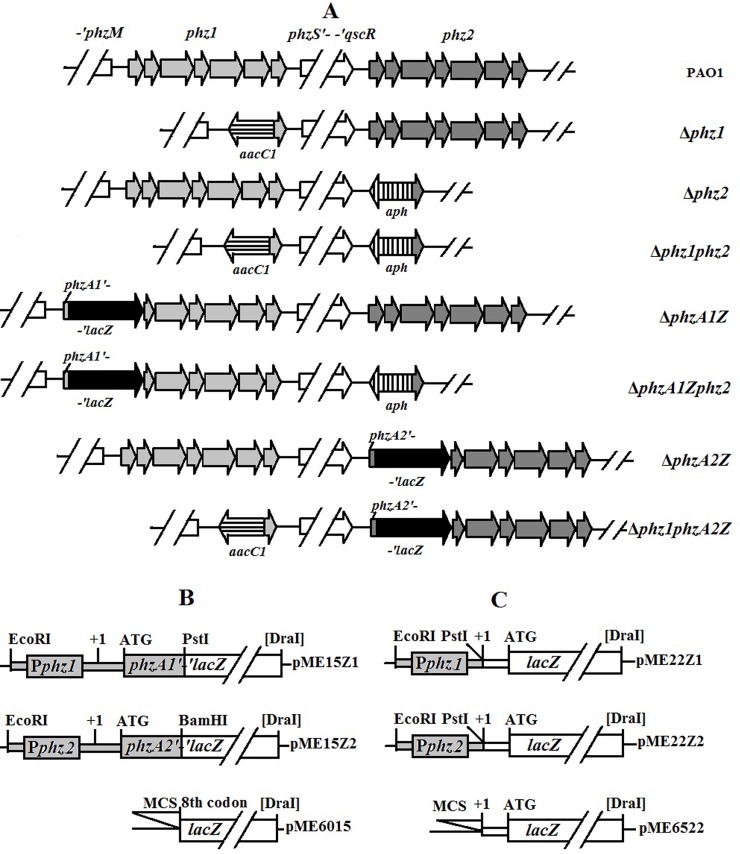
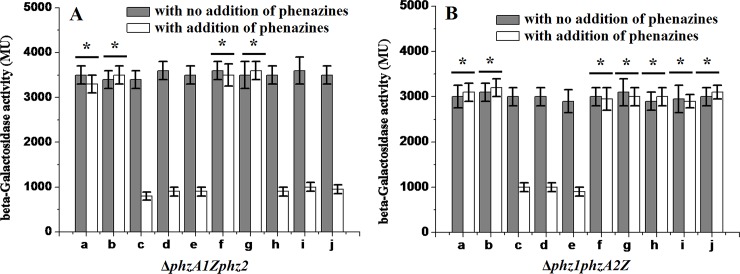
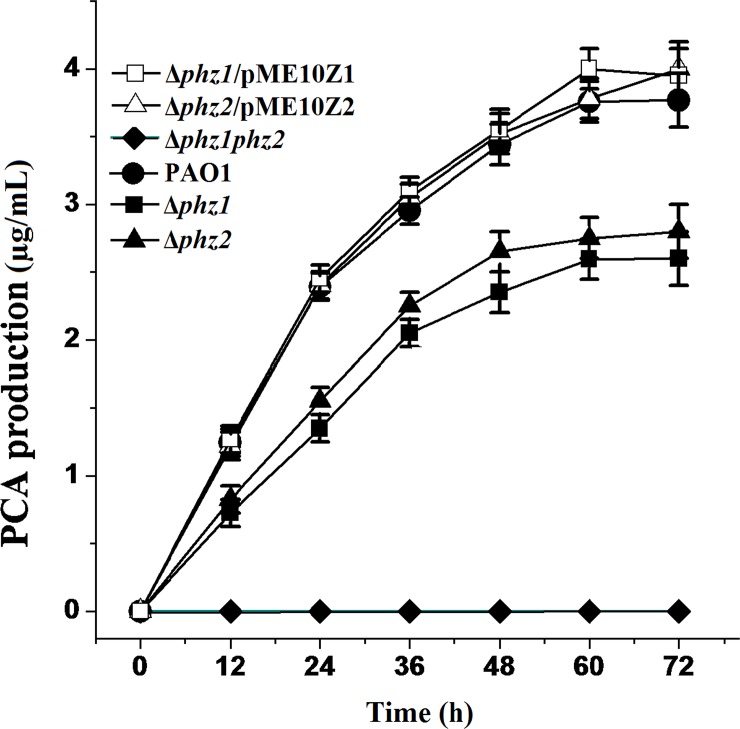
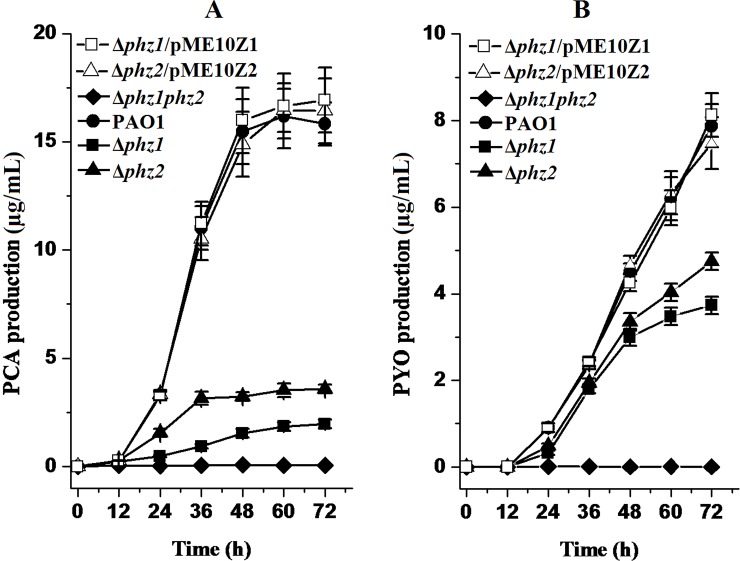
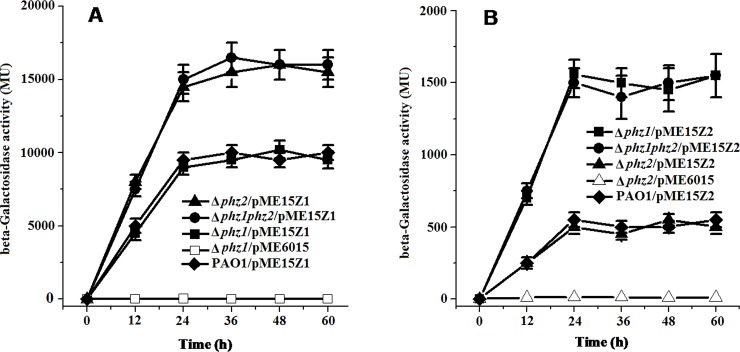
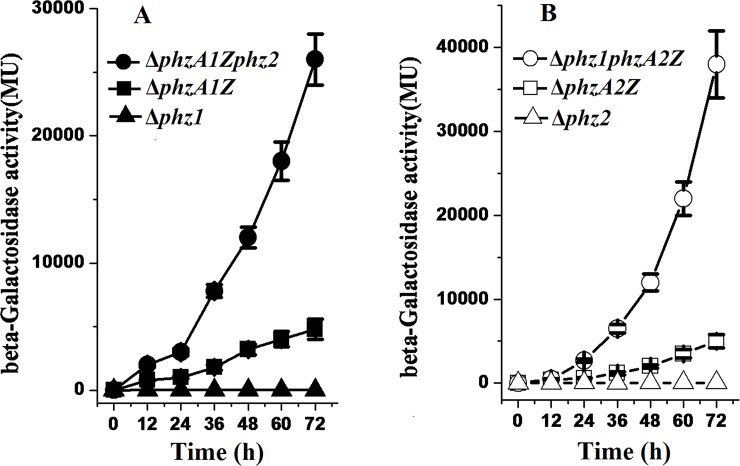
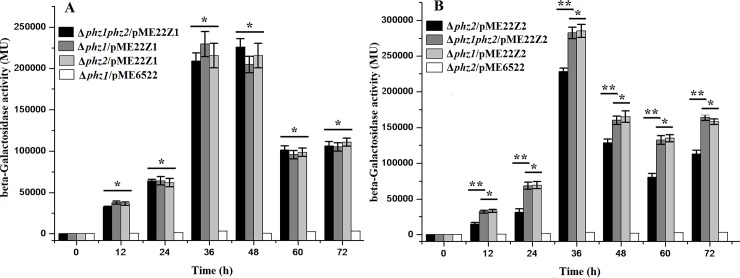
Gene duplication often provides selective advantages for the survival of microorganisms in adapting to varying environmental conditions. P. aeruginosa PAO1 possesses two seven-gene operons [phz1 (phzA1B1C1D1E1F1G1) and phz2 (phzA2B2C2D2E2F2G2)] that are involved in the biosynthesis of phenazine-1-carboxylic acid and its derivatives. Although the two operons are highly homologous and their functions are well known, it is unclear how the two phz operons coordinate their expressions to maintain the phenazine biosynthesis. By constructing single and double deletion mutants of the two phz operons, we found that the phz1-deletion mutant produced the same or less amount of phenazine-1-carboxylic acid and pyocyanin in GA medium than the phz2-knockout mutant while the phz1-phz2 double knockout mutant did not produce any phenazines. By generating phzA1 and phzA2 translational and transcriptional fusions with a truncated lacZ reporter, we found that the expression of the phz1 operon increased significantly at the post-transcriptional level and did not alter at the transcriptional level in the absence of the phz2 operon. Surprisingly, the expression the phz2 operon increased significantly at the post-transcriptional level and only moderately at the transcriptional level in the absence of the phz1 operon. Our findings suggested that a complex cross-regulation existed between the phz1 and phz2 operons. By mediating the upregulation of one phz operon expression while the other was deleted, this crosstalk would maintain the homeostatic balance of phenazine biosynthesis in P. aeruginosa PAO1.
基因复制通常为微生物在适应不断变化的环境条件时的生存提供选择优势。铜绿假单胞菌PAO1拥有两个七基因操纵子[phz1(phzA1B1C1D1E1F1G1)和phz2(phzA2B2C2D2E2F2G2)],它们参与吩嗪-1-羧酸及其衍生物的生物合成。尽管这两个操纵子高度同源且其功能已为人所知,但尚不清楚这两个phz操纵子如何协调它们的表达以维持吩嗪生物合成。通过构建这两个phz操纵子的单缺失和双缺失突变体,我们发现phz1缺失突变体在GA培养基中产生的吩嗪-1-羧酸和绿脓菌素的量与phz2敲除突变体相同或更少,而phz1-phz2双敲除突变体不产生任何吩嗪。通过用截短的lacZ报告基因产生phzA1和phzA2的翻译和转录融合体,我们发现phz1操纵子的表达在转录后水平显著增加,而在没有phz2操纵子的情况下转录水平没有改变。令人惊讶的是,在没有phz1操纵子的情况下,phz2操纵子的表达在转录后水平显著增加,而在转录水平仅适度增加。我们的研究结果表明phz1和phz2操纵子之间存在复杂的交叉调节。通过在删除另一个phz操纵子时介导一个phz操纵子表达的上调,这种串扰将维持铜绿假单胞菌PAO1中吩嗪生物合成的稳态平衡。