Bhogal Maninder, Balda Maria S, Matter Karl, Allan Bruce D
Department of Corneal and External Disease, Moorfields Eye Hospital, London, UK Department of Cell Biology, University College London, Institute of Ophthalmology, London, UK.
Department of Cell Biology, University College London, Institute of Ophthalmology, London, UK.
Br J Ophthalmol. 2016 Apr;100(4):572-8. doi: 10.1136/bjophthalmol-2015-307534. Epub 2016 Jan 6.
To describe a novel method of global cell viability assessment for Descemet membrane endothelial keratoplasty (DMEK) and the comparison of two contemporary methods of donor tissue preparation.
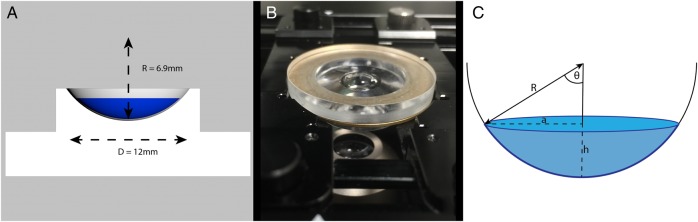
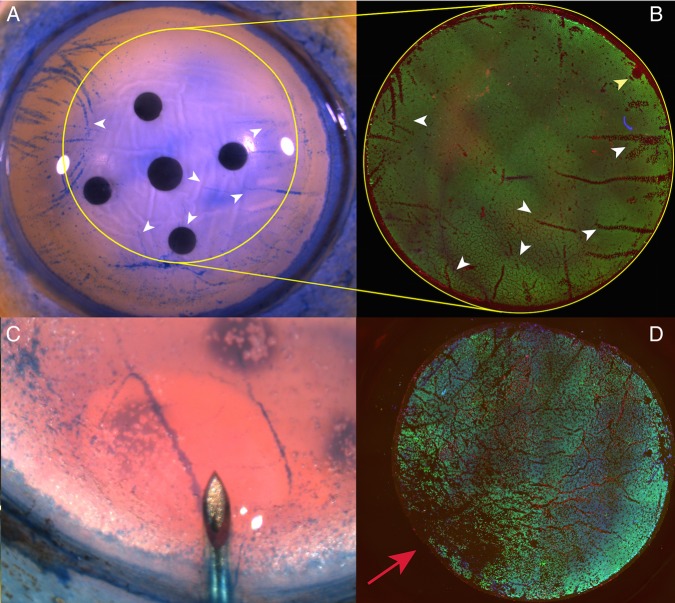
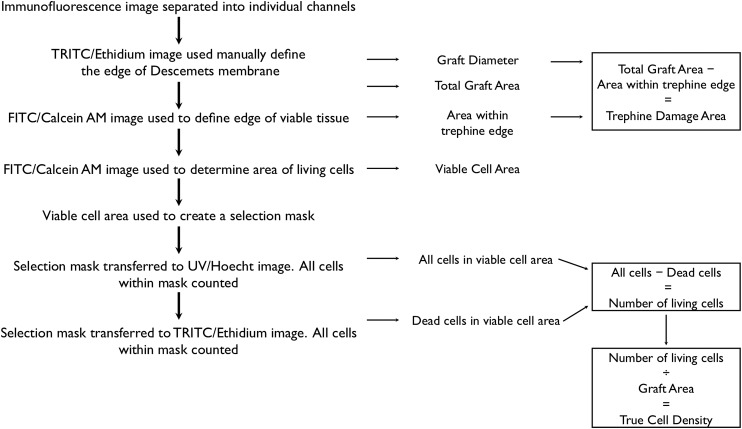
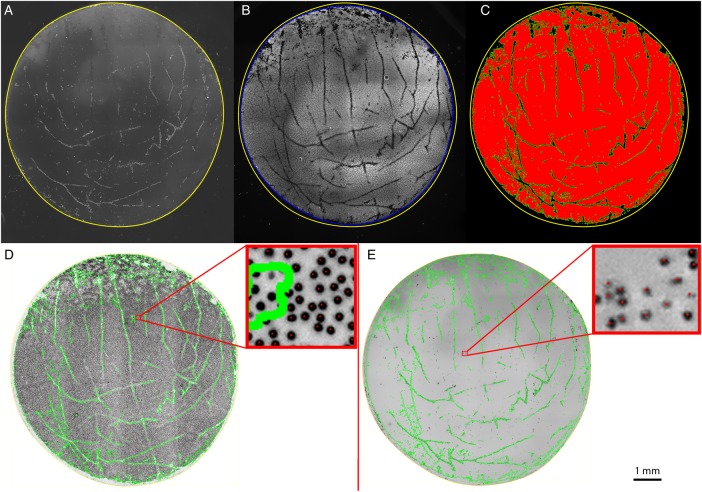
DMEK transplants were prepared using two different methods: liquid bubble separation and manual peeling (n=8 each group). Samples were incubated with Hoechst, calcein-AM and ethidium homodimer prior to mounting on a curved imaging chamber. Z-stacked fluorescence microscopy images were combined to produce an in-focus global image capable of resolving all cell nuclei. Image processing software was used to define a calcein-positive live cell area, count all cell nuclei within this area and subtract ethidium-positive dead cells to derive the total viable endothelial cell count. Corrected global cell density was calculated by dividing the number of viable cells by the graft area, which had been corrected for imaging a curved surface.
Corrected global cell density was lower than the central endothelial cell density in both groups: 85.5% of the pre-preparation central endothelial cell density in the peel group and 75.8% in the bubble group. Corrected global cell density was significantly lower in the liquid bubble separation group than in the peel group (p=0.04).
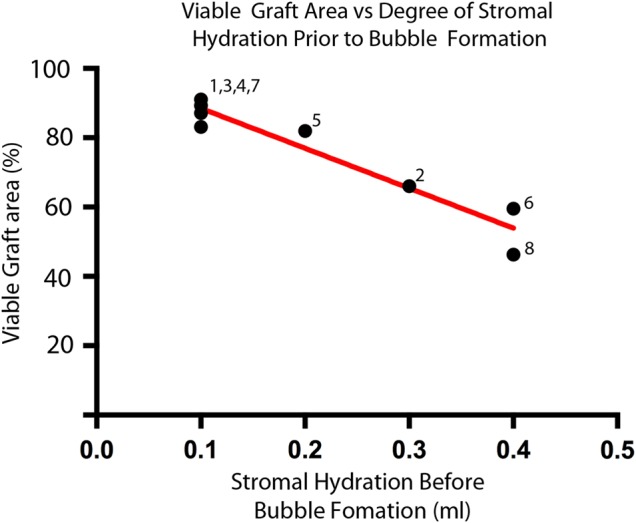
Eye bank estimations of central endothelial cell density overestimate true cell density after graft preparation in DMEK. A peel method is less damaging and more consistent than a liquid bubble method. Cell loss correlated strongly with the degree of stromal hydration prior to bubble separation in the liquid bubble group.
描述一种用于Descemet膜内皮角膜移植术(DMEK)的新型整体细胞活力评估方法,并比较两种当代供体组织制备方法。
使用两种不同方法制备DMEK移植物:液泡分离法和手工剥离法(每组n = 8)。在将样本安装到弯曲成像室之前,用Hoechst、钙黄绿素-AM和碘化丙啶同型二聚体孵育。将Z轴堆叠的荧光显微镜图像合并,以生成能够分辨所有细胞核的聚焦整体图像。使用图像处理软件定义钙黄绿素阳性活细胞区域,计算该区域内的所有细胞核数量,并减去碘化丙啶阳性死细胞,以得出存活内皮细胞总数。通过将活细胞数量除以已针对弯曲表面成像进行校正的移植物面积,计算校正后的整体细胞密度。
两组校正后的整体细胞密度均低于中央内皮细胞密度:剥离组为制备前中央内皮细胞密度的85.5%,液泡组为75.8%。液泡分离组校正后的整体细胞密度显著低于剥离组(p = 0.04)。
眼库对DMEK移植物制备后中央内皮细胞密度的估计高估了真实细胞密度。与液泡法相比,剥离法的损伤更小且更稳定。在液泡组中,细胞损失与液泡分离前基质水化程度密切相关。