Hasan Syed Adnan, Jabeen Suraiya
Department of Environmental Sciences, Sindh Madressatul Islam University Aiwan-e-Tijarat Road , Karachi - 74000 , Pakistan.
Institute of Environmental Studies, University of Karachi , Karachi -75270, Pakistan.
Biotechnol Biotechnol Equip. 2015 Jan 2;29(1):45-53. doi: 10.1080/13102818.2014.991638. Epub 2015 Jan 7.
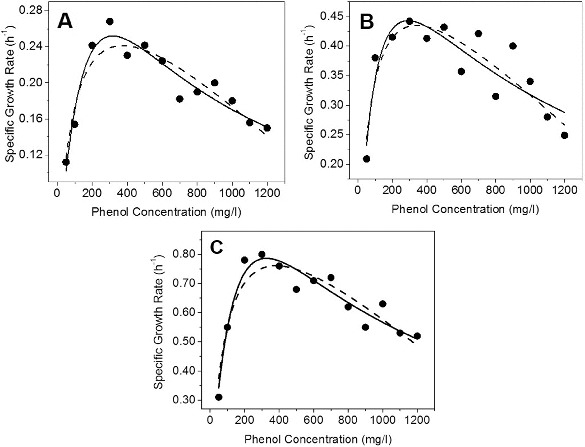
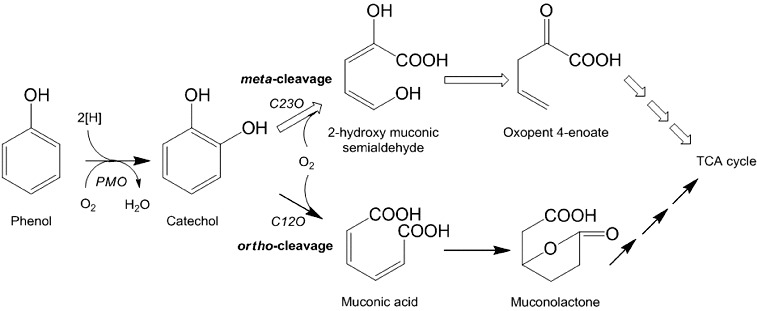
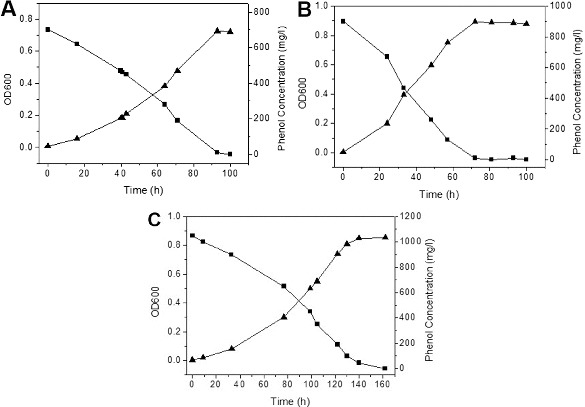
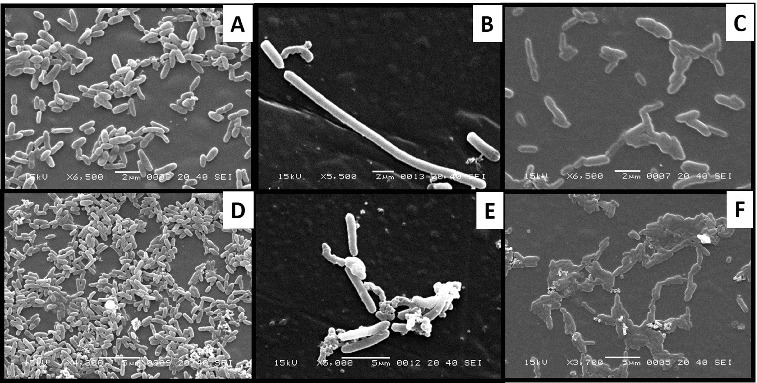
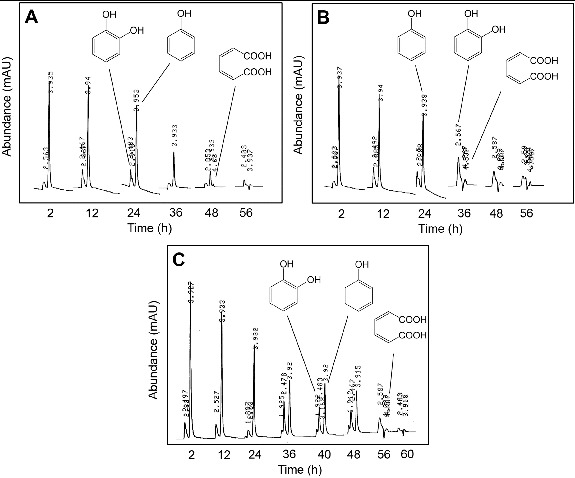
This article elucidates that strain (IES--1) is a versatile toxic organic compound degrader. With the degradation of malathion and cypermethrin (studied by other researchers previously), this strain was able to degrade phenol. Two other indigenous soil flora (i.e., sp. (IES-S) and (IES-B)) were also found to be potential phenol degraders. Phenol was degraded with Monod kinetics during growth in nutrient broth and mineral salts medium. Before entering into the growth inhibition phase, strains IES--1, IES-S and IES-B could tolerate up to 400, 700 and 500 mg/L phenol, respectively, when contained in nutrient broth. However, according to the Luong-Levenspiel model, the growth of strains IES--1, IES-S and IES-B would cease at 2000, 2174 and 2190 mg/L phenol, respectively. Strain IES--1 degraded 700, 900 and 1050 mg/L phenol contained in mineral salts medium with the specific rates of 0.034, 0.075 and 0.021 h, respectively. All these strains grew by making clusters when exposed to phenol in order to prevent damages due to high substrate concentration. These strains transformed phenol into catechol, which was then degraded via -cleavage pathway.
本文阐明菌株(IES - 1)是一种多功能的有毒有机化合物降解菌。随着马拉硫磷和氯氰菊酯(先前由其他研究人员研究)的降解,该菌株能够降解苯酚。另外两种本地土壤菌群(即sp.(IES - S)和(IES - B))也被发现是潜在的苯酚降解菌。在营养肉汤和矿物盐培养基中生长期间,苯酚以莫诺德动力学进行降解。在进入生长抑制阶段之前,当营养肉汤中含有苯酚时,IES - 1、IES - S和IES - B菌株分别能够耐受高达400、700和500mg/L的苯酚。然而,根据卢昂 - 莱文斯皮尔模型,IES - 1、IES - S和IES - B菌株的生长将分别在2000、2174和2190mg/L的苯酚浓度下停止。IES - 1菌株降解矿物盐培养基中含有的700、900和1050mg/L苯酚,其比速率分别为0.034、0.075和0.021h⁻¹。当暴露于苯酚时,所有这些菌株通过形成菌簇生长,以防止由于高底物浓度造成的损害。这些菌株将苯酚转化为儿茶酚,然后通过邻位裂解途径进行降解。