Tang Min, Fu Yang, Wang Ying, Zheng Zhi, Fan Ying, Sun Xiaodong, Xu Xun
Department of Ophthalmology, Shanghai General Hospital of Nanjing Medical University, No.100 Haining Road, Hongkou District, Shanghai, 200080, China.
Department of Ophthalmology, Shanghai General Hospital, Shanghai Jiao Tong University, School of Medicine, Shanghai, 200080, China.
BMC Ophthalmol. 2016 Jan 9;16:7. doi: 10.1186/s12886-016-0183-7.
Neovascular glaucoma is a refractive glaucoma. Recently, anti-VEGF factors have been used alone or in combination for the treatment of neovascular glaucoma. However, the medium- and long-term efficacy of such drugs remains to be evaluated. This study was to determine the efficacy of intravitreal ranibizumab combined with Ahmed glaucoma valve implantation for the treatment of neovascular glaucoma.
In this prospective non-randomized study, 43 neovascular glaucoma patients (43 eyes) were assigned to receive either 0.5 mg intravitreal ranibizumab for three to 14 days before Ahmed glaucoma valve implantation (injection group, n = 21) or Ahmed glaucoma valve implantation alone (control group, n = 22). The patients were followed up for six to 12 months. Differences in surgical success rate, intraocular pressure, best corrected visual acuity, anti-glaucoma medications and postoperative complications were compared between the two groups. Surgical success was defined as IOP > = 6 mm Hg and < = 21 mm Hg, with or without the use of anti-glaucoma medications, and without severe complications or reoperation.
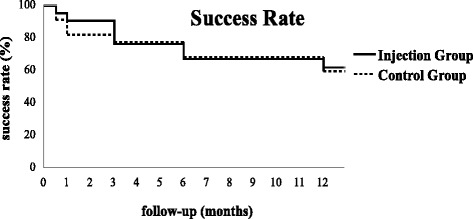
Of the 43 patients, 40 completed the 6-month follow-up and 37 completed the 1-year follow-up. Success rate was 73.7% vs. 71.4% at six months and 72.2% vs. 68.4% at 12 months in the injection group and the control group respectively. No significant difference was noted between the two groups (six months: P = 0.87, 12 months: P = 1.00). There were no significant differences in the two groups with respect to intraocular pressure, best corrected visual acuity, anti-glaucoma medications or postoperative complications at six months or 12 months.
Single intravitreal ranibizumab (0.5 mg) before surgery has no significant effect on the medium- or long-term outcomes of neovascular glaucoma treated with Ahmed glaucoma valve implantation.
Chinese Clinical Trial Registry ( ChiCTR-OOC-14005709, Trial registration date: 2014-12-01).
新生血管性青光眼是一种难治性青光眼。近年来,抗血管内皮生长因子(VEGF)药物已被单独或联合用于治疗新生血管性青光眼。然而,此类药物的中长期疗效仍有待评估。本研究旨在确定玻璃体内注射雷珠单抗联合艾哈迈德青光眼引流阀植入术治疗新生血管性青光眼的疗效。
在这项前瞻性非随机研究中,43例新生血管性青光眼患者(43只眼)被分为两组,一组在艾哈迈德青光眼引流阀植入术前3至14天接受0.5mg玻璃体内注射雷珠单抗(注射组,n = 21),另一组仅接受艾哈迈德青光眼引流阀植入术(对照组,n = 22)。对患者进行6至12个月的随访。比较两组患者的手术成功率、眼压、最佳矫正视力、抗青光眼药物使用情况及术后并发症。手术成功定义为眼压> = 6mmHg且<= 21mmHg,无论是否使用抗青光眼药物,且无严重并发症或再次手术。
43例患者中,40例完成了6个月随访,37例完成了1年随访。注射组和对照组在6个月时的成功率分别为73.7%和71.4%,在12个月时分别为72.2%和68.4%。两组之间无显著差异(6个月:P = 0.87,12个月:P = 1.00)。在6个月或12个月时,两组在眼压、最佳矫正视力、抗青光眼药物使用情况或术后并发症方面均无显著差异。
术前单次玻璃体内注射雷珠单抗(0.5mg)对艾哈迈德青光眼引流阀植入术治疗新生血管性青光眼的中长期疗效无显著影响。
中国临床试验注册中心(ChiCTR-OOC-14005709,试验注册日期:2014年12月1日)。