Hoseini Bibi Leila, Sadati Zahra Miri Kalateh, Rakhshani Mohammad Hassan
M.Sc. in Midwifery, Department of Midwifery, Nursing and Midwifery school, Sabzevar University of Medical Sciences, Sabzevar, Iran.
Nursing B.Sc., Educational Hospital of Shahid Mobini Brothers, Sabzevar, Iran.
Electron Physician. 2015 Nov 20;7(7):1494-9. doi: 10.19082/1494. eCollection 2015 Nov.
The neonatal mortality rate (NMR) is an essential index in the assessment of community health. With the rapid advancement of neonatal care, the causes of death in this group and the overall mortality rate have changed. For these reasons, the aim of this study was to determine the current NMR and its causes in Sabzevar City's Neonatal Intensive Care Unit (NICU).
This cross-sectional study was conducted in the NICU at Sabzevar Hospital from 2006 through 2013. Based on previous studies, the sample size was determined to be 365 neonates who were admitted to the NICU and died before they were discharged. The study tool was a researcher-developed checklist related to deceased neonates in the NICU. The checklist was confirmed based on the validity of its content and its inter-rater reliability. We used chi-squared, the Mann-Whitney U test, and the Spearman correlation to analyze the data.
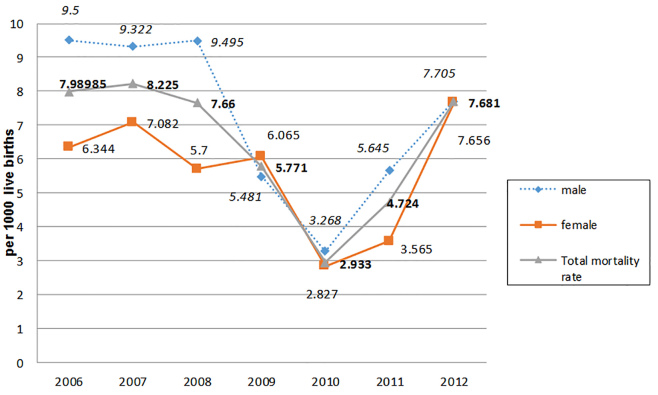
The NMR in Sabzevar's NICU was 6.44 per 1000 during the seven-year period; this rate included the following cases per 1000 live births: very early mortality (2.16), early mortality (3.33), and late mortality (0.96). Among 58,270 live births, 3,667 of the neonates were admitted to the NICU during the seven-year period, which was equivalent to 62.93 admissions per 1000 live births. Of the 3,667 neonates admitted to the NICU, 375 (10.23%) died before they were discharged. The most recurrent diagnoses were respiratory distress syndrome (46%), followed by sepsis (12%). The one-sample chi-squared test as a goodness-of-fit test (95% CI) showed that the mortality rates were significantly different based on gender (p = 0.004), birth weight (p < 0.001), gestational age (p < 0.001), different causes of death (p < 0.001), and different years of death (2006-2013) (p < 0.001). There also was a significant difference between the duration of survival (very early mortality, early mortality, and late mortality) (p < 0.001).
Neonatal mortality in the present study was comparable with that reported in similar studies in Iran and in other countries. The strong association between the mortality rate in the NICU with premature birth and low birth weight indicates the necessity of prenatal care aimed at preventing pre-term labor. Comprehensive programs from antenatal care and care at and after birth are recommended, including the investigation of the risks for neonatal death and offering preventive strategies.
新生儿死亡率(NMR)是评估社区健康的一项重要指标。随着新生儿护理的迅速发展,该群体的死亡原因及总体死亡率已发生变化。基于这些原因,本研究旨在确定萨卜泽瓦尔市新生儿重症监护病房(NICU)当前的新生儿死亡率及其原因。
本横断面研究于2006年至2013年在萨卜泽瓦尔医院的新生儿重症监护病房进行。根据以往研究,确定样本量为365名入住新生儿重症监护病房且在出院前死亡的新生儿。研究工具是研究人员编制的一份与新生儿重症监护病房死亡新生儿相关的检查表。该检查表经内容效度和评分者间信度确认。我们使用卡方检验、曼-惠特尼U检验和斯皮尔曼相关性分析数据。
在这七年期间,萨卜泽瓦尔新生儿重症监护病房的新生儿死亡率为每1000例中有6.44例;该比率按每1000例活产计算包括以下情况:极早期死亡率(2.16)、早期死亡率(3.33)和晚期死亡率(0.96)。在58270例活产中,七年期间有3667例新生儿入住新生儿重症监护病房,相当于每1000例活产中有62.93例入院。在入住新生儿重症监护病房的3667例新生儿中,375例(10.23%)在出院前死亡。最常见的诊断是呼吸窘迫综合征(46%),其次是败血症(12%)。作为拟合优度检验的单样本卡方检验(95%置信区间)显示,死亡率在性别(p = 0.004)、出生体重(p < 0.001)、胎龄(p < 0.001)、不同死亡原因(p < 0.001)以及不同死亡年份(2006 - 2013年)(p < 0.001)方面存在显著差异。生存时长(极早期死亡率、早期死亡率和晚期死亡率)之间也存在显著差异(p < 0.001)。
本研究中的新生儿死亡率与伊朗及其他国家类似研究报告的死亡率相当。新生儿重症监护病房死亡率与早产和低出生体重之间的密切关联表明,有必要开展旨在预防早产的产前护理。建议实施从产前护理到出生时及出生后的综合项目,包括调查新生儿死亡风险并提供预防策略。