Greenfield Geva, Ignatowicz Agnieszka, Gnani Shamini, Bucktowonsing Medhavi, Ladbrooke Tim, Millington Hugh, Car Josip, Majeed Azeem
Department of Primary Care and Public Health, School of Public Health, Imperial College London, London, UK.
Department of Primary Care and Public Health, School of Public Health, Imperial College London, London, UK Division of Health Sciences, Warwick Medical School, The University of Warwick, Coventry, UK.
BMJ Open. 2016 Jan 14;6(1):e007683. doi: 10.1136/bmjopen-2015-007683.
General practitioner (GP)-led urgent care centres were established to meet the growing demand for urgent care. Staff members working in such centres are central in influencing patients' choices about which services they use, but little is known about staff perceptions of patients' motives for attending urgent care. We hence aimed to explore their perceptions of patients' motives for attending such centres.
A phenomenological, qualitative study, including semistructured interviews. The interviews were analysed using thematic content analysis.
2 GP-led urgent care centres in 2 academic hospitals in London.
15 staff members working at the centres including 8 GPs, 5 emergency nurse practitioners and 2 receptionists.
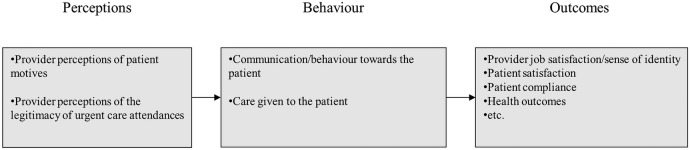
We identified 4 main themes: 'Confusion about choices', 'As if increase of appetite had grown; By what it fed on', 'Overt reasons, covert motives' and 'A question of legitimacy'. The participants thought that the centres introduce convenient and fast access for patients. So convenient, that an increasing number of patients use them as a regular alternative to their community GP. The participants perceived that patients attend the centres because they are anxious about their symptoms and view them as serious, cannot get an appointment with their GP quickly and conveniently, are dissatisfied with the GP, or lack self-care skills. Staff members perceived some motives as legitimate (an acute health need and difficulties in getting an appointment), and others as less legitimate (convenience, minor illness, and seeking quicker access to hospital facilities).
The participants perceived that patients attend urgent care centres because of the convenience of access relative to primary care, as well as sense of acuity and anxiety, lack self-care skills and other reasons. They perceived some motives as more legitimate than others. Attention to unmet needs in primary care can help in promoting balanced access to urgent care.
设立由全科医生(GP)主导的紧急护理中心是为了满足对紧急护理日益增长的需求。在此类中心工作的工作人员在影响患者对所使用服务的选择方面起着核心作用,但对于工作人员对患者前往紧急护理的动机的看法却知之甚少。因此,我们旨在探讨他们对患者前往此类中心动机的看法。
一项现象学定性研究,包括半结构化访谈。采用主题内容分析法对访谈进行分析。
伦敦两家学术医院中的2个由全科医生主导的紧急护理中心。
在这些中心工作的15名工作人员,包括8名全科医生、5名急诊护士和2名接待员。
我们确定了4个主要主题:“选择困惑”、“好似食欲增长;靠何物滋养”、“公开的理由,隐秘的动机”和“合法性问题”。参与者认为这些中心为患者提供了便捷快速的就诊途径。如此便捷,以至于越来越多的患者将其作为社区全科医生的常规替代选择。参与者认为患者前往这些中心是因为他们对自己的症状感到焦虑并认为症状严重、无法快速便捷地预约到全科医生、对全科医生不满意或者缺乏自我护理技能。工作人员认为一些动机是合理的(急性健康需求和难以预约),而另一些则不太合理(便利、小病以及寻求更快获得医院设施)。
参与者认为患者前往紧急护理中心是因为相对于初级医疗保健而言就诊便捷,以及有紧迫感和焦虑感、缺乏自我护理技能及其他原因。他们认为一些动机比其他动机更合理。关注初级医疗保健中未满足的需求有助于促进对紧急护理的均衡利用。