Friis Karina, Lasgaard Mathias, Osborne Richard H, Maindal Helle T
Public Health and Quality Improvement, Central Denmark Region, Aarhus, Denmark.
Public Health and Quality Improvement, Central Denmark Region, Aarhus, Denmark Department of Psychology, University of Southern Denmark, Odense, Denmark.
BMJ Open. 2016 Jan 14;6(1):e009627. doi: 10.1136/bmjopen-2015-009627.
To (1) quantify levels of subjective health literacy in people with long-term health conditions (diabetes, cardiovascular disease, chronic obstructive pulmonary disease, musculoskeletal disorders, cancer and mental disorders) and compare these to levels in the general population and (2) examine the association between health literacy, socioeconomic characteristics and comorbidity in each long-term condition group.
Population-based survey in the Central Denmark Region (n=29,473).
Health literacy was measured using two scales from the Health Literacy Questionnaire (HLQ): (1) Ability to understand health information and (2) Ability to actively engage with healthcare providers.
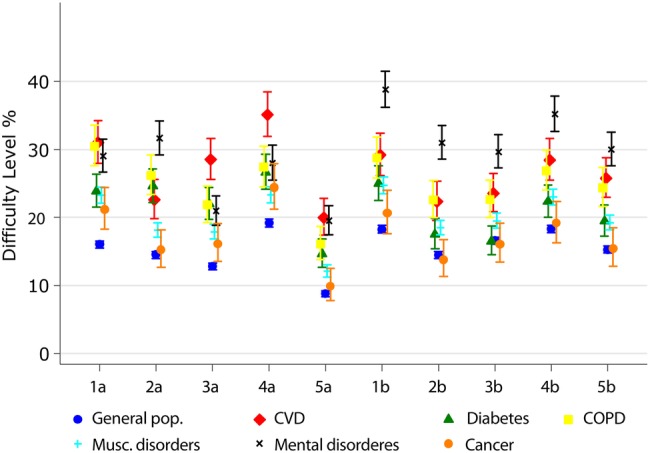
People with long-term conditions reported more difficulties than the general population in understanding health information and actively engaging with healthcare providers. Wide variation was found between disease groups, with people with cancer having fewer difficulties and people with mental health disorders having more difficulties in actively engaging with healthcare providers than other long-term condition groups. Having more than one long-term condition was associated with more difficulty in engaging with healthcare providers and understanding health information. People with low levels of education had lower health literacy than people with high levels of education.
Compared with the general population, people with long-term conditions report more difficulties in understanding health information and engaging with healthcare providers. These two dimensions are critical to the provision of patient-centred healthcare and for optimising health outcomes. More effort should be made to respond to the health literacy needs among individuals with long-term conditions, multiple comorbidities and low education levels, to improve health outcomes and to reduce social inequality in health.
(1)量化患有长期健康状况(糖尿病、心血管疾病、慢性阻塞性肺疾病、肌肉骨骼疾病、癌症和精神障碍)的人群的主观健康素养水平,并将其与普通人群的水平进行比较;(2)研究每个长期疾病组中健康素养、社会经济特征和合并症之间的关联。
丹麦中部地区基于人群的调查(n = 29473)。
使用健康素养问卷(HLQ)中的两个量表测量健康素养:(1)理解健康信息的能力;(2)与医疗服务提供者积极互动的能力。
患有长期疾病的人群在理解健康信息和与医疗服务提供者积极互动方面比普通人群报告了更多困难。在疾病组之间发现了很大差异,与其他长期疾病组相比,癌症患者在与医疗服务提供者积极互动方面困难较少,而精神健康障碍患者困难较多。患有不止一种长期疾病与在与医疗服务提供者互动和理解健康信息方面有更多困难相关。教育水平低的人群的健康素养低于教育水平高的人群。
与普通人群相比,患有长期疾病的人群在理解健康信息和与医疗服务提供者互动方面报告了更多困难。这两个维度对于提供以患者为中心的医疗保健和优化健康结局至关重要。应做出更多努力来满足患有长期疾病、多种合并症和低教育水平的个体的健康素养需求,以改善健康结局并减少健康方面的社会不平等。