Veroniki Areti Angeliki, Straus Sharon E, Ashoor Huda M, Hamid Jemila S, Hemmelgarn Brenda R, Holroyd-Leduc Jayna, Majumdar Sumit R, McAuley Glenn, Tricco Andrea C
Li Ka Shing Knowledge Institute, St. Michael's Hospital, Toronto, Ontario, Canada.
Li Ka Shing Knowledge Institute, St. Michael's Hospital, Toronto, Ontario, Canada Department of Geriatric Medicine, University of Toronto, Toronto, Ontario, Canada.
BMJ Open. 2016 Jan 13;6(1):e010251. doi: 10.1136/bmjopen-2015-010251.
Alzheimer's dementia (AD) is the most common cause of dementia, and several organisations, such as the National Institute for Health and Care Excellence, suggest that management of patients with AD should be tailored to their needs. To date, little research has been conducted on the treatment effect in different subgroups of patients with AD. The aim of this study is to examine the comparative effectiveness and safety of cognitive enhancers for different patient characteristics.
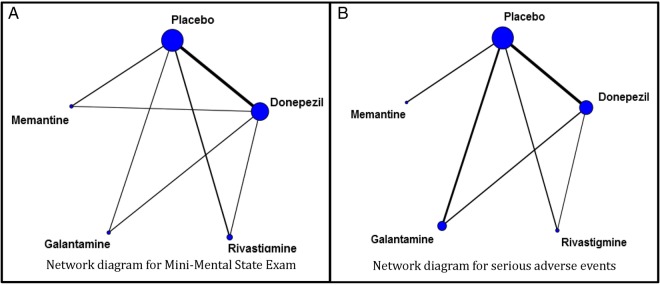
We will update our previous literature search from January 2015 forward, using the same terms and electronic databases (eg, MEDLINE) from our previous review. We will additionally search grey literature and scan the reference lists of the included studies. Randomised clinical trials of any duration conducted at any time comparing cognitive enhancers alone or in any combination against other cognitive enhancers, or placebo in adults with AD will be eligible. The outcomes of interest are cognition according to the Mini-Mental State Examination, and overall serious adverse events. For each outcome and treatment comparison, we will perform a Bayesian hierarchical random-effects meta-analysis combining the individual patient data (IPD) from each eligible study. If the identified treatment comparisons form a connected network diagram, we will perform an IPD network meta-analysis (NMA) to estimate subgroup effects for patients with different characteristics, such as AD severity and sex. We will combine aggregated data from studies that we will not be able to obtain IPD, with the IPD provided by the original authors, in a single model. We will use the PRISMA-IPD and PRISMA-NMA statements to report our findings.
The findings of this study will be of interest to stakeholders, including decision makers, guideline developers, clinicians, methodologists and patients, and they will help to improve guidelines for the management of patients with AD.
CRD42015023507.
阿尔茨海默病性痴呆(AD)是痴呆最常见的病因,一些组织,如英国国家卫生与临床优化研究所,建议对AD患者的管理应根据其需求进行调整。迄今为止,针对AD不同亚组患者的治疗效果研究较少。本研究的目的是探讨认知增强剂针对不同患者特征的比较疗效和安全性。
我们将更新2015年1月以来的文献检索,使用与之前综述相同的检索词和电子数据库(如MEDLINE)。我们还将检索灰色文献并浏览纳入研究的参考文献列表。在任何时间进行的、比较单独使用或联合使用认知增强剂与其他认知增强剂或安慰剂治疗AD成人患者的任何时长的随机临床试验均符合要求。感兴趣的结局指标是简易精神状态检查表评估的认知情况以及总体严重不良事件。对于每个结局指标和治疗比较,我们将进行贝叶斯分层随机效应荟萃分析,合并每个符合要求研究的个体患者数据(IPD)。如果确定的治疗比较形成一个连通的网络图,我们将进行IPD网络荟萃分析(NMA),以估计不同特征患者(如AD严重程度和性别)的亚组效应。我们将把无法获取IPD的研究的汇总数据与原始作者提供的IPD合并到一个模型中。我们将使用PRISMA-IPD和PRISMA-NMA声明来报告我们的研究结果。
本研究的结果将受到包括决策者、指南制定者、临床医生、方法学家和患者在内的利益相关者的关注,并将有助于改进AD患者的管理指南。
CRD420150235