Kim Hee Jeong, Yoon Tae-In, Chae Hee Dong, Kim Jeong Eun, Chae Eun Young, Yu Jong Han, Sohn Guiyun, Ko Beom Seok, Lee Jong Won, Son Byung Ho, Ahn Sei Hyun
Division of Breast and Endocrine Surgery, Department of Surgery, Asan Medical Center, University of Ulsan College of Medicine, Seoul, Korea.
Department of Obstetrics and Gynecology, Asan Medical Center, University of Ulsan College of Medicine, Seoul, Korea.
J Breast Cancer. 2015 Dec;18(4):365-70. doi: 10.4048/jbc.2015.18.4.365. Epub 2015 Dec 23.
This study aimed to determine the oncologic efficacy of gonadotropin-releasing hormone (GnRH) agonist treatment concurrent with chemotherapy in a neoadjuvant setting.
A retrospective analysis was performed on 332 cases of invasive breast cancer in patients who were <40 years old at diagnosis and received GnRH agonists concurrent with neoadjuvant chemotherapy (GnRH agonist group) or neoadjuvant chemotherapy alone (neochemotherapy-alone group) from December 2010 to September 2014. Pathologic complete response rates (pCR) and Ki-67 changes were evaluated between the two groups.
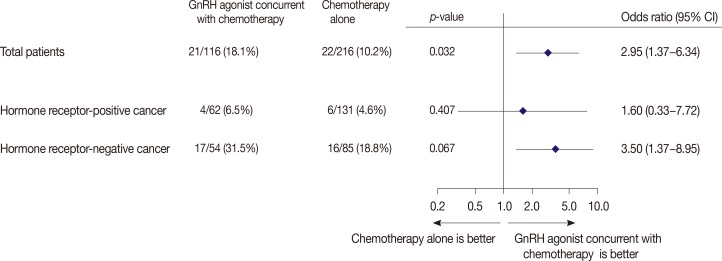
Median age was 32±3.9 and 36±3.0 years in the GnRH agonist group and neochemotherapy-alone group, respectively (p<0.001). After adjustment for tumor size, grade, lymph node metastasis, hormone receptor (HR) status, and chemotherapy regimen, the GnRH agonist group exhibited a higher pCR rate with an odds ratio (OR) of 2.98 (95% confidence interval [CI], 1.37-6.34) and a greater decrease in Ki-67 expression after treatment (p=0.05) than the neochemotherapy-alone group. For HR-negative tumors, the GnRH agonist group showed a higher pCR rate (multivariate OR, 3.50; 95% CI, 1.37-8.95) and a greater decrease in Ki-67 expression (p=0.047). For HR-positive breast cancer, the pCR rate, change in Ki-67 index, and clinical response were higher, and preoperative endocrine prognostic index scores were lower, in the GnRH agonist group, but these did not reach statistical significance.
Concurrent administration of GnRH agonists during neoadjuvant chemotherapy improved pCR rates and suppressed Ki-67 expression, especially in HR-negative tumors.
本研究旨在确定在新辅助治疗中促性腺激素释放激素(GnRH)激动剂与化疗同时使用的肿瘤学疗效。
对2010年12月至2014年9月期间诊断时年龄小于40岁、接受GnRH激动剂与新辅助化疗同时治疗(GnRH激动剂组)或仅接受新辅助化疗(单纯新化疗组)的332例浸润性乳腺癌患者进行回顾性分析。评估两组之间的病理完全缓解率(pCR)和Ki-67变化。
GnRH激动剂组和单纯新化疗组的中位年龄分别为32±3.9岁和36±3.0岁(p<0.001)。在调整肿瘤大小、分级、淋巴结转移、激素受体(HR)状态和化疗方案后,GnRH激动剂组的pCR率更高,优势比(OR)为2.98(95%置信区间[CI],1.37 - 6.34),且治疗后Ki-67表达的下降幅度更大(p = 0.05),高于单纯新化疗组。对于HR阴性肿瘤,GnRH激动剂组显示出更高的pCR率(多变量OR,3.50;95%CI,1.37 - 8.95)和更大的Ki-67表达下降幅度(p = 0.047)。对于HR阳性乳腺癌,GnRH激动剂组的pCR率、Ki-67指数变化和临床反应更高,术前内分泌预后指数评分更低,但这些均未达到统计学意义。
在新辅助化疗期间同时给予GnRH激动剂可提高pCR率并抑制Ki-67表达,尤其是在HR阴性肿瘤中。