Kim Ha-Yon, Lee So-Yeon, Kim Deog-Young, Moon Ji-Young, Choi Yoon-Seok, Song Ik-Chan, Lee Hyo-Jin, Yun Hwan-Jung, Kim Samyong, Jo Deog-Yeon
Department of Drug Activity, New Drug Development Center, Medical Innovation Foundation, Osong, Daejeon, Korea.
Department of Internal Medicine, School of Medicine, Chungnam National University, Daejeon, Korea.
Blood Res. 2015 Dec;50(4):218-26. doi: 10.5045/br.2015.50.4.218. Epub 2015 Dec 21.
The C-X-C chemokine receptor 7 (CXCR7) has been shown to be a decoy receptor for CXCR4 in certain cell types. We investigated the expression status and functional roles of CXCR7 in acute myeloid leukemia (AML) cells in vitro.
CXCR7 mRNA was knocked down in AML cells by using small interfering RNA (siRNA) technology, and subsequent biological alterations in the cells were evaluated in vitro.
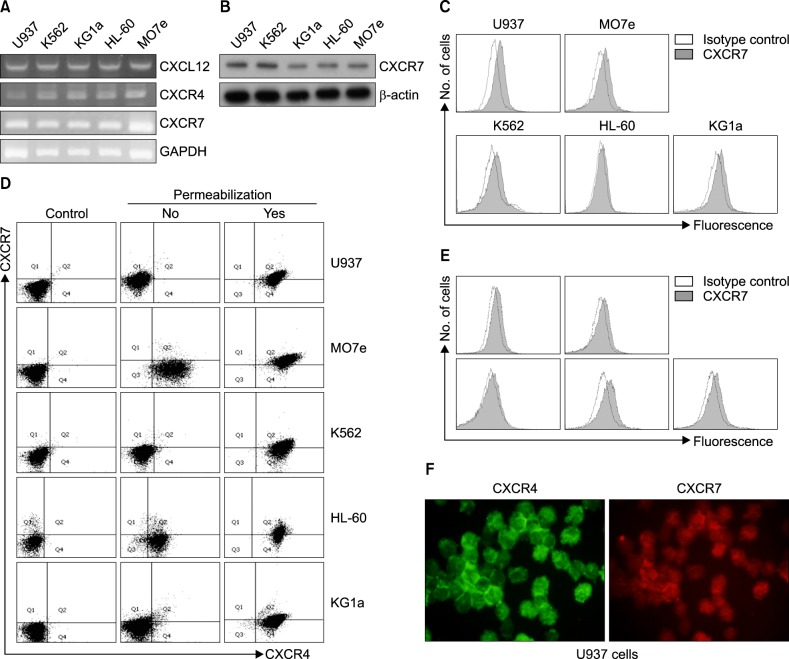
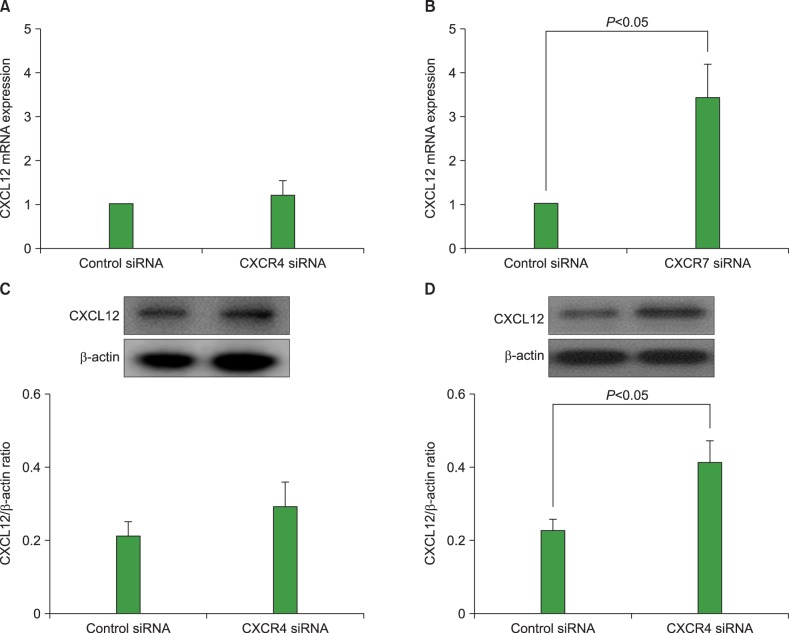
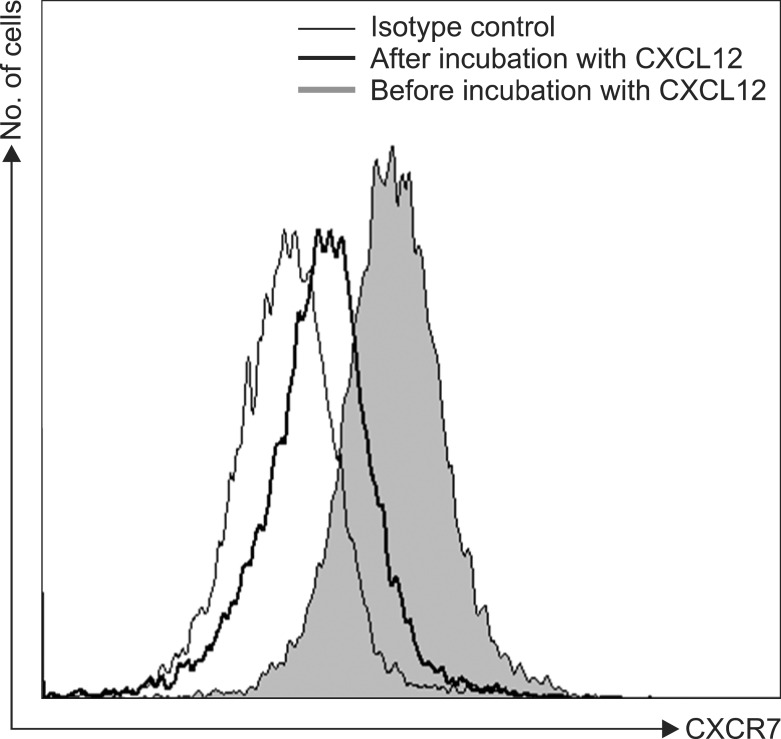
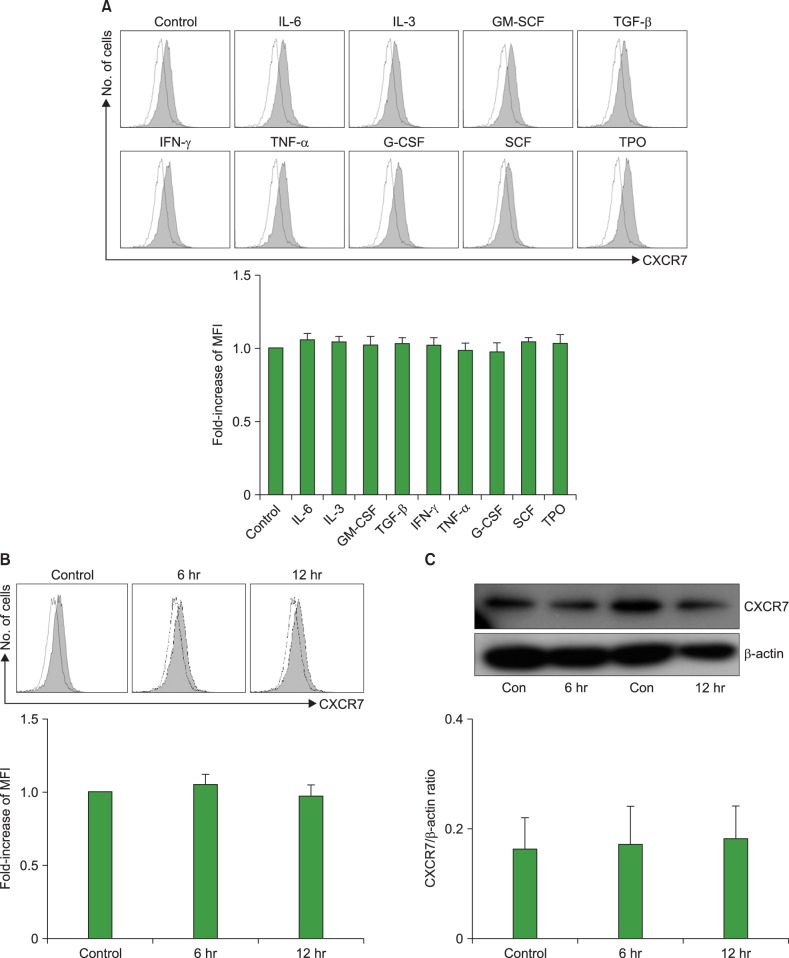
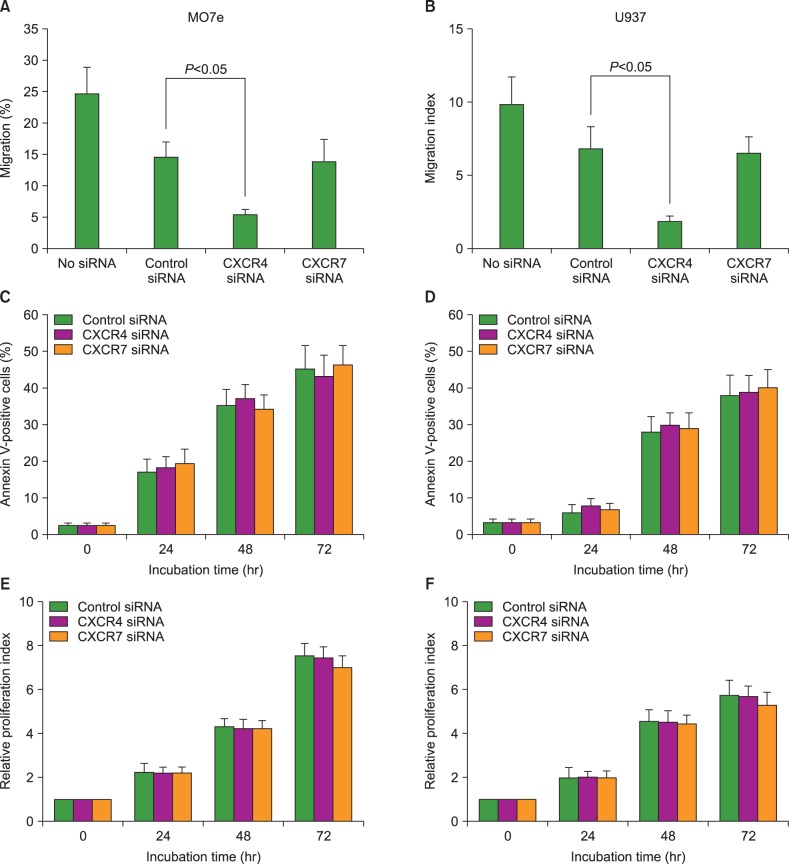
All AML cell lines examined in this study (U937, K562, KG1a, HL-60, and MO7e) and primary CD34(+) cells obtained from patients with AML expressed CXCR7 mRNA at various levels. Western blotting showed that all AML cells produced CXCR7. Furthermore, all AML cells expressed CXCR7 in both the cytoplasm and on the cell surface at various levels. Stromal cell-derived factor-1 (SDF-1; C-X-C motif ligand 12 (CXCL12)) induced internalization of cell surface CXCR7. However, neither hypoxia nor the examined hematopoietic growth factors (interleukin-1β (IL-1β), IL-3, IL-6, granulocyte-colony-stimulating factor, granulocyte, macrophage-colony-stimulating factor, and stem cell factor) and proinflammatory cytokines (interferon-γ, transforming growth factor-β, and tumor necrosis factor-α) were found to alter cell surface CXCR7 expression. The transfection of AML cells with CXCR4 siRNA, but not CXCR7 siRNA, significantly impaired the CXCL12-induced transmigration of the cells. The transfection of AML cells with CXCR7 siRNA did not affect the survival or proliferation of these cells. Knockdown of CXCR7, but not CXCR4, induced the upregulation of CXCL12 mRNA expression and CXCL12 production in AML cells.
CXCR7 is involved in the regulation of autocrine CXCL12 in AML cells.
C-X-C趋化因子受体7(CXCR7)在某些细胞类型中已被证明是CXCR4的诱饵受体。我们在体外研究了CXCR7在急性髓系白血病(AML)细胞中的表达状态和功能作用。
利用小干扰RNA(siRNA)技术敲低AML细胞中的CXCR7 mRNA,并在体外评估细胞随后的生物学变化。
本研究中检测的所有AML细胞系(U937、K562、KG1a、HL-60和MO7e)以及从AML患者获得的原代CD34(+)细胞均以不同水平表达CXCR7 mRNA。蛋白质印迹法显示所有AML细胞均产生CXCR7。此外,所有AML细胞在细胞质和细胞表面均以不同水平表达CXCR7。基质细胞衍生因子-1(SDF-1;C-X-C基序配体12(CXCL12))诱导细胞表面CXCR7内化。然而,未发现缺氧以及所检测的造血生长因子(白细胞介素-1β(IL-1β)、IL-3、IL-6、粒细胞集落刺激因子、粒细胞巨噬细胞集落刺激因子和干细胞因子)和促炎细胞因子(干扰素-γ、转化生长因子-β和肿瘤坏死因子-α)会改变细胞表面CXCR7的表达。用CXCR4 siRNA而非CXCR7 siRNA转染AML细胞会显著损害CXCL12诱导的细胞迁移。用CXCR7 siRNA转染AML细胞不影响这些细胞的存活或增殖。敲低CXCR7而非CXCR4会诱导AML细胞中CXCL12 mRNA表达和CXCL12产生上调。
CXCR7参与AML细胞中自分泌CXCL12的调节。