Lai Li, Ghebremariam Yohannes T
Department of Cardiovascular Sciences, Center for Cardiovascular Regeneration, Houston Methodist Research Institute, 6670 Bertner Avenue, Houston, TX 77030, USA.
Department of Cardiovascular Sciences, Center for Cardiovascular Regeneration, Houston Methodist Research Institute, 6670 Bertner Avenue, Houston, TX 77030, USA; Department of Cardiothoracic Surgery, Weill Cornell Medical College of Cornell University, New York, NY 10065, USA.
J Diabetes Res. 2016;2016:1982096. doi: 10.1155/2016/1982096. Epub 2015 Dec 6.
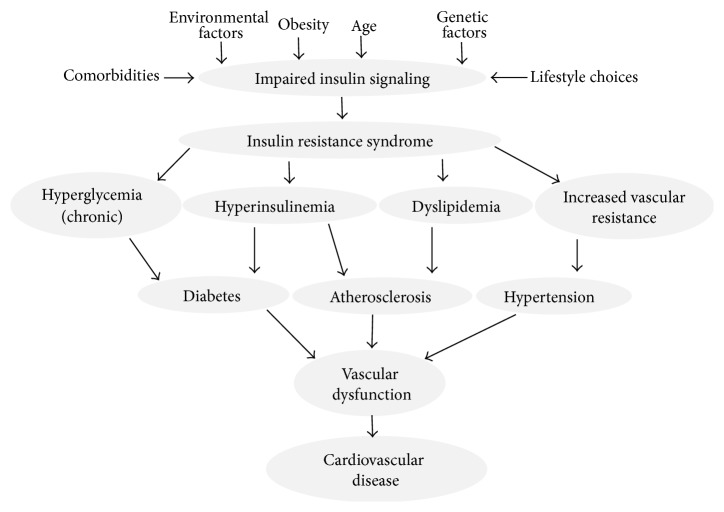
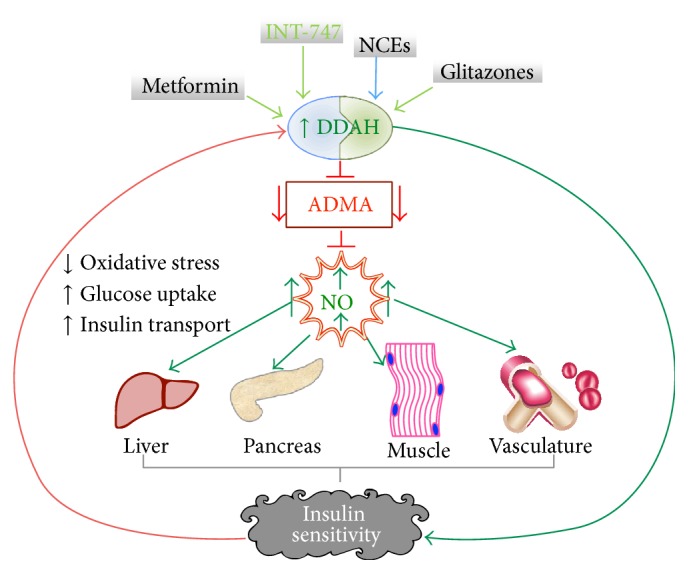
Insulin resistance syndrome (IRS) is a configuration of cardiovascular risk factors involved in the development of metabolic disorders including type 2 diabetes mellitus. In addition to diet, age, socioeconomic, and environmental factors, genetic factors that impair insulin signaling are centrally involved in the development and exacerbation of IRS. Genetic and pharmacological studies have demonstrated that the nitric oxide (NO) synthase (NOS) genes are critically involved in the regulation of insulin-mediated glucose disposal. The generation of NO by the NOS enzymes is known to contribute to vascular homeostasis including insulin-mediated skeletal muscle vasodilation and insulin sensitivity. By contrast, excessive inhibition of NOS enzymes by exogenous or endogenous factors is associated with insulin resistance (IR). Asymmetric dimethylarginine (ADMA) is an endogenous molecule that competitively inhibits all the NOS enzymes and contributes to metabolic perturbations including IR. The concentration of ADMA in plasma and tissue is enzymatically regulated by dimethylarginine dimethylaminohydrolase (DDAH), a widely expressed enzyme in the cardiovascular system. In preclinical studies, overexpression of DDAH has been shown to reduce ADMA levels, improve vascular compliance, and increase insulin sensitivity. This review discusses the feasibility of the NOS/DDAH pathway as a novel target to develop vasoprotective insulin sensitizers.
胰岛素抵抗综合征(IRS)是一种与包括2型糖尿病在内的代谢紊乱发展相关的心血管危险因素组合。除了饮食、年龄、社会经济和环境因素外,损害胰岛素信号传导的遗传因素在IRS的发生和加重中也起着核心作用。遗传和药理学研究表明,一氧化氮(NO)合酶(NOS)基因在胰岛素介导的葡萄糖代谢调节中起着关键作用。已知NOS酶产生的NO有助于维持血管稳态,包括胰岛素介导的骨骼肌血管舒张和胰岛素敏感性。相比之下,外源性或内源性因素对NOS酶的过度抑制与胰岛素抵抗(IR)有关。不对称二甲基精氨酸(ADMA)是一种内源性分子,它竞争性抑制所有NOS酶,并导致包括IR在内的代谢紊乱。血浆和组织中ADMA的浓度由二甲基精氨酸二甲胺水解酶(DDAH)进行酶促调节,DDAH是心血管系统中广泛表达的一种酶。在临床前研究中,DDAH的过表达已被证明可降低ADMA水平、改善血管顺应性并提高胰岛素敏感性。本综述讨论了将NOS/DDAH途径作为开发血管保护型胰岛素增敏剂的新靶点的可行性。