Watanabe Colin, Cuellar Trinna L, Haley Benjamin
a Departments of Bioinformatics and Computational Biology , South San Francisco , CA 94080.
c Genentech, Inc . South San Francisco , CA 94080 , USA.
RNA Biol. 2016;13(1):25-33. doi: 10.1080/15476286.2015.1128062.
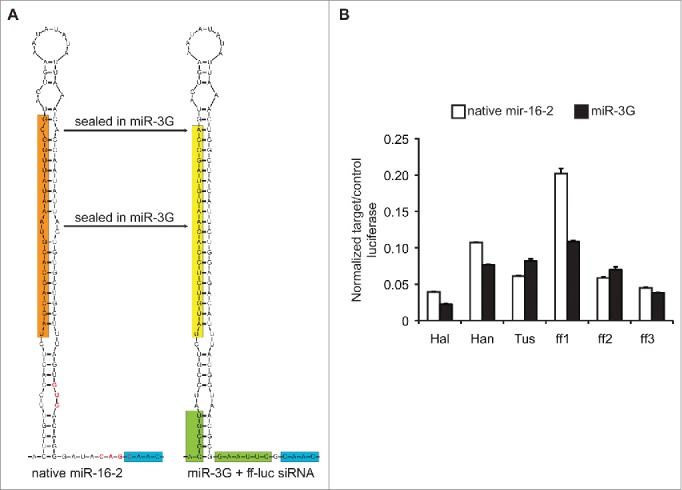
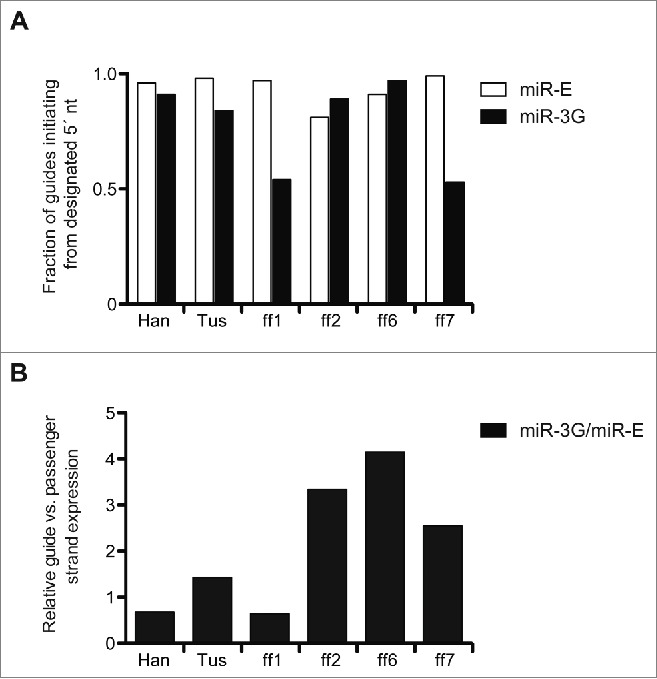
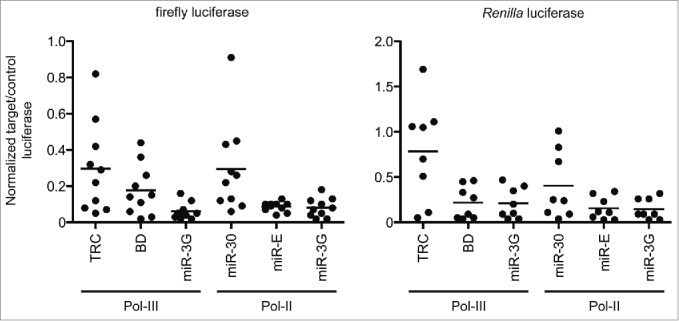
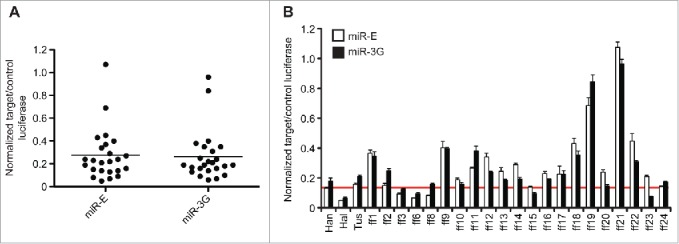
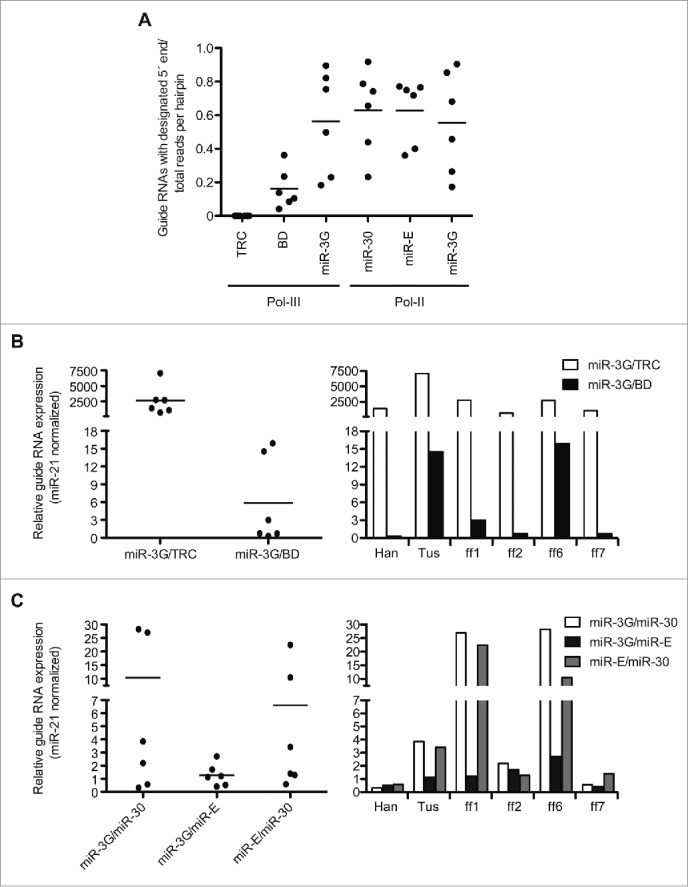
Incorporating miRNA-like features into vector-based hairpin scaffolds has been shown to augment small RNA processing and RNAi efficiency. Therefore, defining an optimal, native hairpin context may obviate a need for hairpin-specific targeting design schemes, which confound the movement of functional siRNAs into shRNA/artificial miRNA backbones, or large-scale screens to identify efficacious sequences. Thus, we used quantitative cell-based assays to compare separate third generation artificial miRNA systems, miR-E (based on miR-30a) and miR-3G (based on miR-16-2 and first described in this study) to widely-adopted, first and second generation formats in both Pol-II and Pol-III expression vector contexts. Despite their unique structures and strandedness, and in contrast to first and second-generation RNAi triggers, the third generation formats operated with remarkable similarity to one another, and strong silencing was observed with a significant fraction of the evaluated target sequences within either promoter context. By pairing an established siRNA design algorithm with the third generation vectors we could readily identify targeting sequences that matched or exceeded the potency of those discovered through large-scale sensor-based assays. We find that third generation hairpin systems enable the maximal level of siRNA function, likely through enhanced processing and accumulation of precisely-defined guide RNAs. Therefore, we predict future gains in RNAi potency will come from improved hairpin expression and identification of optimal siRNA-intrinsic silencing properties rather than further modification of these scaffolds. Consequently, third generation systems should be the primary format for vector-based RNAi studies; miR-3G is advantageous due to its small expression cassette and simplified, cost-efficient cloning scheme.
已证明将类似miRNA的特征整合到基于载体的发夹支架中可增强小RNA加工和RNAi效率。因此,定义最佳的天然发夹环境可能无需特定于发夹的靶向设计方案,这些方案会混淆功能性siRNA进入shRNA/人工miRNA骨架的转移,也无需进行大规模筛选以鉴定有效序列。因此,我们使用基于细胞的定量分析方法,在Pol-II和Pol-III表达载体环境中,将单独的第三代人工miRNA系统miR-E(基于miR-30a)和miR-3G(基于miR-16-2,本研究首次描述)与广泛采用的第一代和第二代形式进行比较。尽管它们具有独特的结构和链性,并且与第一代和第二代RNAi触发物不同,但第三代形式的操作彼此之间具有显著的相似性,并且在任何一种启动子环境中,很大一部分评估的靶序列都观察到了强烈的沉默作用。通过将既定的siRNA设计算法与第三代载体配对,我们可以轻松识别出与通过基于大规模传感器的分析发现的序列效力相匹配或超过其效力的靶向序列。我们发现第三代发夹系统能够实现siRNA功能的最大水平,这可能是通过增强精确界定的引导RNA的加工和积累来实现的。因此,我们预测未来RNAi效力的提高将来自于改善发夹表达和鉴定最佳的siRNA内在沉默特性,而不是对这些支架进行进一步修饰。因此,第三代系统应成为基于载体的RNAi研究的主要形式;miR-3G因其小的表达盒和简化的、具有成本效益的克隆方案而具有优势。