
苏云金芽孢杆菌晶体蛋白Cry6Aa触发由天冬氨酸蛋白酶(ASP-1)介导的秀丽隐杆线虫坏死途径。
Bacillus thuringiensis Crystal Protein Cry6Aa Triggers Caenorhabditis elegans Necrosis Pathway Mediated by Aspartic Protease (ASP-1).
作者信息
Zhang Fengjuan, Peng Donghai, Cheng Chunsheng, Zhou Wei, Ju Shouyong, Wan Danfeng, Yu Ziquan, Shi Jianwei, Deng Yaoyao, Wang Fenshan, Ye Xiaobo, Hu Zhenfei, Lin Jian, Ruan Lifang, Sun Ming
机构信息
State Key Laboratory of Agricultural Microbiology, College of Life Science and Technology, Huazhong Agricultural University, Wuhan, China.
Haikou Experimental Station, Chinese Academy of Tropical Agricultural Sciences, Haikou, China.
出版信息
PLoS Pathog. 2016 Jan 21;12(1):e1005389. doi: 10.1371/journal.ppat.1005389. eCollection 2016 Jan.
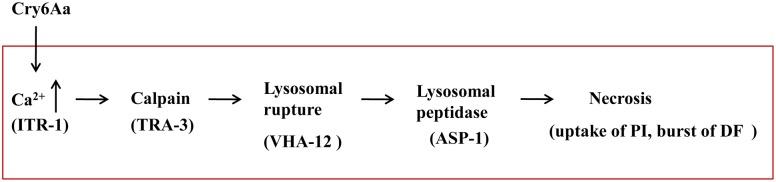
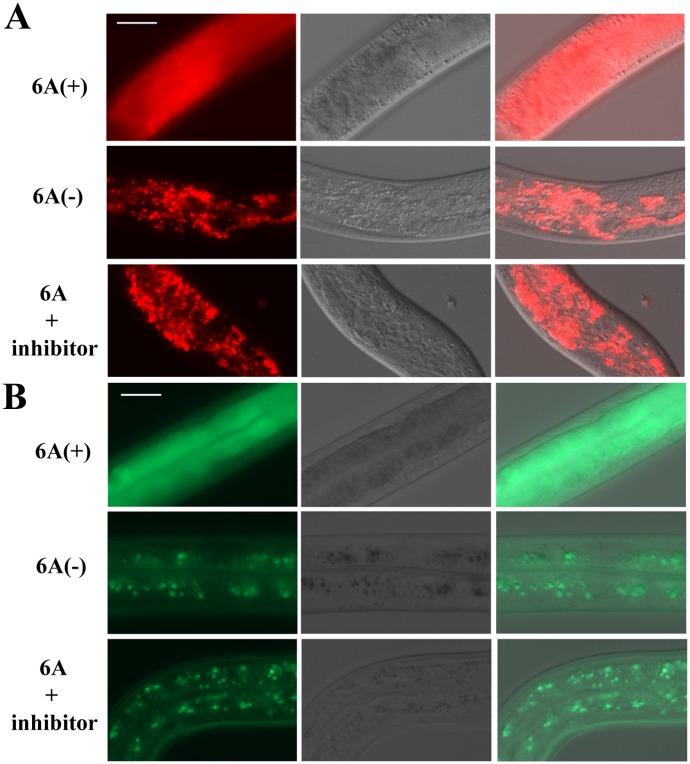
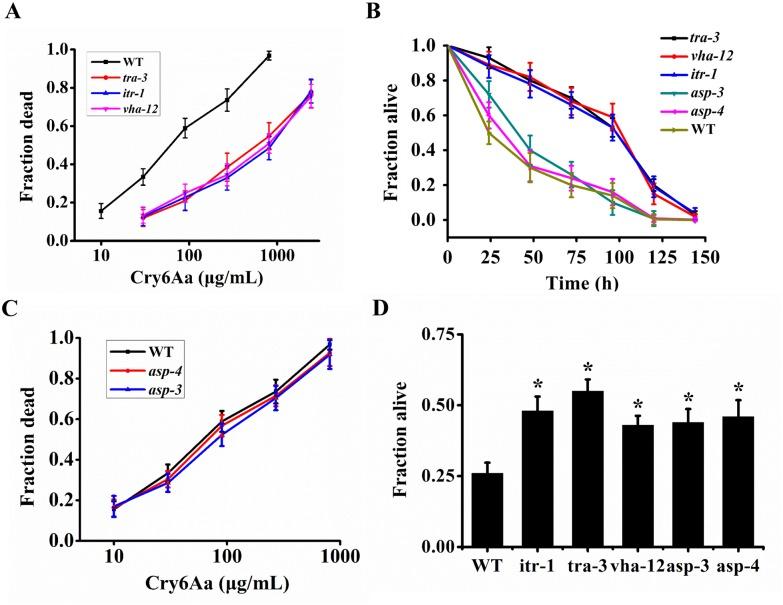
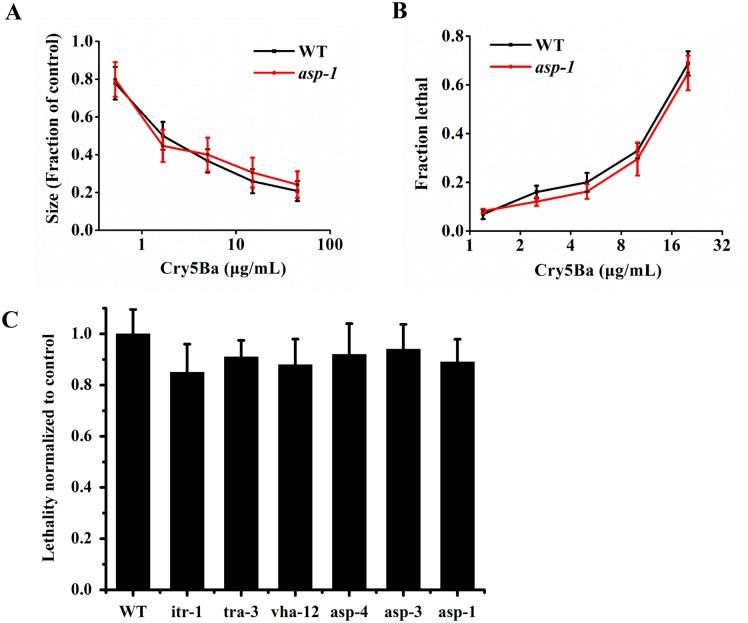
Cell death plays an important role in host-pathogen interactions. Crystal proteins (toxins) are essential components of Bacillus thuringiensis (Bt) biological pesticides because of their specific toxicity against insects and nematodes. However, the mode of action by which crystal toxins to induce cell death is not completely understood. Here we show that crystal toxin triggers cell death by necrosis signaling pathway using crystal toxin Cry6Aa-Caenorhabditis elegans toxin-host interaction system, which involves an increase in concentrations of cytoplasmic calcium, lysosomal lyses, uptake of propidium iodide, and burst of death fluorescence. We find that a deficiency in the necrosis pathway confers tolerance to Cry6Aa toxin. Intriguingly, the necrosis pathway is specifically triggered by Cry6Aa, not by Cry5Ba, whose amino acid sequence is different from that of Cry6Aa. Furthermore, Cry6Aa-induced necrosis pathway requires aspartic protease (ASP-1). In addition, ASP-1 protects Cry6Aa from over-degradation in C. elegans. This is the first demonstration that deficiency in necrosis pathway confers tolerance to Bt crystal protein, and that Cry6A triggers necrosis represents a newly added necrosis paradigm in the C. elegans. Understanding this model could lead to new strategies for nematode control.
细胞死亡在宿主与病原体的相互作用中起着重要作用。晶体蛋白(毒素)是苏云金芽孢杆菌(Bt)生物杀虫剂的重要组成部分,因为它们对昆虫和线虫具有特异性毒性。然而,晶体毒素诱导细胞死亡的作用模式尚未完全明确。在此,我们利用晶体毒素Cry6Aa-秀丽隐杆线虫毒素-宿主相互作用系统表明,晶体毒素通过坏死信号通路触发细胞死亡,这涉及细胞质钙浓度增加、溶酶体裂解、碘化丙啶摄取以及死亡荧光爆发。我们发现坏死途径缺陷赋予对Cry6Aa毒素的耐受性。有趣的是,坏死途径是由Cry6Aa特异性触发的,而非氨基酸序列与Cry6Aa不同的Cry5Ba。此外,Cry6Aa诱导的坏死途径需要天冬氨酸蛋白酶(ASP-1)。另外,ASP-1保护Cry6Aa在秀丽隐杆线虫中不被过度降解。这是首次证明坏死途径缺陷赋予对Bt晶体蛋白的耐受性,并且Cry6A触发坏死代表秀丽隐杆线虫中新增的坏死模式。理解这一模型可能会带来线虫防治的新策略。






 Zotero 插件