Hendrichs Jorge, Vera M Teresa, De Meyer Marc, Clarke Anthony R
Insect Pest Control Section, Joint FAO/IAEA Division of Nuclear Techniques in Food and Agriculture, Vienna, Austria.
Cátedra Terapéutica Vegetal, Facultad de Agronomía y Zootecnia (FAZ), Universidad Nacional de Tucumán (UNT), San Miguel de Tucumán; Argentina; Consejo Nacional de Investigaciones Científicas y Técnicas (CONICET), Argentina.
Zookeys. 2015 Nov 26(540):5-39. doi: 10.3897/zookeys.540.9656. eCollection 2015.
An FAO/IAEA Co-ordinated Research Project (CRP) on "Resolution of Cryptic Species Complexes of Tephritid Pests to Overcome Constraints to SIT Application and International Trade" was conducted from 2010 to 2015. As captured in the CRP title, the objective was to undertake targeted research into the systematics and diagnostics of taxonomically challenging fruit fly groups of economic importance. The scientific output was the accurate alignment of biological species with taxonomic names; which led to the applied outcome of assisting FAO and IAEA Member States in overcoming technical constraints to the application of the Sterile Insect Technique (SIT) against pest fruit flies and the facilitation of international agricultural trade. Close to 50 researchers from over 20 countries participated in the CRP, using coordinated, multidisciplinary research to address, within an integrative taxonomic framework, cryptic species complexes of major tephritid pests. The following progress was made for the four complexes selected and studied: Anastrepha fraterculus complex - Eight morphotypes and their geographic and ecological distributions in Latin America were defined. The morphotypes can be considered as distinct biological species on the basis of differences in karyotype, sexual incompatibility, post-mating isolation, cuticular hydrocarbon, pheromone, and molecular analyses. Discriminative taxonomic tools using linear and geometric morphometrics of both adult and larval morphology were developed for this complex. Bactrocera dorsalis complex - Based on genetic, cytogenetic, pheromonal, morphometric, and behavioural data, which showed no or only minor variation between the Asian/African pest fruit flies Bactrocera dorsalis, Bactrocera papayae, Bactrocera philippinensis and Bactrocera invadens, the latter three species were synonymized with Bactrocera dorsalis. Of the five target pest taxa studied, only Bactrocera dorsalis and Bactrocera carambolae remain as scientifically valid names. Molecular and pheromone markers are now available to distinguish Bactrocera dorsalis from Bactrocera carambolae. Ceratitis FAR Complex (Ceratitis fasciventris, Ceratitis anonae, Ceratitis rosa) - Morphology, morphometry, genetic, genomic, pheromone, cuticular hydrocarbon, ecology, behaviour, and developmental physiology data provide evidence for the existence of five different entities within this fruit fly complex from the African region. These are currently recognised as Ceratitis anonae, Ceratitis fasciventris (F1 and F2), Ceratitis rosa and a new species related to Ceratitis rosa (R2). The biological limits within Ceratitis fasciventris (i.e. F1 and F2) are not fully resolved. Microsatellites markers and morphological identification tools for the adult males of the five different FAR entities were developed based on male leg structures. Zeugodacus cucurbitae (formerly Bactrocera (Zeugodacus) cucurbitae) - Genetic variability was studied among melon fly populations throughout its geographic range in Africa and the Asia/Pacific region and found to be limited. Cross-mating studies indicated no incompatibility or sexual isolation. Host preference and genetic studies showed no evidence for the existence of host races. It was concluded that the melon fly does not represent a cryptic species complex, neither with regard to geographic distribution nor to host range. Nevertheless, the higher taxonomic classification under which this species had been placed, by the time the CRP was started, was found to be paraphyletic; as a result the subgenus Zeugodacus was elevated to genus level.
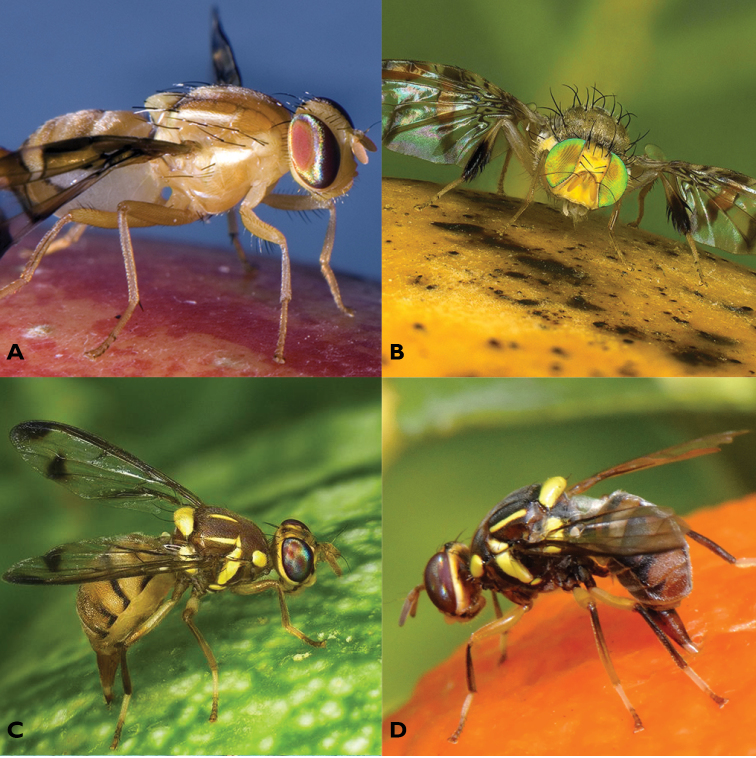
2010年至2015年期间开展了一项由联合国粮食及农业组织(FAO)/国际原子能机构(IAEA)协调的研究项目(CRP),项目名称为“解析实蝇害虫的隐性物种复合体以克服昆虫不育技术应用和国际贸易的限制”。正如CRP标题所示,其目标是针对具有经济重要性、在分类学上具有挑战性的果蝇类群进行系统学和诊断研究。科学成果是将生物物种与分类学名称准确对应;这带来了实际成果,即协助粮农组织和国际原子能机构成员国克服在应用昆虫不育技术(SIT)防治害虫果蝇方面的技术限制,并促进国际农产品贸易。来自20多个国家的近50名研究人员参与了该CRP,运用协调一致的多学科研究方法,在综合分类框架内研究主要实蝇害虫的隐性物种复合体。针对选定并研究的四个复合体取得了以下进展:
巴西按实蝇复合体——确定了拉丁美洲的八种形态型及其地理和生态分布。基于核型、性不相容性、交配后隔离、表皮碳氢化合物、信息素和分子分析的差异,这些形态型可被视为不同的生物物种。针对该复合体,开发了利用成虫和幼虫形态的线性和几何形态测量学的鉴别分类工具。
橘小实蝇复合体——基于遗传、细胞遗传、信息素、形态测量和行为数据,结果显示亚洲/非洲害虫果蝇橘小实蝇、番木瓜实蝇、菲律宾实蝇和入侵实蝇之间没有差异或只有微小差异,后三个物种被归为橘小实蝇的同物异名。在所研究的五个目标害虫分类单元中,只有橘小实蝇和杨桃实蝇仍然是科学上有效的名称。现在有分子和信息素标记可用于区分橘小实蝇和杨桃实蝇。
非洲果实蝇复合体(包括束腰果实蝇、番荔枝果实蝇、蔷薇果实蝇)——形态学、形态测量学、遗传学、基因组学、信息素、表皮碳氢化合物、生态学、行为学和发育生理学数据证明,来自非洲地区的这个果蝇复合体中存在五个不同的实体。目前它们被确认为番荔枝果实蝇、束腰果实蝇(F1和F2)、蔷薇果实蝇以及一个与蔷薇果实蝇相关的新物种(R2)。束腰果实蝇(即F1和F2)内部的生物学界限尚未完全厘清。基于雄性腿部结构,开发了用于这五个不同非洲果实蝇实体成年雄性的微卫星标记和形态鉴定工具。
瓜实蝇(原称黄瓜实蝇属瓜实蝇)——研究了非洲及亚太地区整个地理范围内瓜实蝇种群的遗传变异性,发现其有限。杂交交配研究表明不存在不相容性或性隔离。寄主偏好和遗传研究未发现存在寄主族的证据。得出的结论是,瓜实蝇无论是在地理分布还是寄主范围方面,都不构成隐性物种复合体。然而,在CRP启动时该物种所属更高分类等级被发现是并系的;因此黄瓜实蝇亚属被提升到属级。
