Olshefsky Audrey, Shehata Laila, Kuldell Natalie
Department of Biological Engineering, Massachusetts Institute of Technology, Cambridge, MA, United States of America.
BioBuilder Educational Foundation, Cambridge, MA, United States of America.
PLoS One. 2016 Jan 22;11(1):e0147494. doi: 10.1371/journal.pone.0147494. eCollection 2016.
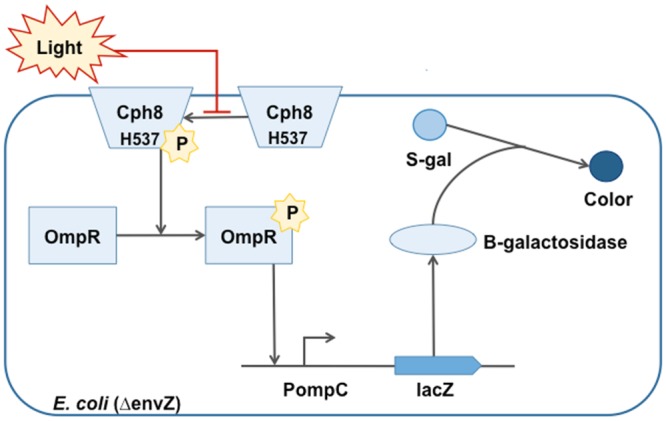
Two-component signaling (2CS) systems enable bacterial cells to respond to changes in their local environment, often using a membrane-bound sensor protein and a cytoplasmic responder protein to regulate gene expression. Previous work has shown that Escherichia coli's natural EnvZ/OmpR 2CS could be modified to construct a light-sensing bacterial photography system. The resulting bacterial photographs, or "coliroids," rely on a phosphotransfer reaction between Cph8, a synthetic version of EnvZ that senses red light, and OmpR. Gene expression changes can be visualized through upregulation of a LacZ reporter gene by phosphorylated OmpR. Unfortunately, basal LacZ expression leads to a detectable reporter signal even when cells are grown in the light, diminishing the contrast of the coliroids. We performed site-directed mutagenesis near the phosphotransfer site of Cph8 to isolate mutants with potentially improved image contrast. Five mutants were examined, but only one of the mutants, T541S, increased the ratio of dark/light gene expression, as measured by β-galactosidase activity. The ratio changed from 2.57 fold in the starting strain to 5.59 in the T541S mutant. The ratio decreased in the four other mutant strains we examined. The phenotype observed in the T541S mutant strain may arise because the serine sidechain is chemically similar but physically smaller than the threonine sidechain. This may minimally change the protein's local structure, but may be less sterically constrained when compared to threonine, resulting in a higher probability of a phosphotransfer event. Our initial success pairing synthetic biology and site-directed mutagenesis to optimize the bacterial photography system's performance encourages us to imagine further improvements to the performance of this and other synthetic systems, especially those based on 2CS signaling.
双组分信号传导(2CS)系统使细菌细胞能够响应其局部环境的变化,通常利用膜结合传感器蛋白和细胞质应答蛋白来调节基因表达。先前的研究表明,大肠杆菌天然的EnvZ/OmpR 2CS系统可以进行改造,以构建一个光传感细菌摄影系统。由此产生的细菌照片,即“类菌质体”,依赖于EnvZ的合成版本Cph8(可感知红光)与OmpR之间的磷酸转移反应。基因表达的变化可以通过磷酸化的OmpR上调LacZ报告基因来可视化。不幸的是,即使细胞在光照下生长,基础LacZ表达也会导致可检测到的报告信号,从而降低了类菌质体的对比度。我们在Cph8的磷酸转移位点附近进行了定点诱变,以分离出图像对比度可能得到改善的突变体。我们检测了五个突变体,但只有一个突变体T541S增加了暗/光基因表达的比率,这是通过β-半乳糖苷酶活性来衡量的。该比率从起始菌株中的2.57倍变为T541S突变体中的5.59倍。我们检测的其他四个突变菌株中的比率下降。在T541S突变菌株中观察到的表型可能是因为丝氨酸侧链在化学性质上与苏氨酸侧链相似,但在物理尺寸上较小。这可能对蛋白质的局部结构影响最小,但与苏氨酸相比,空间位阻可能较小,从而导致磷酸转移事件发生的概率更高。我们最初成功地将合成生物学与定点诱变相结合,以优化细菌摄影系统的性能,这鼓励我们设想进一步改进该系统以及其他合成系统的性能,特别是那些基于2CS信号传导的系统。