Deng Qingming, Heine Thomas, Irle Stephan, Popov Alexey A
Leibniz-Institute for Solid State and Materials Research (IFW Dresden), D-01171 Dresden, Germany.
Nanoscale. 2016 Feb 14;8(6):3796-808. doi: 10.1039/c5nr08645k. Epub 2016 Jan 27.
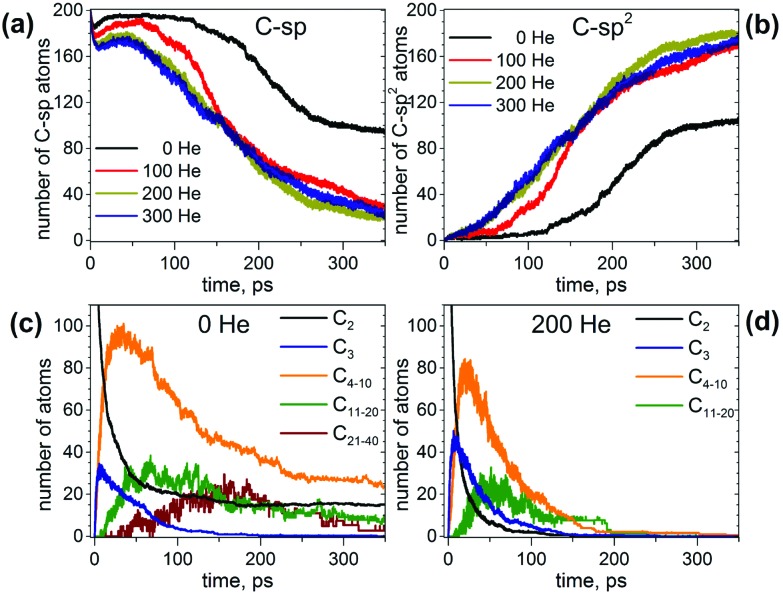
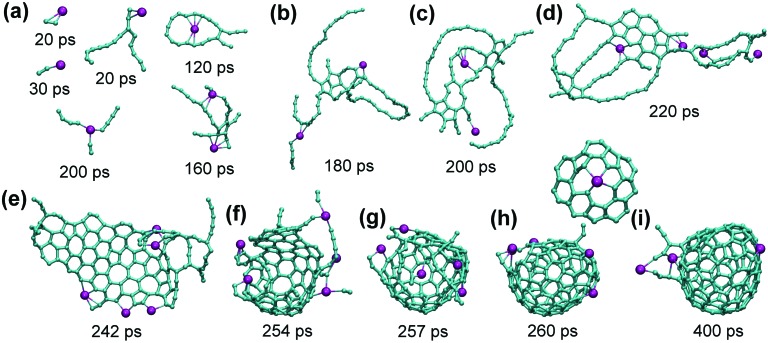
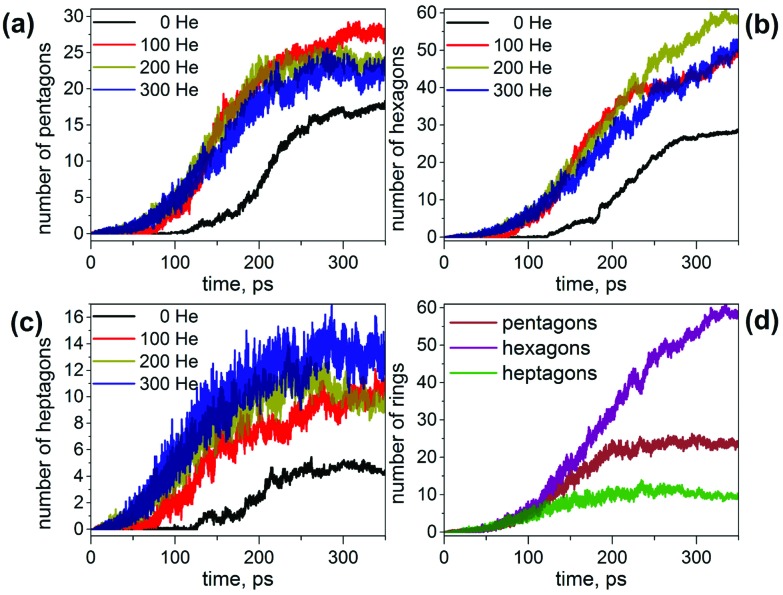
The endohedral metallofullerene (EMF) self-assembly process in Sc/carbon vapor in the presence and absence of an inert cooling gas (helium) is systematically investigated using quantum chemical molecular dynamics simulations. It is revealed that the presence of He atoms accelerates the formation of pentagons and hexagons and reduces the size of the self-assembled carbon cages in comparison with analogous He-free simulations. As a result, the Sc/C/He system simulations produce a larger number of successful trajectories (i.e. leading to Sc-EMFs) with more realistic cage-size distribution than simulations of the Sc/C system. The main Sc encapsulation mechanism involves nucleation of several hexagons and pentagons with Sc atoms already at the early stages of carbon vapor condensation. In such proto-cages, both Sc-C σ-bonds and coordination bonds between Sc atoms and the π-system of the carbon network are present. Sc atoms are thus rather labile and can move along the carbon network, but the overall bonding is sufficiently strong to prevent dissociation even at temperatures around 2000 kelvin. Further growth of the fullerene cage results in the encapsulation of one or two Sc atoms within the fullerene. In agreement with experimental studies, an extension of the simulations to Fe and Ti as the metal component showed that Fe-EMFs are not formed at all, whereas Ti is prone to form Ti-EMFs with small cage sizes, including Ti@C28-Td and Ti@C30-C2v(3).
使用量子化学分子动力学模拟系统地研究了在有和没有惰性冷却气体(氦气)的情况下,钪/碳蒸气中的内嵌金属富勒烯(EMF)自组装过程。结果表明,与类似的无氦模拟相比,氦原子的存在加速了五边形和六边形的形成,并减小了自组装碳笼的尺寸。因此,与钪/碳系统的模拟相比,钪/碳/氦系统的模拟产生了更多成功的轨迹(即导致形成钪-EMF),且笼尺寸分布更符合实际情况。主要的钪包封机制涉及在碳蒸气冷凝的早期阶段,几个六边形和五边形与钪原子的成核。在这样的原始笼中,既存在钪-碳σ键,也存在钪原子与碳网络π系统之间的配位键。因此,钪原子相当不稳定,可以沿着碳网络移动,但整体键合足够强,即使在2000开尔文左右的温度下也能防止解离。富勒烯笼的进一步生长导致一个或两个钪原子被包封在富勒烯内。与实验研究一致,将模拟扩展到以铁和钛作为金属组分的情况表明,根本不会形成铁-EMF,而钛则倾向于形成笼尺寸较小的钛-EMF,包括Ti@C28-Td和Ti@C30-C2v(3)。