Shao Connie, Shen Christine, Lu Emily, Haydon Rex C, Luu Hue H, Athiviraham Aravind, He Tong-Chuan, Lee Michael J
The University of Chicago Pritzker School of Medicine, Chicago, IL 60637, USA; Molecular Oncology Laboratory, Department of Orthopaedic Surgery and Rehabilitation Medicine, The University of Chicago Medical Center, Chicago, IL 60637, USA.
Molecular Oncology Laboratory, Department of Orthopaedic Surgery and Rehabilitation Medicine, The University of Chicago Medical Center, Chicago, IL 60637, USA; College of Liberal Arts and Sciences, University of Illinois at Urbana-Champaign, Urbana, IL 61801, USA.
Genes Dis. 2015 Dec;2(4):295-298. doi: 10.1016/j.gendis.2015.09.002. Epub 2015 Sep 30.
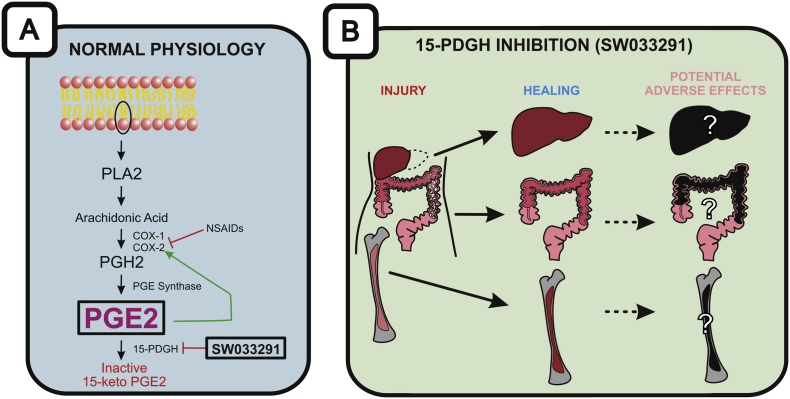
Increasing prostaglandin E2 by knocking out its inhibitor 15-hydroxyprostaglandin dehydrogenase (15-PDGH) or administering a compound that inhibits 15-PDGH was recently found to improve healing in hematopoietic stem cell transplants, colitis recovery, and hepatogenesis after transection in mice. These results are suggestive of pharmacologic therapies or even genetic therapy that could improve patient outcomes, especially since the excess PGE2 and the 15-PDGH inhibitor have proven to be non-toxic. However, elevated levels of PGE2 are associated with increased risk of cancer and blood clotting problems. It would be unacceptable to treat a cancer patient with chemotherapy and replenish the hematopoietic stem cells with the help of PGE2, only to have increased expression of PGE2 and induce another cancer. Therefore, to assess the most therapeutic aspects of PGE2, it is important to consider effects that could induce disease.
最近发现,通过敲除前列腺素E2的抑制剂15-羟基前列腺素脱氢酶(15-PDGH)或给予抑制15-PDGH的化合物来增加前列腺素E2,可改善小鼠造血干细胞移植后的愈合、结肠炎恢复以及肝横断后的肝再生。这些结果提示了可能改善患者预后的药物治疗甚至基因治疗,特别是因为过量的前列腺素E2和15-PDGH抑制剂已被证明无毒。然而,前列腺素E2水平升高与癌症风险增加和血液凝固问题有关。用化疗治疗癌症患者并在前列腺素E2的帮助下补充造血干细胞,结果却导致前列腺素E2表达增加并诱发另一种癌症,这是不可接受的。因此,为了评估前列腺素E2最具治疗作用的方面,考虑其可能诱发疾病的影响非常重要。