Medina Patrick J, Adams Val R
Department of Pharmacy: Clinical and Administrative Sciences, The University of Oklahoma College of Pharmacy, Oklahoma City, Oklahoma.
Pharmacy Practice and Science Department, University of Kentucky College of Pharmacy, Lexington, Kentucky.
Pharmacotherapy. 2016 Mar;36(3):317-34. doi: 10.1002/phar.1714.
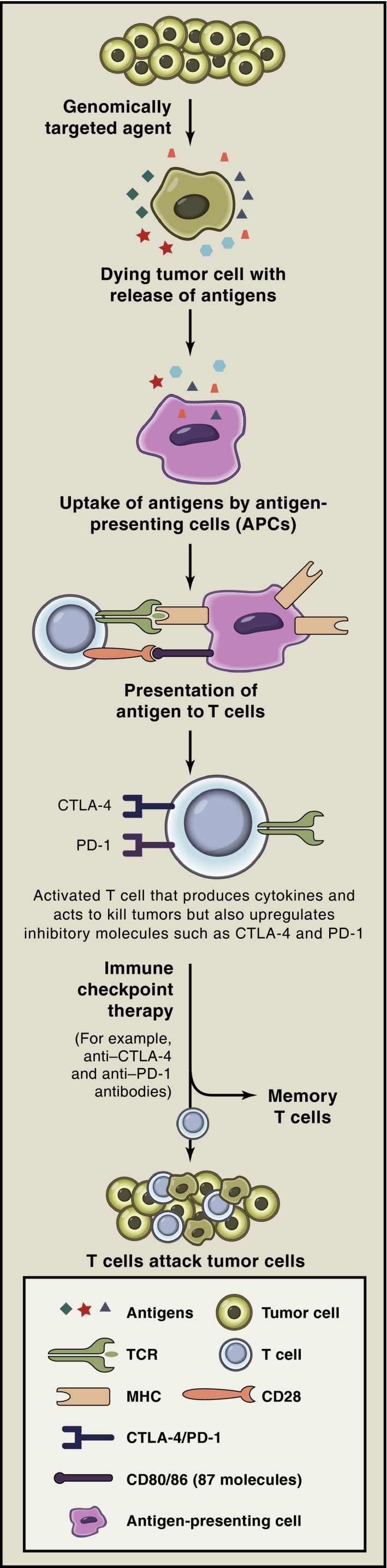
Immune checkpoint inhibitors are designed to restore a patient's own antitumor immune response that has been suppressed during tumor development. The first monoclonal antibodies against the immune checkpoint programmed death 1 (PD-1) receptor, nivolumab and pembrolizumab, are now approved for clinical use. Both agents are indicated for the treatment of advanced melanoma, as well as for the treatment of metastatic non-small cell lung cancer (NSCLC). Nivolumab is also approved for the treatment of advanced renal cell carcinoma. In patients with melanoma, these agents result in objective response rates of ~25-40%, with durable responses lasting more than 2 years in some cases. Results from phase III trials have shown improved survival with nivolumab versus standard-of-care chemotherapy in both patients with advanced melanoma and those with advanced NSCLC. In patients with advanced melanoma, both PD-1 inhibitors (nivolumab and pembrolizumab) have shown improved survival versus ipilimumab. PD-1 inhibitors are associated with adverse events that have immune etiologies, with grade greater than 3 adverse events typically reported in 16% or less of patients. However, most immune-mediated adverse events (including grade 3-4 adverse events) can be managed by using published management algorithms without permanent discontinuation of the agent. As nivolumab and pembrolizumab enter the clinic, and with more PD-1 pathway agents in development for a range of tumor types, this review aims to provide pharmacists with a basic understanding of the role of PD-1 in modulating the immune system and their use in the cancer treatment. The most recent clinical efficacy and safety data are discussed, highlighting the response characteristics distinctive to immune checkpoint inhibitors, along with pharmacokinetic and pharmacodynamic data and cost considerations.
免疫检查点抑制剂旨在恢复患者自身在肿瘤发展过程中受到抑制的抗肿瘤免疫反应。首批针对免疫检查点程序性死亡1(PD-1)受体的单克隆抗体纳武单抗和派姆单抗现已获批用于临床。这两种药物均被批准用于治疗晚期黑色素瘤以及转移性非小细胞肺癌(NSCLC)。纳武单抗还被批准用于治疗晚期肾细胞癌。在黑色素瘤患者中,这些药物的客观缓解率约为25%至40%,在某些情况下,持久缓解可持续超过2年。III期试验结果表明,在晚期黑色素瘤患者和晚期NSCLC患者中,纳武单抗相较于标准护理化疗可提高生存率。在晚期黑色素瘤患者中,两种PD-1抑制剂(纳武单抗和派姆单抗)相较于伊匹单抗均显示出更高的生存率。PD-1抑制剂与具有免疫病因的不良事件相关,通常在16%或更少的患者中报告3级以上不良事件。然而,大多数免疫介导的不良事件(包括3-4级不良事件)可以通过使用已发表的管理算法进行处理,而无需永久停用该药物。随着纳武单抗和派姆单抗进入临床,以及更多针对多种肿瘤类型的PD-1通路药物正在研发中,本综述旨在为药剂师提供对PD-1在调节免疫系统中的作用及其在癌症治疗中的应用的基本理解。文中讨论了最新的临床疗效和安全性数据,突出了免疫检查点抑制剂独特的反应特征,以及药代动力学和药效学数据及成本考量。